
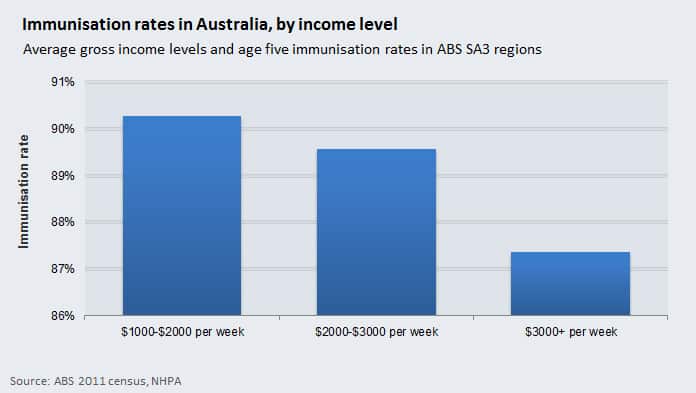
A combination of census and immunisation data tells us that lower income areas of Australia have a vaccination rate of about 90 per cent. However, in areas with the highest average family income levels, this drops to 87 per cent. This is putting thousands of children at unnecessary risk.
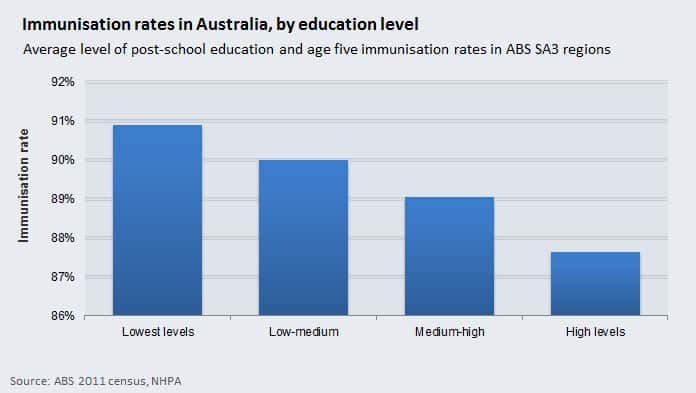
Perhaps even more counter-intuitively, highly educated mothers are less likely to vaccinate their children. 91 per cent of children born in the least educated areas of Australia are fully vaccinated at age five. These are areas where mothers with no post-school education are prevalent. In the highest-educated areas of Australia vaccination rates are less than 88 per cent.
News that makes sense
Your trusted source for staying up-to-date with the world around you. Get free daily news updates and analysis, straight to your inbox.
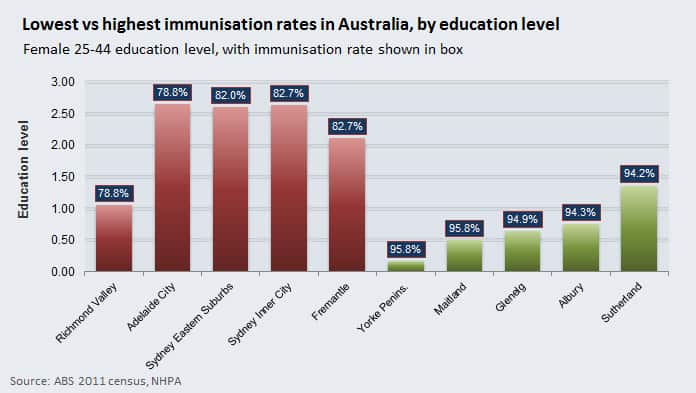
In the chart above we can see the areas with the lowest and highest rates of immunisation in Australia. The areas with the lowest rates – those shown in red – are highly educated, with the exception of Richmond Valley, which is the home of Australia’s anti-vaccination movement. In contrast, we can see that the highest rates are seen in lower-educated areas.
The scientific evidence supporting the benefits of vaccination is overwhelming. That vaccines drastically reduce the incidence of serious illness is not even up for debate. Millions of lives are saved every year thanks to childhood vaccination.
The discussion over adverse effects is at least one worth having. However, the risk-benefit calculation leads to only one rational conclusion. In 2011, academics undertook an exhaustive review of previous studies, in an exercise known as a meta-analysis. They collected evidence from 12,000 previously peer reviewed articles and concluded that MMR does not cause autism, the flu jab has no link with asthma and that few health problems are associated with vaccines.
So, we can protect children against nasty diseases with an extremely low risk of adverse effects using methods underpinned by solid science. Yet, many of our educated parents are rejecting vaccinations for their children. How can we explain this paradox?
On paper, the equation should be simple. Smart parents should weigh up the risk of their children catching a potentially fatal disease with the negligible risk of vaccination side-effects and conclude that vaccinating their children is the sensible thing to do.
Unfortunately, anti-vaccination lobby groups skew that equation by stoking fear in parents. In Australia, the euphemistically-named Australian Vaccination Network (AVN) is a big influence. The polished website of this anti-vaccination organisation paints a veneer of legitimacy. It claims to offer the “other side of the debate” - implying that both sides are equal.
However, the AVN preaches an ideology based on pseudo-science. It ignores the weight of evidence in favour of vaccinating children and instead muddies the water by carefully selecting dubious studies and the words of dubious ‘experts’.
Often the influence of the AVN on parents is indirect. The group spreads its dogma far and wide. Due to some overlapping principles, their tentacles reach into alternative medicine practices such as homeopathic and chiropractic. Seemingly innocuous advice to eat more fruit or exercise more often can extend to harmful advice to essentially avoid modern medicine. Research has shown that alternative health users tend to be women, middle aged, well-educated and earning good incomes.
Without realising it, when parents interact with these groups their behaviour is being influenced, even if it merely a subtle shift of their own risk-benefit equation. By simply Googling innocuous topics such as exercise or healthy food, or by visiting a chiropractor, they may be unwittingly encountering ideologically-driven anti-vaccination advocates.
Ironically, misinformation spreads like a disease. Once it infects a social circle it spreads from person to person and can become accepted as fact. A recent study showed that the social circle of parents plays an important role in vaccination decisions. Anti-vaccination misinformation has reached epidemic proportions in the Richmond Valley area of northern New South Wales. This is home to the AVN and also happens to have the lowest rate of vaccination in Australia.
Unfortunately, we have clearly seen the consequences of clusters of low rates of vaccination. An outbreak of measles occurred in 1990-1992 among members of two Philadelphia churches that reject vaccinations. Over half of the 892 church members became infected with measles, and six children died. The outbreak of measles in Wales earlier this year, in which over 1,200 contracted the illness, is also believed to be a consequence of low MMR vaccination rates.
The AVN maintain a substantial online presence. For example, their Facebook page has almost 7,000 ‘likes’. However, the Stop the Australian (Anti)Vaccination Network page has about 3,500 more followers, indicating that the group is a minority, albeit a particularly vocal one. News comment sections are routinely flooded with anti-vaccination propaganda, and there are accusations that some individuals post a slew of comments under multiple pseudonyms.
So what can be done? Given that the AVN are waging a propaganda war on social media, the Australian government needs to step up its social media footprint. Monitoring social media and news comments sections and engaging the public through these channels would be a good start.
A second front is fighting a legislative battle. Thankfully, the anti-vaccination lobbyists seem to be making it easy for the authorities. The AVN has been ordered by NSW Fair Trading to change its misleading name. Subsequently they have been investigated for fraud including undertaking commercial activities in breach of not-for-profit status. Recently the NSW Health Care Complaints Commission has been investigating the AVN for encouraging supporters to join the Church of Conscious Living in order to achieve religious exemption for vaccinations.
Regulating the type of advice given by alternative medicine practitioners is also critical. Under pressure from medical authorities, the Chiropractic Board has recently declared an intention to crack down on practitioners who advise against vaccination.
What do you think? Join the conversation on our Facebook post.







