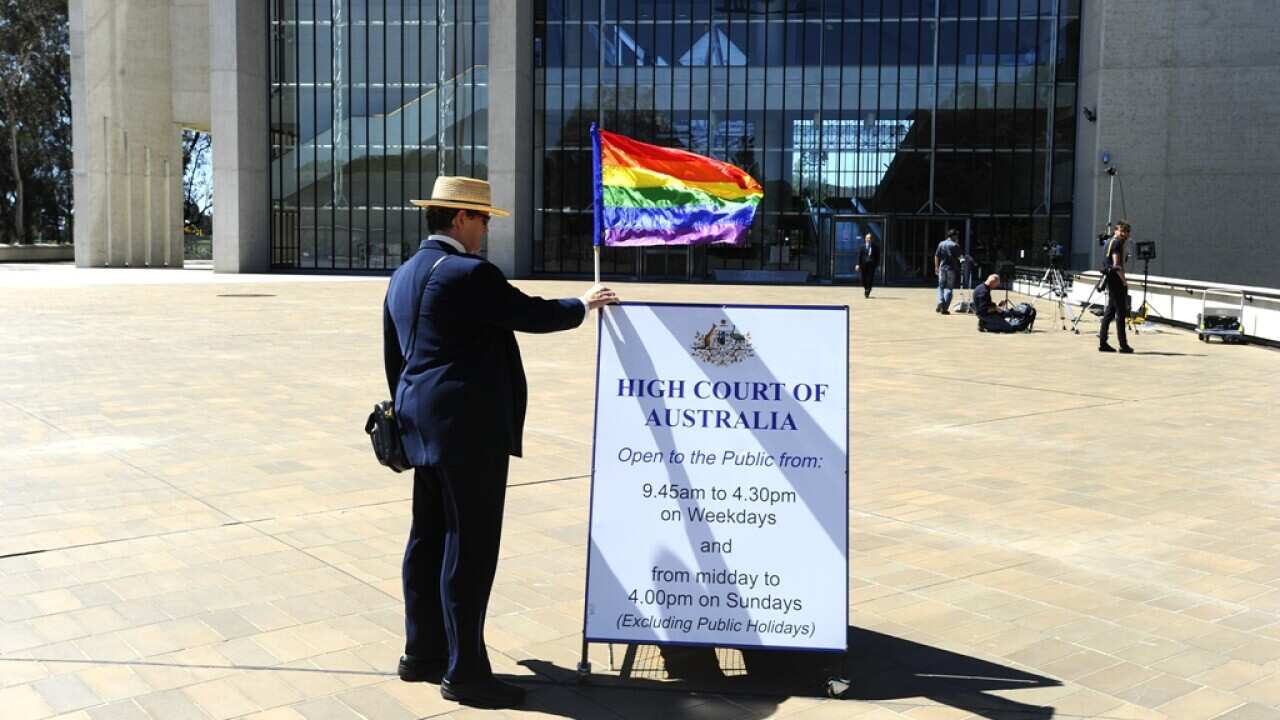
With Tony Abbott now in the lodge, marriage equality campaigners have turned their focus to the states. They had their first major win last week when the ACT passed the country’s first marriage equality legislation.Campaigners are now turning their attention back to New South Wales and Tasmania, who both have bills before Parliament.
The shift towards the states however have brought in some uncomfortable compromises, compromises that once accepted mean that the ‘marriage equality’ movement should once and for all drop the ‘equality’ tagline.
The issue comes from a rather obscure constitutional problem that has been highlighted around state-based same-sex marriage legislation. The problem is simple - if state and federal legislation contradict each other, federal legislation overrules. With the federal marriage act explicitly defining marriage to be between ‘a man and a woman, to the exclusion of all others’, any state based bill that contradicts this would be overturned by the High Court. State-based bills can survive though if instead of removing the ‘man and woman’ definition of marriage they create a ‘new’ form of marriage - that being ‘same-sex marriage’. Essentially states are creating a new institution called ‘same-sex marriage’ - one the constitutionally is different from the straight marriages as defined by the federal government.
Marriage equality advocates have been hitting this message hard, in particular slamming the ACT legislature for not listening to advocates over particular changes demanded on the bill. Australian Marriage Equality has said that if ACT Government do not make amendments they will ‘destroy the hopes of hundreds of couples planning to wed’, whilst former Democrats Leader Brian Greig took to Crikey to slam the ACT legislation as a political stunt designed to embarrass the Prime Minister.
News that makes sense
Your trusted source for staying up-to-date with the world around you. Get free daily news updates and analysis, straight to your inbox.
The problem with AME’s and Greig’s position however, is that the form of marriage they are arguing for is not equal at all. In creating a new definition for marriage they are once again developing an institution based around gender and sex binaries.
And in doing so marriage equality advocates are actively excluding those who do not identify as either male or female from their bills. They are, with the swift text of some amendments, sweeping many trans and intersex couples our of the marriage equation.
The response to these concerns has been twofold. First, marriage equality advocates have argued that these definitions don’t actually create inequalities, as the bill doesn’t actually stop trans and intersex people from getting married. For example, Deputy Director of Australian Marriage Equality Ivan Hinton, argued after the ACT amended its legislation to exclude trans and intersex people:
"Transgender and intersex people are not excluded from this legislation.
"For the purposes of state and federal law almost all Australians are currently identified as either male or female and, as a consequence, will be able to marry under the federal law or the territory law depending on their circumstances."
Does that mean it's okay these bills discriminate against trans and intersex people because all other legislation does as well? The discrimination in these bills are just based on discrimination in current legislation - so what’s everyone complaining about?
The other argument of course is that even if these bills are discriminatory, they are still a step in the right direction. It’s an argument that makes sense - stepping stones are important to build momentum towards change. That is however, until we start to remember that marriage equality advocates have long argued against other stepping stones. For example, Tony Briffa from the Organisation Intersex International Australia, points towards the debate around civil unions. As Briffa says:
“Just as Civil Unions were rejected by the GLBTI community because they would not have provide legal equality to same sex relationships, we should not go down the path of state based laws that exclude sections of our community.”
And in doing so Briffa manages to capture the issue all in one sentence.
Marriage equality has never actually been about full equality. For years now marriage equality advocates have argued against the inclusion of poly relationships within marriage, often using the same sorts of arguments homophobes have used against gay and lesbian people to exclude poly people from the debate. And now trans and intersex people are being swept away as well.
And that’s because instead of being about true equality the marriage campaign has just been about getting mongamous gays and lesbians into marriage, at the exclusion of all others. An elitist agenda pushed by lesbians and gays has seen other members of the queer umbrella, whether it is people in poly relationships, or now trans* and intersex folk slowly pushed under the bus.
If marriage advocates truly cared about marriage ‘equality’ they would be campaigning for one national law that allowed all people to marry, no matter their sexuality, gender identification, nor relationship make up. As long as advocates continue to exclude people from the debate, whether it is trans, intesex or poly people they should drop the ‘equality’ banner.
Simon Copland is a freelance writer and climate campaigner. He is a regular columnist for the Sydney Star Observer and blogs at The Moonbat.







