(Transcript from World News Australia Radio)
Indonesia is warning co-operation on problems like people smuggling could be in jeopardy, if Australia doesn't promise to stop spying on it.
Media reports last week said Australia's Jakarta embassy was among a regional network used for political, diplomatic and economic intelligence gathering.
Indonesia says Australia's response to the allegations so far is unacceptable.
Thea Cowie reports.
News that makes sense
Your trusted source for staying up-to-date with the world around you. Get free daily news updates and analysis, straight to your inbox.
(Click on audio tab to listen to this item)
Australia is refusing to confirm or deny allegations it's spied on its closest neighbour.
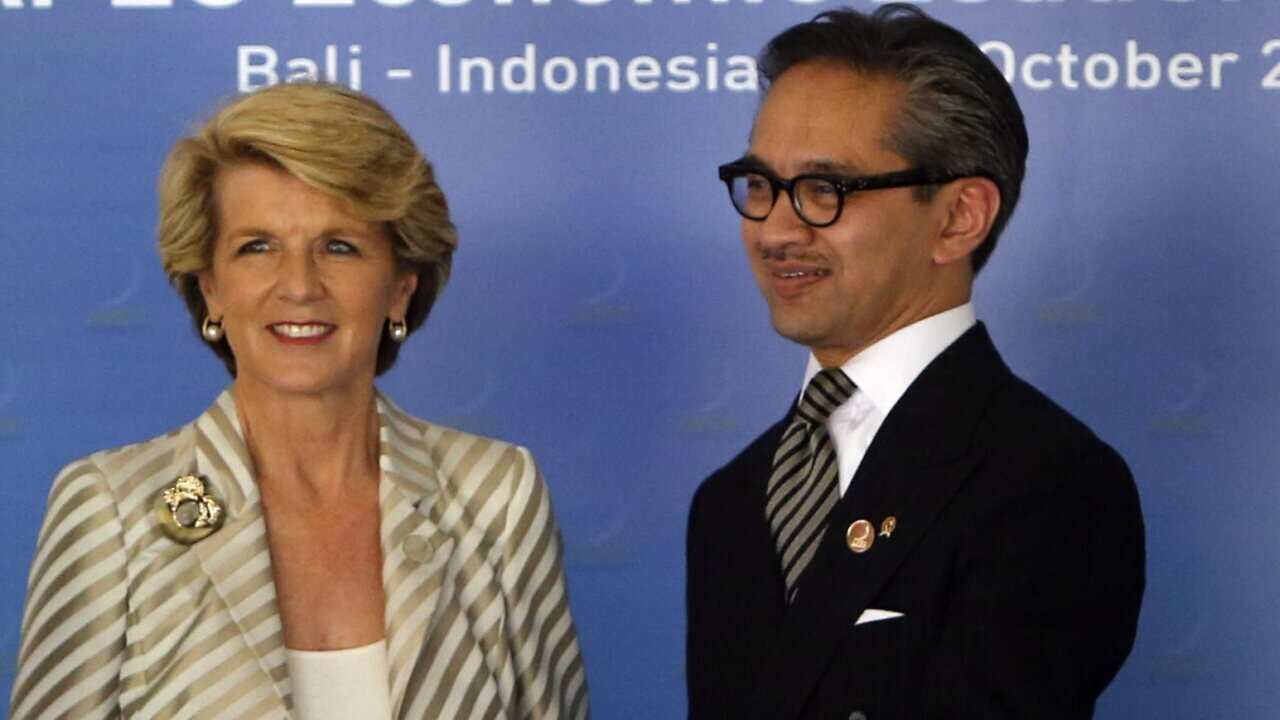
Foreign Minister Julie Bishop says she takes Indonesia's concerns seriously but it's longstanding practice for Australian governments not to comment on intelligence matters.
Her Indonesian counterpart, Marty Natalegawa, says that's not good enough and could cost Australia dearly.
"We'll have to assume that such activities are taking place and draw our own conclusion in terms of what does it mean in terms of their view of Indonesia as a partner? If Australia feels that there are ways of obtaining information other than the official one then one wonders where we are in terms of co-operation. To address issues such as people smuggling for example, to disrupt terrorist attacks etc. Now this information flow has been rather effective, very, very important. We need to look at that."
Dr Natalegawa says Indonesia's response to the spying row could affect information exchanges with the United States - not just Australia.
The spying row erupted last week after reports Australia and the US mounted a joint surveillance operation on Indonesia during the 2007 UN climate change conference in Bali.
In response, Prime Minister Tony Abbott said no Australian agency would do anything illegal.
"Every Australian governmental agency, every Australian official at home and abroad, operates in accordance with the law and that's the assurance I can give people at home and abroad. Our people operate in accordance with law."
Joining the public outcry against the spying allegations are Indonesia internet activists.
A group calling itself Anonymous Indonesia has hacked more than 170 websites ending in ".au" - many of them small businesses including a Perth jumping castle company, a Brisbane grout cleaner and a Melbourne dry cleaner.
The website homepages have been turned into messages to the Australian government with one saying "Stop all forms of tapping into Indonesia or we will make your internet network destroyed".
Meanwhile international fury is continuing over spying allegations, mainly directed against the United States.
Indonesia has joined Germany and Brazil in co-sponsoring an anti-spying resolution at the United Nations General Assembly.
The draft resolution on the protection of individual liberties calls for measures to end violations of the right to privacy, including in digital communications.
Dr Natalegawa says something needs to change.
"Most of all it's about trust, isn't it. Countries may have capacities, technical capacities, to intercept and to carry out the activity that's been reported, and information may have been gathered. But the cost, in terms of trust, in terms of the damage, that may be resulting, is something that we must all reflect on."







