(Transcript from World News Australia Radio)
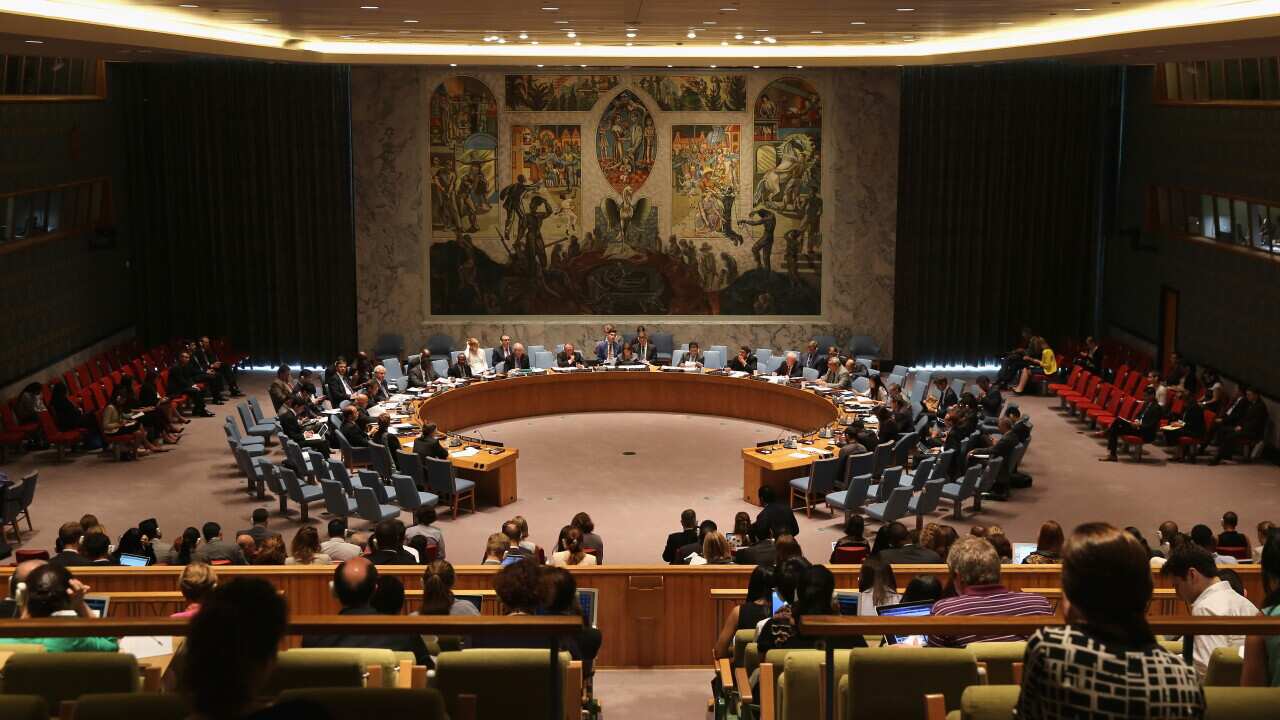
Some proposals centre on the crucial veto power held by the Council's five permanent members, allowing any one of them to block decisions.
But countries including Australia are also calling for changes in the way members of the Council are selected, to better represent the people of the world.
With the second of our two-part series, here's Andi Yu. (Listen to part one here.)
(Click on audio tab above to hear full item)
News that makes sense
Your trusted source for staying up-to-date with the world around you. Get free daily news updates and analysis, straight to your inbox.
Since its formation after the Second World War in 1946, the UN Security Council has had just five permanent members: the United States, Russia, China, Britain and France.
From among the other 188 member countries of the UN, ten are elected in a vote in the General Assembly as temporary members.
Critics say the temporary membership places are allocated on an outdated and illogical basis: five collectively representing African and Asian countries together; one representing Eastern Europe; and two representing Latin America and the Caribbean.
The final two places can represent either Western Europe, or the rest of the world.
UN representative Philippa King says Australia is among those advocating for changes in the membership rules.
"Australia has long supported an expansion of the Council's membership in both the permanent and non-permanent categories. This is important both to ensure a more equitable geographic balance and to enhance the Council's legitimacy."
New Zealand representative Jim McLay says the power the permanent members wield on the Council does not reflect the global reality.
And he says the rules on electing non-permanent members also need to change.
"Back in 1945 some very influential states were left out of those original power-sharing arrangements. They and those whose power has emerged in the ensuing years, understandably now chafe at being excluded from this organisation's most powerful body. We also share the view of many smaller states that the current number of non-permanent seats and the associated geographic groups no longer ensure fairness in representation, or opportunity for election."
In a UN General Assembly debate on Security Council reform proposals, Africa has been a major focus, with many speakers arguing it's the continent most in need of stronger representation.
Botswana's Nkoloi Nkoloi says Africa is very under-represented.
"It therefore defies human logic that Africa still remains the only unrepresented constituency in such a body, whose legitimacy and strength must derive from the totality of its membership. While all regions of the world are represented and have a footprint in the Council, Africa still is relegated to the back bench, with no voice, no power and no presence to influence key decisions of this powerful institution."
Sudan's Abuzeid Mohamed says the lack of a strong African voice on the Council makes no sense.
"The African continent has 54 states. Its representation in the Security Council, which is non-permanent, does not correspond with this number nor with the African matters being discussed in the Council which represent more than 70 per cent of the matters undertaken by the Council."
Some UN members are calling for an increase in the number of permanent members of the Council.
Ambassador for Portugal, Alvaro Jose Costa, was among many speakers in support of this idea.
"It is increasingly difficult to justify why countries such as Brazil or India are not permanent members of the Council. Moreover, we are of the strong view that Africa absolutely deserves permanent representation in the Security Council. Africa must be treated with justice and in a way, reflecting its size, its economic load and its weight in today's world."
Croatia is another country calling for an expanded Security Council.
Ambassador Vladimir Drobnjak says a new rotating seat should be created for the Eastern European states.
"Any enlargement of this crucial body should happen in both the permanent and non-permanent categories of membership, with one additional seat to be reserved for the group of Eastern European states in the non-permanent category."
Many countries argued that the Security Council reforms were urgent, and should be introduced by the UN's 70th birthday in 2015.
However some, like Rwandan representative Eugene-Richard Gasana, are pessimistic.
"The intergovernmental negotiations of the Security Council reform have been going far too long. Some even wonder if it will be achieved in our life time."







