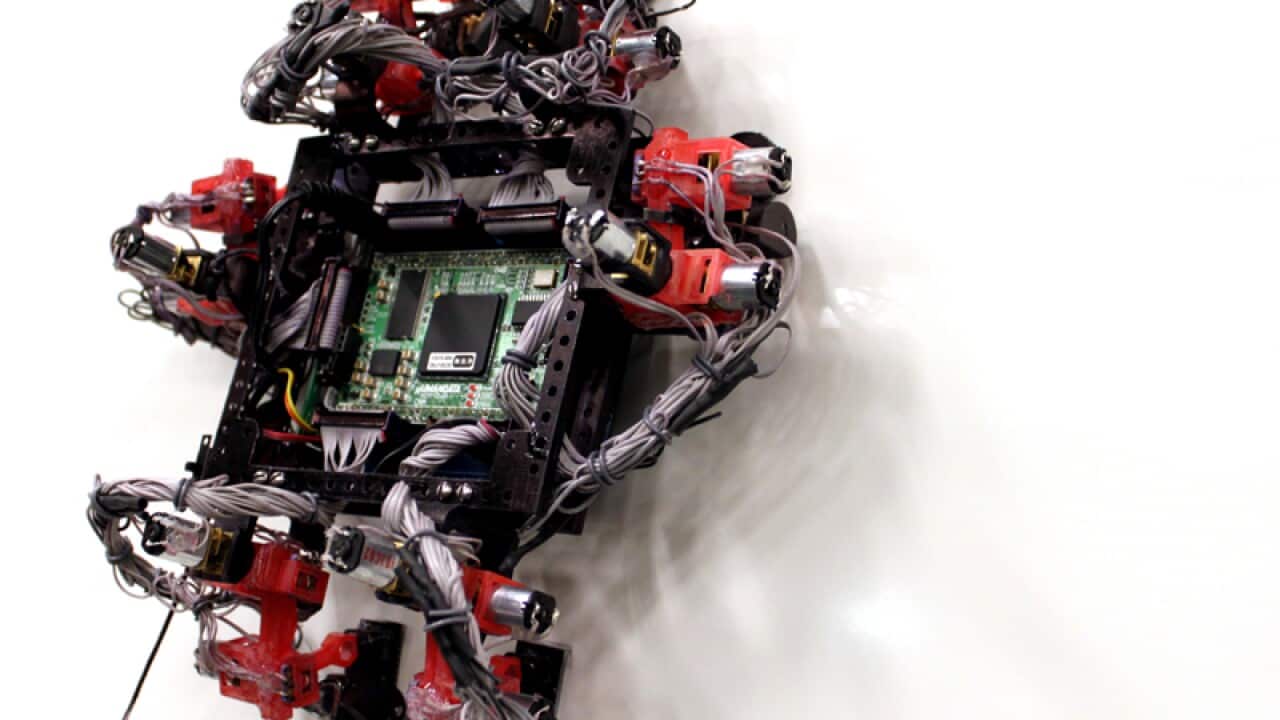
A wall-crawling robot inspired by the gecko has taken a small but important step towards a future in space, scientists say.
The tiny legged prototype could be the forerunner of automatons which crawl along the hulls of spacecraft, cleaning and maintaining them, the European Space Agency (ESA) says.
Its footpads are covered with dry microfibres modelled on the toe hair of the gecko, which is celebrated for its ability to scuttle up windows and along walls yet not leave a trace.
The lizard does the trick through millions of ultra-fine hairs called setae, which interact with the climbing surface to create a molecular attraction known as the van der Waals force.
Researchers at Canada's Simon Fraser University first built a 240-gram tank-like gecko-bot, using tracks with microfibre treads.
News that makes sense
Your trusted source for staying up-to-date with the world around you. Get free daily news updates and analysis, straight to your inbox.
They then developed this into a six-legged climbing robot, nicknamed Abigaille.
"This approach is an example of biomimicry, taking engineering solutions from the natural world," said team leader Mike Henrey.
The "dry adhesive" that helps Abigaille climb walls has now been put through its paces at a materials-testing lab at ESA's European Space and Technology Centre (ESTEC) in Noordwijk, the Netherlands.
Replicating the vacuum and temperatures of space, but not the zero gravity, the tests found that the adhesive worked like a charm, the agency said.
"A depth-sensing indentation instrument was used inside a vacuum chamber to precisely assess the dry adhesive's sticking performance," ESA specialist Laurent Pambaguian said in a press release on Thursday.
"Experimental success means deployment in space might one day be possible."
Abigaille's six legs each have four degrees of freedom, which enables the "gecko-bot" to shift from horizontal to vertical environments.
Dry adhesives in space are compelling because other options have to be ruled out for safety reasons.
Sticky tape is a no-no because it collects dust, becomes less sticky over time and in a vacuum gives off fumes.
Magnets, too, are out as they cannot stick to composite surfaces and their magnetic field could affect instruments.
And Velcro is also excluded, as it needs a mating surface of hooks - and these can break off and become a hazard.
Gecko setae are microscopic: their ends are just 100-200 nanometres, or 100-200 billionths of a metre, across. By comparison, the human hair is gigantic, being around 100,000 nanometres in diameter.







