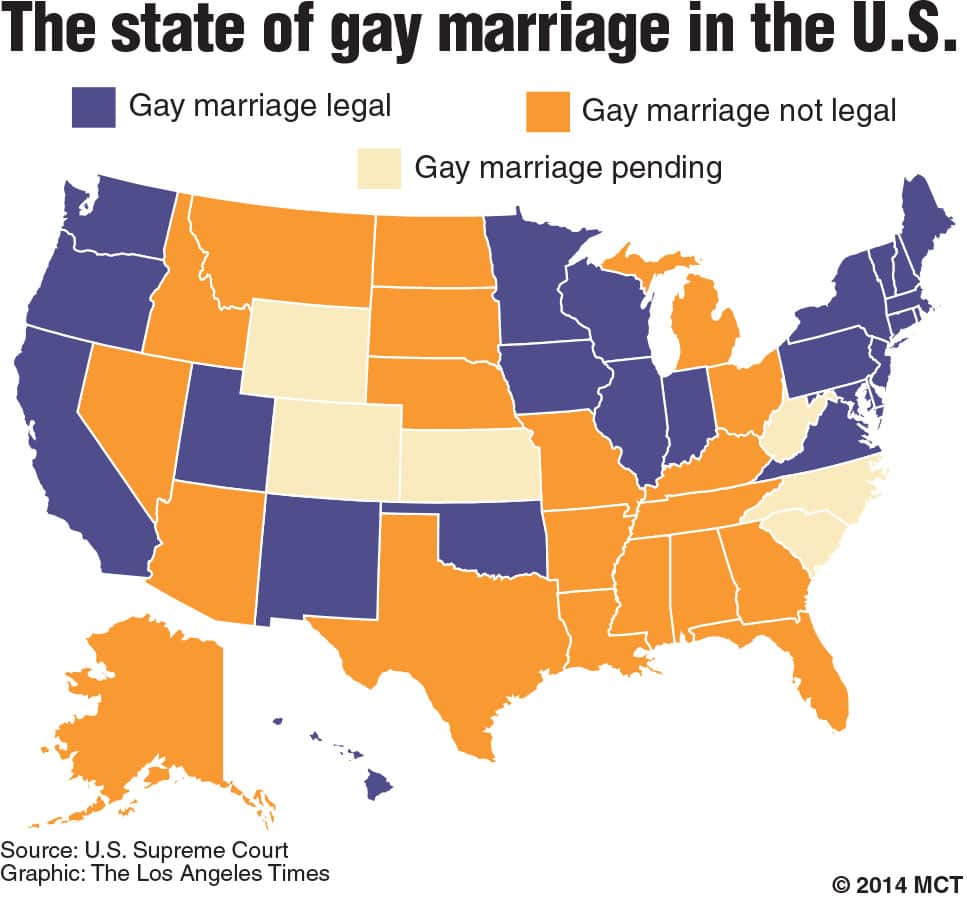
The US Supreme Court ruling to reject appeals from five states seeking to prohibit same-sex marriage means the number of states that legalise same sex marriage now stands at 24, with six more states also affected.
The Williams Institute at the University of California says this means two-thirds of America's same-sex population will live in a state where they can get married.
Following the surprise decision, county offices were overwhelmed with same-sex marriage applicants.
News that makes sense
Your trusted source for staying up-to-date with the world around you. Get free daily news updates and analysis, straight to your inbox.
Supporters of traditional marriage have promised to challenge the decision, saying several federal appeals courts have yet to be heard on the matter.
But the co-convener of the New South Wales Gay and Lesbian Rights Lobby, Justin Koonin, says it puts growing pressure on Australian politicians to legalise gay marriage.
"I think the US case is possibly slightly different from what's going to happen in Australia, because, ultimately, in Australia, it will be a decision of parliament and not a decision of the courts," he said.
"Nevertheless, what's remarkable is the level of public support in Australia is probably even greater than that in the US."
Mr Koonin says the reason why Australia has not followed other countries like New Zealand, Canada and France lies in the political leadership.
"I think we're getting closer towards a resolution in parliament. The last vote that we had in 2012 was closer than it ever had been.
"The Labor Party had granted its Members a conscience vote. What needs to happen now is for the Coalition to do the same. And then I think we'll have a real interesting situation and the possibility of success."
But despite the growing public support, opposition to legalising same-sex marriage remains.
The Australian Christian Lobby argues the passage of gay-marriage laws would create a real vulnerability to freedom of religion and conscience.
Constitutional lawyer George Williams at the University of NSW says states do have a role in contributing to the debate on legalising same-sex marriage.
"I'm certainly confident that states should be involved in this debate and should be considering laws to enact same sex marriage," he said.
"That doesn't mean I would be predicting what the High Court outcome would be. In fact, you would have to say there is a very real possibility that a state same sex marriage law could be struck down.
"But that is only a possibility. A differently drafted state law has not been considered by the court. And even apart from those constitutional considerations, in a federation like ours, leadership by one or more states on this issue could be very important in terms of producing a change at a federal level."
Full interview: Lawyer Professor George Williams on gay marriage in Australia
Moves to legalise same-sex marriage in Australia have had mixed success, with the High Court overturning an attempt to pass laws in the Australian Capital Territory last year.
The High Court ruled any change to the Marriage Act must come from the federal government.
Norfolk Island, an external territory, tabled legislation on same-sex marriage last month in a scheme that would exist parallel but separate to the Federal Marriage Act.
Australian Marriage Equality national convener Rodney Croome says compared to comparable countries, Australia is an outlier on the issue of legalising same-sex marriage.
"Marriage equality now prevails across most of Western Europe, including in the United Kingdom, increasingly in the US, and Canada, of course, and as close as New Zealand," he said.
"Almost through the entire English-speaking developed world, there's marriage equality, except in Australia.
"We're increasingly an outpost of outdated prejudices and homophobia. If we want to be seen as a progressive nation, if we want to rejoin the company of nations that provide their citizens with full equality, we really need to pass this reform, and we have to pass it soon."
Crossbench senator David Leyonhjelm had planned to introduce a bill to legalise same-sex marriage into the Senate last week.
But the plan was dropped over concerns it would lack bipartisan support.