
Tasmanian author Richard Flanagan has won the prestigious Man Booker literary prize for his novel, The Narrow Road to the Deep North.
The 53-year-old was so excited that as he recieved the award, which is worth around $A91,000, he hugged the Duchess of Cornwell as she presented him his prize.
The win is deeply personal for Flanagan who was inspired by the story of his father and other Australian prisoners of war who were forced to work on the Burma Death Railway.
His father, who survived World War Two, died on the day Flanagan finished writing the novel.
"My father was a Japanese prisoner of war. He was on the death railway and I guess I grew up, as did my five siblings, as children of the death railway," he said.
"We carried in consequence many incommunicable things."
"I realised at a certain point if I was to continue writing I would have to write this book. I don't think I particularly wanted to write it but I understood it was the book I had to write in order to keep on writing."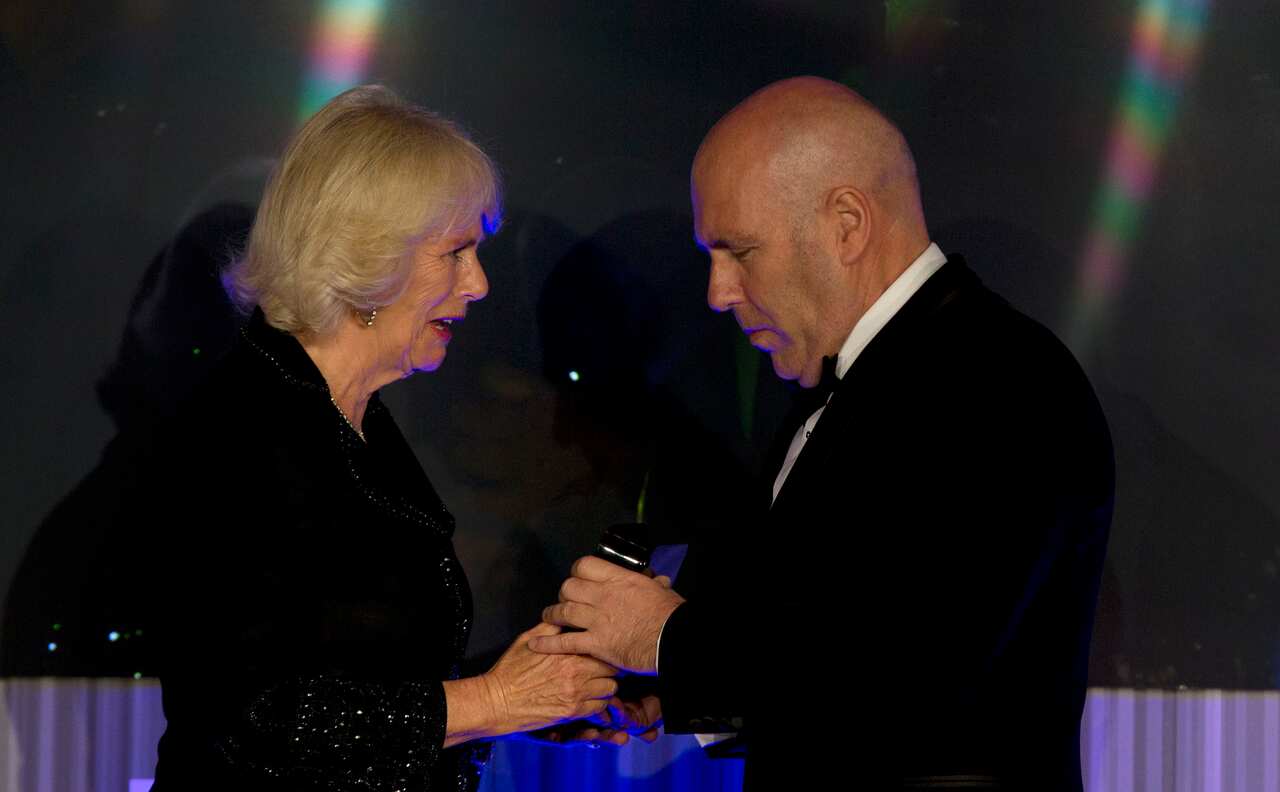 Speaking to an audience after his win, Flanagan said he didn't come from a literary tradition, but rather from a rainforest on an island at the end of the world.
The Duchess of Cornwall congratulates Australian author Richard Flanagan (AAP)
"In Australia the Man Booker prize is sometimes seen as something of a chicken raffle."
"I just didn't expect to end up the chicken."
"My grandparents were illiterate and I never expected to stand here before you in a grand hall in London as a writer being so honoured," the Tasmanian said.
"Perhaps in consequence I do not share the pessimism of the age about the novel. They are one of our greatest spiritual, aesthetic and intellectual traditions."
When asked what he would do with the $A91,000 prize money, he said he would just live.
"I'm not a wealthy man and in essence it means I can continue to write," he said.
"A year-and-a-half ago when I finished this book, I was contemplating looking to get what work I could in the mines in far-northern Australia because things had come to such a pass with my writing and I spent so long on this book."
It's only the fifth time an Australian has won the prestige prize and the first time in more than a decade.
Past Australian winners include Thomas Keneally (1982), Peter Carey (1988, 2001) and DBC Pierre (2003).
Praise for 'magnificent novel'
The judging panel said The Narrow Road to the Deep North, which is the sixth novel for Flanagan, was a "harrowing account of the cost of war to all who are caught up in it."
AC Grayling, who chaired the panel of judges, praised the "profundly intelligent humanity" and "excoriating"
descriptions of suffering in Flanagan's novel.
"This is a magnificent novel of love and war. Written in prose of extraordinary elegance and force, it bridges East and West, past and present, with a story of guilt and heroism," he said.
"This is the book that Richard Flanagan was born to write."
Flanagan left school at 16, later winning a Rhodes scholarship to Oxford where he took a Master of Letters degree and worked as a labourer and river guide while writing.
Initially, he wrote history books before turning to fiction and his 2002 novel Gould's Book of Fish won the Commonwealth Writer's Prize.
Federal Minister for Arts, George Brandis, congratulated Flanagan and said it was a reflection of Australian literature.
"This accolade recognises not only Richard’s wonderful writing and imagination, but is a reflection of the quality of Australian literature," Mr Brandis said in a statement.
Federal opposition leader Bill Shorten congratulated Flanagan and praised The Narrow Road to the Deep North for its ability to "stir something elemental in the reader's soul".
"I commend Richard Flanagan on his achievement - and heartily recommend The Narrow Road to the Deep North to anyone yet to read it," he said in a statement.
Greens leader, Christine Milne, joined in congratulating the author for his 'literary brilliance'.
“Richard worked on this book for a long time and was profoundly influenced by his father’s experiences as a prisoner of war on the Burma railway.
“I am especially excited by Richard Flanagan’s win as a fellow Tasmanian and as a friend. Richard loves Tasmania and he has now put us firmly on the global literary map."
Share


