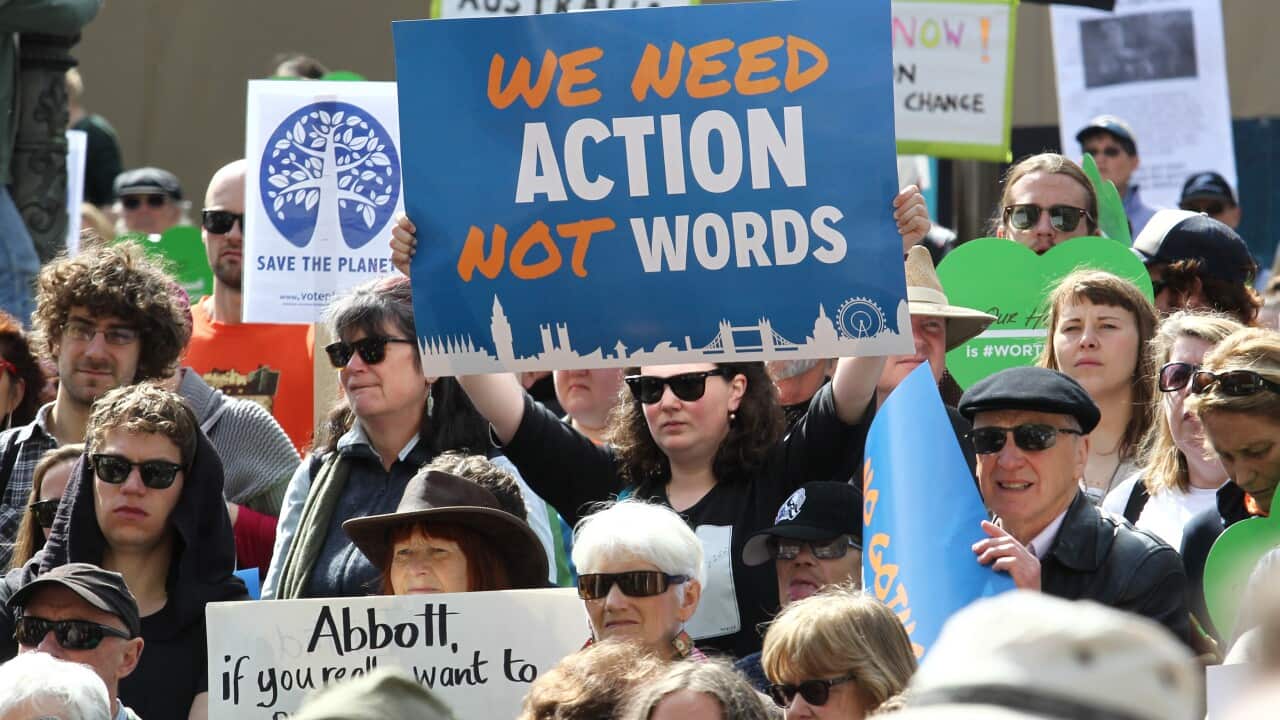
The challenge to the world is to avoid much higher temperatures of 4-5 average warming than the 2 degree target. Two degrees will be a threat to Austalia’s future but 4-5 degrees threatens civilisation, health, well-being and indeed survival.
The release this week of the Intergovernmental Panel on Climate Change’s latest Report makes it clear Australia is taking insufficient action to address the dire health consequences that will increasingly result from unchecked climate change. The Report states the world is on track for more than 4 degrees of average warming: two degrees of warming will be a threat to Australia’s future but 4-5 degrees has a high risk of severe, irreversible and widespread climate and ecosystem impacts, threatening health, well-being and survival.
The Report comes in the lead up to next year’s major UN climate negotiations: to maintain a likely chance of remaining below two degrees the world needs to reduce it’s anthropogenic greenhouse gas emissions by 40 per cent to 70 per cent globally by 2050 compared to 2010, and get emissions levels near zero or below by 2100.
As medical professionals, Doctors for the Environment Australia is extremely concerned the federal and state governments are neglecting their duty of care to citizens and society to both limit climate change to the extent possible, thereby preventing the likely health consequences, and also to prepare Australia for those effects which we cannot avoid. It is predicted Australia will face days hotter than 50C within 10 or 15 years under continuing global warming- the human body struggles to cope with such temperatures, such a situation would dramatically increase the number of heat-related deaths and illnesses. Everyday human activity will be profoundly affected according to the Report: outdoor workers productivity declines and growing food will be an increasing challenge.
Our health systems and emergency services are largely unprepared to cope with the effects of increasing extreme weather events. Recent events serve only too well to highlight this. Queensland’s floods of 2011 saw drowning, injuries, water-insecurity, mosquito-borne, water-borne and soil infectious diseases, all aside from the ongoing mental health impacts we still see today. The economic costs were considerable. In the Fitzroy River basin, flood levels silently rose over sandbags, drowned the pumps and inundated General Practitioner practices. In 2009, the Black Saturday fires claimed 173 lives, and many don’t know that the simultaneous heat wave across Victoria killed a further 374 people.
News that makes sense
Your trusted source for staying up-to-date with the world around you. Get free daily news updates and analysis, straight to your inbox.
It is predicted Australia will face days hotter than 50C within 10 or 15 years under continuing global warming - the human body struggles to cope with such temperatures, such a situation would dramatically increasing the number of heat-related deaths and illnesses.
Some seemed to have learned from the past- I attended a recent address by a nurse whose hospital had installed a second generator and revised its emergency action plan following a power cut and subsequent generator failure during the fires- many have not. The Auditor General recently reported on the Victoria’s Heatwave Management Plan, concluding it is inadequate and that: "Individual agency heatwave plans are not mandatory, their quality is variable, and there is lack of clarity around the triggers for activation of the plans. There is also inadequate assurance as to their quality."
In the weeks following the Black Saturday fires I remember meeting a general practitioner who lost his house, his practice and many of his patients; like the citizens of the Pacific Islands increasingly seeing their islands submerged by sea level rise, Australians affected by such events recognise that our nation is particularly vulnerable to climate change. The IPCC highlights we are for the most part a hot, dry continent and further warming will cause more frequent heat extremes, bush fires and scarcity of water, with flow-on effects on health.
Australia clearly needs federal support and a coordinated approach to prepare our health and emergency services. But we also need to look at wider risk reduction such as the design of buildings and cities, community development and social equity. We are threatening the foundations for health with the Report finding species and ecosystems are already being significantly affected: the Great Barrier Reef’s coral reef systems could be eliminated by mid-to late-century under current rates of ocean warming and acidification. Climate change is having a negative impact on agricultural food production, and Australia could see marked decreases in water flows in the Murray-Darling Basin if projections of severe dry conditions are realised.
Ultimately, Australia must make a much bigger commitment of at least 40 per cent in the next few decades to reduce carbon emissions to limit the extent of climate change. Our health systems may not be able to cope with warming much above the two degree ‘safe’ limit. Australia’s five per cent reduction target by 2020 is therefore woefully inadequate to fairly contribute to achieving this two degree target at a global scale.
Alarmingly the government is now intent on scaling back the Renewable Energy Target- when it should be increased for it is an effective public health measure alone, leaving aside the climate change benefits. And this is where the IPCCs Report also makes new ground: many policies that will reduce greenhouse emissions will have major benefits for health. In Australia, long term exposure to fine particulate pollution from current levels of fossil fuel burning is estimated to result in 1590 deaths annually in Australia’s four biggest cities, more than the national road toll. With a national obesity epidemic, we could see major benefits for health and a reduction in green-house gas emissions if policies to encourage active transport (walking or cycling) were implemented.
With a national obesity epidemic, we could see major benefits for health and a reduction in green-house gas emissions if policies to encourage active transport (walking or cycling) were implemented.
Addressing climate change should be the government’s number one priority leading up to the Paris negotiations; we only have a short time to prevent the worst effects and there are major health benefits of reducing emissions. The current approach is jeopardising the health of the Australian people. The government’s sloganeering needs to recognise “An emissions trading scheme is a good, healthy scheme”, rather than “The carbon tax is a bad tax” and “Coal is good for humanity”.
Dr Sallie Forrest works in public health as a WA Representative for Doctors for the Environment Australia, and works part-time as a GP.







