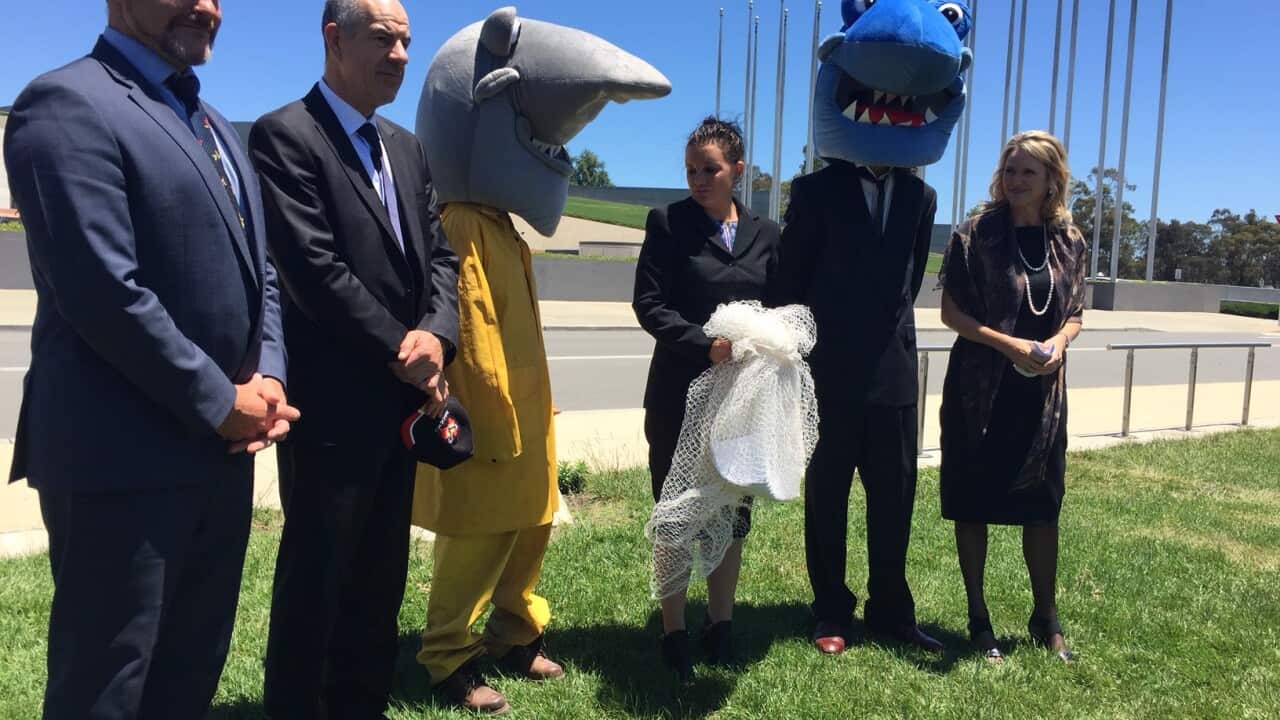
They can scoop up 6,200 tonnes of fish in one expedition, then freeze their catch on board and start again.
Such is the scale of super trawlers, or freezer factories, that for two years have been banned from entering Australian waters.
But that could change now the ban has been lifted and companies look at importing ships to Australia to catch their assigned quotas.
The threat to the Small Pelagic Fishery, which stretches across southern Australia, first arose in 2012, when a Tasmanian company sought to base Dutch ship the FV Magiris out of Devonport.
Seafish Tasmania says it is no longer associated with the Magiris, but hasn’t ruled out bringing similar vessels to the island state.
News that makes sense
Your trusted source for staying up-to-date with the world around you. Get free daily news updates and analysis, straight to your inbox.
“From our perspective, there is no doubt the fishery is sustainable under current management rules,” a spokesperson for Seafish Tasmania said in a statement.
“We plan to fish the quota we hold in the small pelagic fishery sometime in the future. We will announce how and when we will fish."
Seafish Tasmania has an annual quota of 16,500 tonnes.
“Whether you’ve got a big boat, one big boat, or a hundred small boats, if you’ve got a total allowable catch, and it’s stringently enforced, you can’t be damaging the resource.”
Professor Colin Buxton coordinates the University of Tasmania’s Fisheries Research and Development Corporation (FRDC) and believes super trawlers can be sustainable.
“The quotas are set based on an estimate of the stock, and that estimation then takes into consideration the needs of other animals,” he says.
“In the case of the small pelagic fisheries, our quotas are set at a very conservative level, and the reason for that is really not only to look after the fish themselves, but to look after everything that eats them.”
“Whether you’ve got a big boat, one big boat, or a hundred small boats, if you’ve got a total allowable catch, and it’s stringently enforced, you can’t be damaging the resource.”
But Professor Buxton concedes there isn’t enough scientific research to completely understand the impact on fisheries, that by-catch, potentially of protected species, is likely.
And an independent panel appointed by the government to research the fishery, agrees.
The panel’s recently released report found it would be inevitable that declared commercial fishing activity would lead to localised depletion and impact protected species such as seals and dolphins.
“There remains considerable uncertainty about the level of direct interactions that would result in an adverse environmental impact.”
“Some interactions will result in mortalities regardless of the adoption of the best available mitigation and management measures,” the report says.
“There remains considerable uncertainty about the level of direct interactions that would result in an adverse environmental impact”
And that’s precisely what the “Stop the Trawler” coalition is concerned about.
Supported by a raft of politicians, including newly-Independent Tasmanian Senator Jacqui Lambie and Greens Senator Peter Whish-Wilson, the coalition has taken a petition with 27,000 signatures to Canberra, to lobby the government to permanently ban super trawlers.
The Coalition’s Rebecca Hubbard says the government needs to be held to account for an earlier promise.
“Prime Minister Abbott did say the trawler is banned and it will stay banned,” she says.
“But he hasn’t implemented the necessary legislation to make that ban permanent.”
She’s worried about the environmental and social impact freezer factory trawlers could have on sensitive marine areas.
“We need healthy oceans, to support sustainable fisheries, both at a commercial and commercial level.
“If we see a decline in those small pelagic fish, you could see a decline in the other target fish like tuna, or the other protected species like seals and penguins and seabirds, that rely on those other smaller fish.”
“Prime Minister Abbott did say the trawler is banned and it will stay banned. But he hasn’t implemented the necessary legislation to make that ban permanent.”
Any super trawler activity could also drive local recreational and commercial fishers out of the industry.
President of the Tuna Club Tasmania, John Edwards, says livelihoods could be badly affected.
“Our main concerns are around localised depletions. Our club has experienced localised depletion before,” he says.
“Our bait stocks were depleted to a point where we had one fish caught by a member in one particular year.”
Since the ban was lifted, the Australian Fisheries Management Authority, hasn’t received an application by a large fishing vessel to fish in the small pelagic fishery.
“Our main concerns are around localised depletions."
According to the government, the total catch limit in the small pelagic fishery is currently set to 7.5 per cent of the estimated total fish population.
The government says it’s committed to a balanced and informed approach to fisheries management.