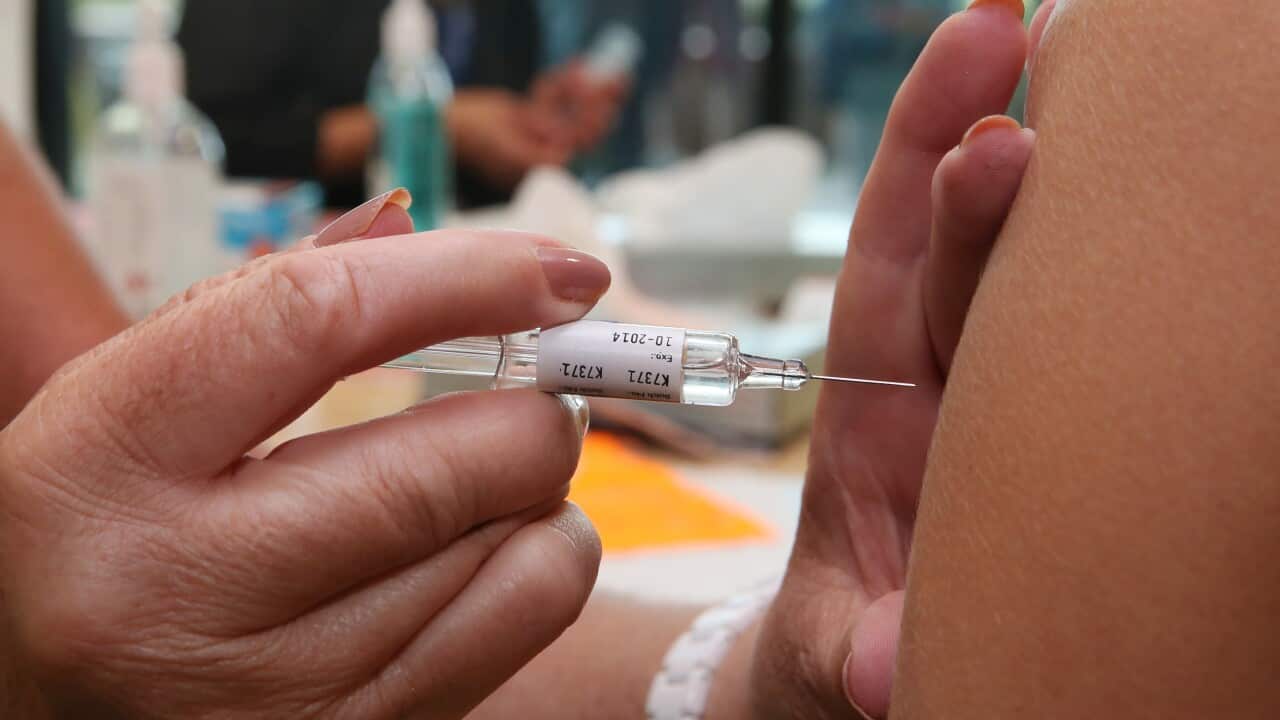
The flu season is approaching but those wanting to protect themselves against the virus may have to wait until April.
Vaccinations in Australia have been delayed by a month to allow manufacturers to include two new strains identified by the World Health Organisation.
Influenza, or the flu, changes from year to year, meaning that each year vaccines have to be updated. If you have been vaccinated in the past, that does not mean you will be protected when this year’s flu season hits.
The northern hemisphere has just battled through a particularly severe influenza season - one linked to the deaths of almost 100 American children.
Authorities are working hard to make sure Australians are better protected.
But the experiences of the northern hemisphere shouldn’t be used for flu predictions in the south, but rather as a warning, says Professor Robert Booy, Infectious Diseases Expert at the University of Sydney and Westmead Children’s Hospital.
“The Northern Hemisphere season has seen a big one… especially resulting in problems and deaths in people in nursing homes and elderly aged over 75.
"We don’t know whether southern cases will reflect northern cases,” Professor Booy told SBS. “We’re concerned that if the events of the northern hemisphere are repeated here, that it could be a bad season.”
But Australia could be better prepared if the strain that dominated in the northern hemisphere - the virus H3N2 – takes hold in Australia.
“The good news is that the vaccine we’ve produced for this year actually covers that strain much better than the vaccine they used six months ago in the northern hemisphere,” Professor Booy said.
But the National Immunisation Program (NIP) will not begin administering vaccines until April 20 this year – one month later than usual.
The delay comes as updated vaccine stocks are updated and sent out.
The trivalent vaccine, available to “at risk” groups free of charge, covers two new strains of influenza to hit the northern hemisphere, as well as H1- or Swine flu - which was responsible for the pandemic in 2009.
“[This kind of] vaccine that’s been available for 20 to 30 years now, and used widely, and it does cover the majority of strains of flu that we’re expecting to see this year,” Professor Booy said.
Who should get the flu vaccine this season?
The government recommends seasonal vaccinations against the flu for groups of people considered at a higher risk of developing complications, such as pneumonia.
This year Indigenous children aged six months to five years old have been added to the “vulnerable” group of people. Health Minister Sussan Ley told the ABC today five Indigenous children die from the flu each year. These children join a list of high risk groups eligible for a free flu shot under the National Immunisation Program (NIP), which also includes:
- pregnant women,
- people aged over 65
- people who identify as Aboriginal and/or Torres Strait Islander 15 years and older
- or a person aged 6 months and older with specified medical conditions.
Professor Booy said it is estimated only 45 to 50 per cent of people on average, who are considered high risk, receive the vaccination each year.
'Super' vaccine
Late April 2015 will also see the introduction of a quadrivalent vaccine on the private market. This vaccine will cover two types of influenza A, and in addition to one type of B it covers the other type of B as well. This will not be available through the NIP.
“We don’t know for sure how much extra protection it will provide - it’s been estimated that perhaps 5 to 10 per cent more protection could be achieved using that vaccine. I wouldn’t call it a ‘super’ vaccine, it’s a bit better than the one we’ve currently got, but I don’t believe a lot better,” Professor Booy said.
Groups not 'at risk'
People who do not fall in the 'at risk' categories will not receive the vaccine for free. But Professor Booy encourages vaccination where possible.
"It is really important that people who don’t have a high risk condition, consider whether they themselves are in contact with someone who has a high risk condition," he said.





