(Transcript from SBS World News Radio)
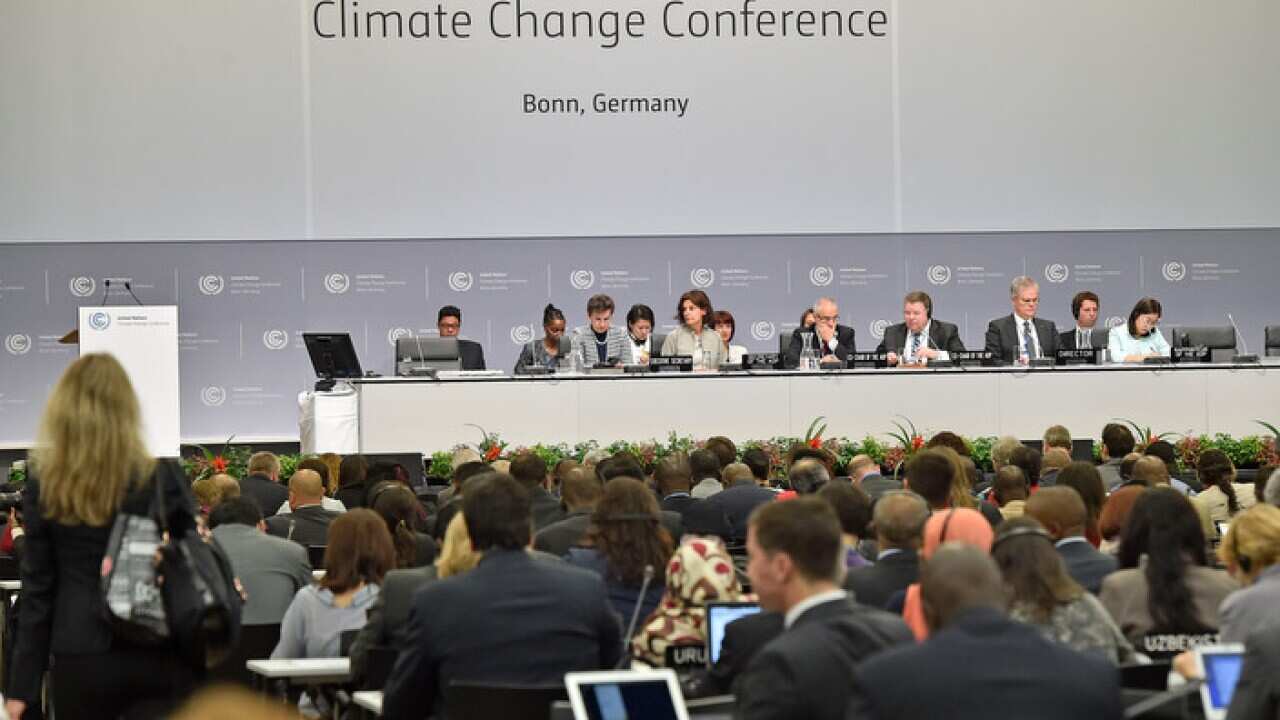
Australia has faced tough questioning at a United Nations climate summit in Germany.
It comes amid a report by a panel led by former United Nations Secretary-General Kofi Annan that criticised the country as a climate change "free rider".
Santilla Chingaipe has the details.
(Click on the audio tab above to hear the full report)
News that makes sense
Your trusted source for staying up-to-date with the world around you. Get free daily news updates and analysis, straight to your inbox.
Australian officials have faced heavy questioning from representatives of various countries at negotiations ahead of this year's United Nations climate conference in France.
International leaders hope to reach an agreement to curb global warming in Paris in December.
The Australian delegation has been asked several questions on its carbon emissions reduction policies.
Under the federal government's Direct Action policy, Australia has pledged to meet an emissions reduction target of five per cent by 2020.
But Brazil questioned whether dropping the carbon tax and replacing it with a $2.5 billion Emissions Reduction Fund will let Australia meet those targets.
"Australia's 2012 projections estimated net emissions in 2020 at 537 megatonnes of CO2 equivalents, including the use of international abatements, sourced through the Emissions Trading Scheme (ETS). But the ETS is going to be replaced by another intiative. So this projection is not feasible anymore, because units for an ETS are not going to be used. The domestic emissions under the same scenario were projected to reach around 637 megatonnes or equivalent. As part of the Emissions Reduction Fund, a safeguard mechanism will ensure reductions purchased through auctions are not undone elsewhere in the Australian economy and this safeguarding mechanism. The final design of the mechanisms is subjected to ongoing consultations with business and will commence on July 1, 2016. So my question is, 'Who will the changes to Australia's climate change policies and changes will support substantial greenhougas emission?"
The United States also wanted to know if the reduction in targets by the Emissions Reduction Fund would be comparable to the Emissions Trading Scheme it replaced.
"Could you share with us some additional details on how Australia ensures that the results of this policy are sufficiently large to acheive your objectives? For example, is the size of the fund calibrated in order to produce mitigation of effects of a certain size by 2020?"
Australia was also questioned over whether its target of five per cent by 2020 is fair.
Australia's representative Peter Woolcott said it is.
"We believe that this is a fair and equitable ... (a) five per cent target is a fair and equitable target. It is comparable to other major developed countries within the OECD. It translates to a 13 per cent reduction off a 2005 baseline."
Asked if he thought the criticisms about the fairness of Australia's targets were unfair, federal Environment Minister Greg Hunt says it is part of the process.
"Each country is asking questions, and each country is being asked questions. What we've been party to is precisely what the international community should be doing. We are asking questions of others and they are rightly asking questions of all countries and so that's how the process should work. And let me be clear, we took a 12 million tonne reduction from a $15 billion carbon tax and turned that into a 47 million tonne reduction in just the first auction alone. So we won't just meet our targets, we will beat our targets and Australians should rightly be proud of that."
The scrutiny in Bonn follows criticism by a panel led by former UN Secretary-General Kofi Annan.
The report by the Africa Progress found Australia was one of four major offenders who appear to have withdrawn from trying to tackle climate change.
The others are Japan, Russia and Canada.
The report says, with one of the world's highest levels of per capita emissions, Australia has gone from leadership to "free rider" status in climate diplomacy.
The panel called on the four countries to aim for zero emissions by 2050, with deep reductions by 2030.
But Mr Hunt has defended the country's reputation and says Australia is committed to setting post-2020 targets.
"There are very few countries that have achieved and beaten the Kyoto 1 targets. There are very few countries that have achieved and will beat their Kyoto 2 targets. And we will be an ambitious and constructive and engaged player in the post-2020 negotiations. Indeed, in the last 24 hours, we have made a statement precisely to that effect, as we are deeply engaged in the current Bonn conference in Germany."
Prime Minister Tony Abbott agrees.
"There is a bipartisan emissions reduction target, a bipartisan emissions reduction target, and, under this Government, we will meet our target. We will meet our target, and it's a very internationally respectable target. We will have our emissions down 13 per cent on 2005 levels by 2020. So we will meet our target."







