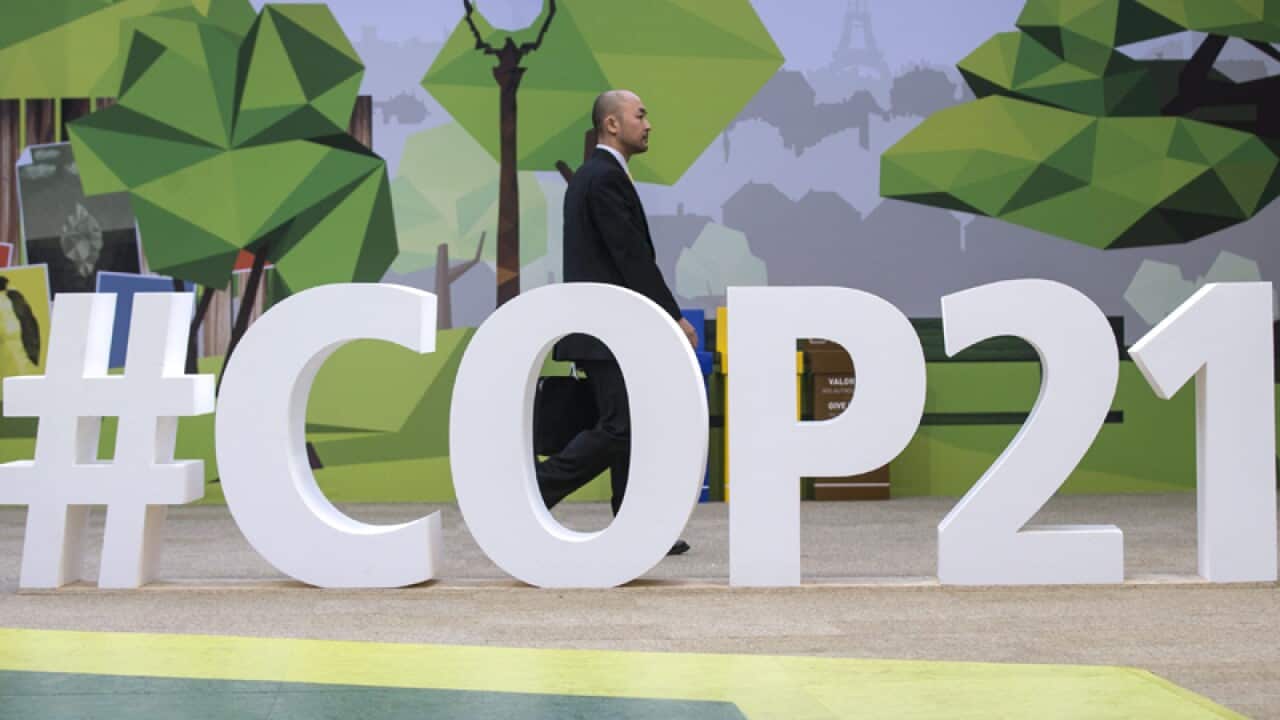
As the world meets in Paris to debate curbing carbon emissions, business leaders have met to find ways to protect our bottom line while transitioning into a low-carbon economy.
And some heavy-hitters added their voices in to drive the message home: going green is the best way to keep investments afloat.
Former Mayor of New York City and businessman, Michael Bloomberg is also the UN's Special Envoy fo Cities and Climate Change.
"No business CEO would survive if they tried to say that climate change isn't real," he said.
News that makes sense
Your trusted source for staying up-to-date with the world around you. Get free daily news updates and analysis, straight to your inbox.
Mr Bloomberg told an audience of business leaders and thinktanks in Paris, that as nations moves towards a cleaner future, businesses have been put under pressure to keep up.
He used the tabacco industry as an example of how fossil fuel industries can adapt.
"Philip Morris banned smoking in their offices. I don't think you have to say anything else."
"These oil companies are going to have to understand they've got a business to run and they've got a world to live in and they'll figure out some balance, some way to do things."
CEO of the Investor Group on Climate Change, Emma Herd, said investors and markets recognise that climate change is a financial risk and has economic impacts.
What does that mean for you?
"Super is invested broadly across the Australian economy, and the Australian economy is very carbon intensive," said Ms Herd.
"Everybody's super is almost always in either one of the two biggest return generating industry sectors, which is resources or financial services, both of which are very exposed to the impacts of climate change."
And global investors have been asking Australian businesses how they will respond to developments in climate change research.
That has led to a push for greater transperancy with Michael Bloomberg chairing a newly formed Task Force on Climate-related Financial Disclosures (TCFD). It was launched by Mark Carney, the Bank of England Governor and Financial Stability chairman, in a sign business leaders are taking climate change action seriously.
The body will aim to help businesses make judgements on their exposure to climate risk and how to best transition investments to a low or net zero-emissions world.
Green groups have long lobbied for fossil fuel divestment, advocating for companies to sell polluting assets and invest in more sustainable and ethical stocks instead. A move that has the support of the UN framework convention on climate change (UNFCCC), which in March said divestment sends a strong signal to companies.
And increasingly, businesses are putting pressure on investors to disclose their climate change financial risks.
Mr Bloomberg said the public wanted to see change.
"In every one of their towns, the farmers have to grow different crops or nothing comes up," he said.
"There's tornadoes, there's floods where there used to be droughts and droughts where there used to be floods. People are starting to raise their houses if they live on the coastline."
Emma Herd said all sectors of society need to be a part of the process of decarbonising.
"I think what has been recognised by business and the investment community is that you can't expect government to provide all the answers, that business and community also have to be part of the solution."
Carbon risk
So what actually is carbon risk? The umbrella term is used for a range of challenges facing business.
- The regulatory impact of policy responses to climate change
- Physical impacts to climate change itself, such as increasing sea level, inundation, or droughts or extreme weather events.
- Market risk - changing market expectations around how companies should perform and what their acceptable levels of emissions should be.
- And technology risk - the rapid rate of technological transformation and how that will leave particular companies disadvantaged in a changing landscape.
"The signs are all saying adapt or perish," Ms Herd said.
In our carbon-intensve economy, she encouraged Australians to check where their super is invested and understand how the superfund manages carbon risk.
Anthony Hobley, chief executive of thinktank, the Carbon Tracker, said finding out how superfunds manage carbon risk can be difficult.
"Not enough information is being put out in a coherent form by companies, for the shareholders and the investors to fully evaluate the risk of those projects in that danger zone."
That could be mitigated through 'stress testing' their business models to understand where potential problems may arise.
"If they allow that money to be used for businesses and companies that contribute to causing climate change, when we come to retire, it may not be a very nice world into which we retire."
It could also affect property values, if climate change hits coastal areas. And in Australia, almost 80 percent of our population lives in built up coastal cities.
"A range of companies, from BHP to AGL through to Westpac and other big major companies in Australia recognise that climate change is a strategic risk they need to manage," said the Climate Institute's Erwin Jackson.
Mr Hobley said some companies have started to produce two degree scenarios and evaluated what a two-degree world would mean for their business, including French oil and gas energy company Total, which has invested heavily in solar.
During the G20 summit in Turkey, the Australian government agreed to support decarbonising the economy, joining European leaders agreeing it should be included in the language of Paris climate negotiations.
Sarah Abo's trip to Paris was supported by the World Meteorological Organisation.







