
Nobel committee leader Berit Reiss-Anderson said the award acknowledged ICAN's work "drawing attention to the catastrophic humanitarian consequences of any use of nuclear weapons and for its groundbreaking efforts to achieve a treaty-based prohibition on such weapons."
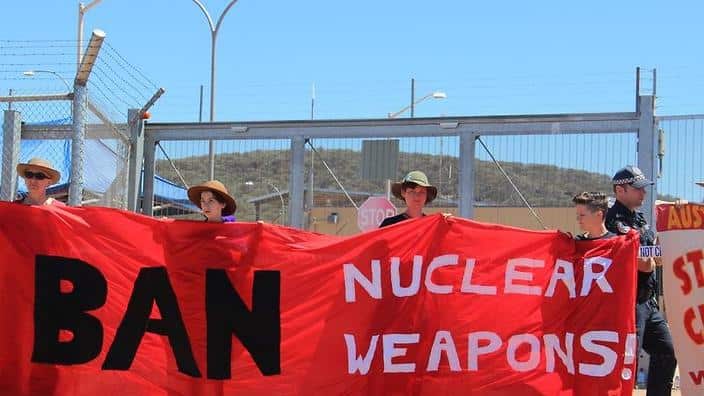
ICAN's Asia-Pacific director Tim Wright used the announcement to push Australia to sign the nuclear ban treaty.
"To really ensure that we stand on the right side of history," he said. "That our country joins the great majority of the world's nations in saying that there is no legitimate role whatsoever for nuclear weapons."
With 122 countries signed up to the pact, United Nations spokeswoman Alessandra Velluci said she hoped the award would provide an impetus for more nations to follow.
"We need 55 ratifications for the treaty to come into force and there is a very active movement from civil society, particularly in Japan, but around the world to bring into force this treaty," she said.
"So I hope that this prize will be conducive to the entry into force of this treaty."
Australia has defended its stance, pointing to its work putting into force comprehensive global test ban treaties.
A spokewoman for the Department of Foreign Affairs and Trade said the government acknowledged ICAN's important work.
"Australia works towards a world free of nuclear weapons through the Nuclear Non-Proliferation Treaty (NPT and associated international discussions on the Comprehensive Test-Ban Treaty (CTBT), control of fissile material and increased transparency of nuclear arsenals," she told SBS World News.
ICAN's network co-ordinator Daniel Hogsta said the Nobel Prize recognised those who have fought tirelessly for disarmament.
"It is a tribute also to the survivors of the atomic bombings of Hiroshima and Nagasaki, the Hibakusha, and the victims of nuclear test explosions around the world," he said.
The honour came as a shock to the organisation's Geneva-based Executive Director Beatrice Fihn.
"It was really hard to believe it at first, so we were a little worried it was a prank," she said.
But it was no joke...and neither, she says, is the current threat of nuclear conflict.
"The election of President Donald Trump has made a lot of people feel very uncomfortable with the fact that he alone can authorise the use of nuclear weapons and there's nothing people can do to stop him. A man that you can bait with a tweet," she said.
ICAN is also warning of the dangers posed by President Trump's plans to tear up the Iran nuclear arms deal, at a time when the Middle East nation is complying with its obligations.





