
Language can be such a major part of understanding culture and history, and has been used as a tool of colonialism. Maintaining bilingualism in cross-cultural contexts is difficult. So what happens if you can't speak your mother tongue? Do you feel you belong even less?
There is so much more to language than just the words, especially for many migrant families living in Australia.
Language can help us feel safe, find community, feel a sense of belonging, success and hope for the future.
But in such an English-dominant country, it's hardly a surprise that trying to maintain language isn't as simple as it seems on the surface.
Noè Harsel and Zione Walker-Nthenda, neither of whom are bilingual, talk about how their inability to speak their mother tongues fluently can lead to personal shame and feelings of inadequacy.
I don’t even feel comfortable ordering sushi at a restaurant. I have recently been able to say, ‘Yes, I am a proud half Japanese woman’. That’s a big tick for me. Why cant I order sushi?!Noè Harsel
Anna Yeon who is fluent in her mother tongue, has at times felt self conscious or been made to feel uncomfortable when speaking Korean in Australia.
I did go through a phase in my adolescence when I wanted to speak only English in public spaces. There was an innate sort of connecting of English speaking and respectability.Anna Yeon
Hear their full conversation in this episode of Like Us, and follow the series in the SBS Radio app, at www.sbs.com.au/likeus or in your favourite podcast app such as Apple Podcasts or Spotify.
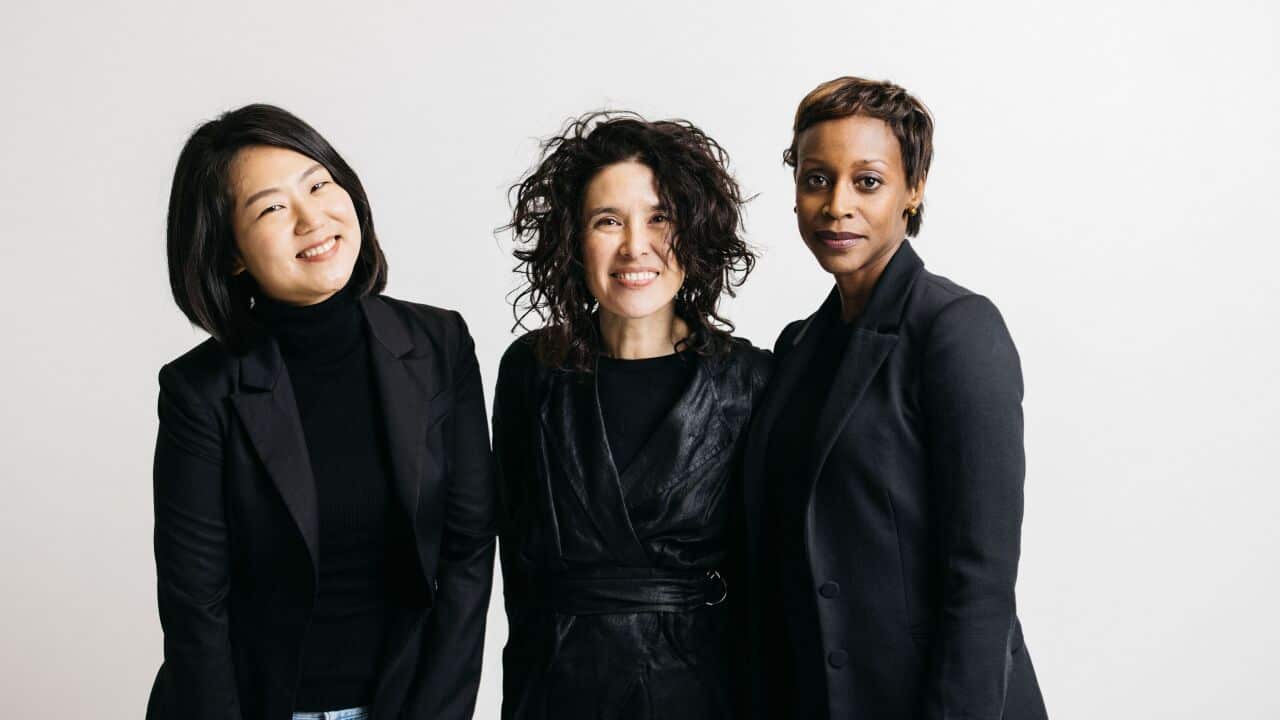
Like Us is hosted by Anna Yeon, Noè Harsel and Zione Walker-Nthenda.
Recorded and edited by Michael Burrows, Brand Music.
Transcript
Noè: We would like to acknowledge the traditional owners of the land we are broadcasting from, the Boonwurrung people of the Kulin Nation, we pay our respects to their Elders past and present. We would also like to acknowledge all Traditional Owners from all Aboriginal and Torres Strait Islander lands you are listening from.
What do you get when a Japanese-Jewish woman, a Korean woman and a Nigerian-Malawian woman get together to chat about living, working and raising families in Australia? You get ‘Like Us’, a podcast that is Anna Song, Noè Harsel and Zione Walker-Nthenda — 3 Australian women from different cultural backgrounds, discussing their personal relationship with Australia and Australia’s relationship with them.
Noè: Hello, ladies!
Anna: Hello Noè, hi Zione!
Zione: Hello, ladies!
Noè: Look I’ve been doing some thinking as every so often I do, when I’m not watching trashy TV. I just want you to know that I do think as well, alright?
Zione: [laughs]
Noè: And this time I’ve been thinking about language and its power, especially in migrant cultures and migrant families and also in colonial and post colonial narratives…
Zione and Anna: Whoa…[laughs].
Noè: Because language has got so much power…
Anna: Absolutely.
Noè: …it has the power of loss and of sadness and all the things, you know? So there are a couple of quotes here I’m going to throw at you, I want you to hear these…
Zione and Anna: hmmm, okay…
Noè: Alright and you might already know them. This one is from Samuel Johnson, “I am always sorry when any language is lost because languages are the pedigrees of nations.”
Zione: Hmm…
Noè: And then there is this one, which is, I know it’s going to get you to the core - it’s a beautiful quote - and it’s from Musa Anter who is a Kudish writer and Musa was assassinated by the Turkish government in 1992, so listen to this quote: “If my mother tongue is shaking the foundations of your state, it probably means, that you built your state on my land.”
Zione and Anna: Wow….
Noè: So with these quotes, I just want you to think about the power of the mother tongue, the mother language, and I want to hear about your experiences about speaking or about not speaking the mother language.
Anna: So that second quote, reminds me of what happened to me on the train recently. It’s not, it’s not - obviously I’m not one of the indigenous peoples of this country - but I was with a Korean friend on the train, speaking Korean and animated - by now, you know how I talk and how I laugh in conversations - so we were audible…
Zione and Noè: [laughs] Good…
Anna: …to the people near us, and there was a nice, nice woman, who was with her child who came up to me and asked, umm, ‘can you speak English’?
Noè: See, hang on - so she came up to you when you and your friend, who were speaking just to each other, in Korean, can.you.speak.English?
Zione: How was that her business?
Anna: I mean…who knows? You would have to ask her why she wanted to know, but…
Noè: Oh… stop…She needed directions?
Anna: Maybe she wanted to strike up a conversation, I don’t know….
Zione: Or butt into your conversation…
Anna: Or maybe she needed directions, or…
Noè: Or maybe she’s just casually racist?
Anna: [laughs] I didn’t take it that way, but let me tell you my reaction, which actually surprised me a little bit. When she asked that question so earnestly, I looked at her and I burst into a bit of laughter. Because… I just, I just could not fathom someone in this country seeing me as not able to speak English [laughs] when I am so fluent, and I have such love of the English language and the written word and literature and all of those things and my identity is so strong as an English speaker. But when I laughed, and I didn’t have any ill intentions or anything, she looked mortified.
Noè: Good!
Zione: hmmm…
Anna: She looked so embarrassed, in front of her child she went bright red in the face…
Zione: Must have taken her to another place…
Noè: I’m angry, I’m angry, I’m sorry… you’re amazing Anna Song; I mean I think that reaction, because it was pure, and as you said, she didn’t mean anything by it…
Anna: It was totally authentic by me …
Noè: Totally authentic…
Anna: I didn’t read anything [bad]...
Noè: You’re a stronger woman than I am, because I would have read a lot into it…
Zione: [laughs]
Anna: I don’t have to be angry because you’re being angry for me…but what it also did make me…it triggered a memory of a long long time ago when I wasn’t so confident, I suppose, in my bilingual identity. I think I did go through a phase in my adolescence when I wanted to speak only English in public spaces, like on a train, like you know…
Zione: Right…Why?
Noè: So so just going back, when you say public spaces, you mean in western public spaces?
Anna: Yes! So outside of the home, basically, even if it was with my family. I think I did..there was an innate sort of, as an adolescent connecting English speaking and respectability. And I wanted to project that with my family …
Zione: ...in public…
Anna: That's right.
Zione: To garner the type of respect, from the broader society that an English speaking…
Anna: …that I felt we deserved.
Zione: That’s right.
Noè: So you felt that by speaking English, you would be more respectable…
Zione: And more accepted?
Anna: And, and… less vulnerable to ill treatment…
Noè and Zione: Yes, get it…Absolutely.
Noè: And I think that’s something projected onto us, as well.
Zione and Anna: …yeah…
Noè: And that’s why so many migrant families make such an effort…
Zione: …an effort…
Noè : … to take away your mother tongue and teach you only English!
Zione: That’s right. Only speaking in English, but not only speak English but speak English in the way it’s spoken here.
Noè and Anna: yeah.
Zione: Because that means you’re from here… You know, there is that context in the UK with Nigerian families but also Ghanaians as far as I understand it; having that parents work really really hard, go to university and spend all their time working and studying, and working and studying, and placing their children in foster families - white families - so that they could learn how to speak English (because they all spoke English, the parents spoke English, because English is the lingua franca of Nigeria) with a proper English accent and be fully English in every way possible. So I know lots and lots and lots of friends and families who have grown up like that; so their entire adolescents until you finish high school.
Noè: It’s interesting you mentioned that, how being adopted into another culture fully - like, it’s not just the language is it; it’s the way you act and the movement…
Zione: Exactly, the imperceptible things that make you seem like, oh you belong!
Noè: Yes!
Zione: And it’s the parents who are most recognising that, we can’t quite make that transition in the same way but we want to give you every opportunity for you to be able to do that.
Anna: You know Zione, now that we are talking about it, I do remember us talking about this exact thing a couple of years ago; and I found it so unbelievable that parents will go to that lengths. And I found it almost unbelievable but I looked it up, and there is like a BBC documentary, it’s like a real thing…
Zione: There is a movie.
Noè: It’s a real thing. But at the same time it’s not that unbelievable, because you want your family - you want your family to survive. You want to feel safe and like you are accepted, right…And all those things which are just more than words and language - but the hand, the way you hold your body, the way you might move your head - all those imperceptible signifiers of being part of a culture.
Zione: And being a respectable part of that culture, right?
Noè: Yes, so Anna, I wonder for example, you lived in New Zealand and Australia for… you know 5,000 years, right?
Zione: And you go back to Korea, don’t you?
Noè: And you go back to Korea all the time, so when you go back - and this happens to my mother when she goes back to Japan and like for 20 million years she’s been in Western countries - she often gets pointed out or told (or she tells me), it’s like she’s a foreigner in Japan. Do you feel like a foreigner in Korea because of the way you act, the way you move, the way you speak even?
Anna: I think I did, but the more often I go back, less of that foreignness is self-aware, if you’d like, so…
Zione: Like a practice…
Anna: That’s right. Also like, I just feel a lot more comfortable in my own skin in Korea, the more often I go back. And with my language, I also went through a phase in my adolescence of not speaking Korean to a point where I kind of felt like I lost it; [a language] that is technically my mother tongue. Because of my parents' sort of desire for me to assimilate I suppose, to the English speaking world and it got to a point where, in the past, I would get very nervous communicating to my grandparents and my extended family in Korean. And I would sound odd - I probably sound a bit odd in my Korean when I go back to sort of “Korean Koreans” - because I left Korea when I was a child. And I speak boring Korean like textbook Korean. I don’t know the sort of the slang…
Noè: …the everyday…
Anna: …the contemporary Korean like [used] in sitcoms; but I can read Korean novels, I follow the [Korean] news…
Noè: Do you dream in Korean?
Anna: You know, I used to get that question so much, in the earlier days and years of our migration; and I don’t know what language I dream in anymore…
Zione: Neither do I. I always feel strange [thinking about this…] Do you feel like you dream in a language?
Noè: You know, I have sometimes, I mean I say this genuinely, I have sometimes dreamt in Japanese and I feel so successful…
Zione: I can believe that because it’s so embedded in your subconscious that it comes out when you are comfortable and when you are at peace and at rest.
Noè: And I feel like a winner!
Zione and Anna: [laughs]
Noè: And I feel like, hey look at that mum! It just sticks!! And I honestly feel, like you say Zione, in the subconscious that is there, that in some shape or form it comes out. Particularly when I have been immersed in my writing and there is a lot of myth writing, like a lot of writing about Japanese tales, fables and fairy tales. And when I’m in those spaces, I do sometimes feel some embodiment of that coming through. Which then says to me, that language is more than just the practice, it’s more than just the words. There is a cultural embodiment…
Anna and Zione: Absolutely…
Noè: and how important language is… So then I ask you, Zione my fellow “non-fluent bilingual”, how does it feel, then for you, to not be fluently bilingual in a nominated mother tongue?
Zione: Oof, it’s such a perfect way to ask that question, oh my goodness! So yes, English is the only language I speak properly, well “properly” like 70%...
Anna: [laughs]
Noè: Oh please, in any language you choose, in any accent you choose…
Zione: I speak a bit of other languages. And I find as a migrant here, say I’m in those clusters with other Nigerians or other Black people, there is an assumption that I can speak a language other than English. And I know that there is a little element of maybe shame or embarrassment around not being able to; and that eventually, they’re going to find out, when everyone is speaking their mother tongue that I can’t… And so, I found my way to - and then that means that people decide I’m not authentic, right? If you can’t speak your mother tongue then maybe you are not really, quite, one of us. So my way of, my signifier, is the fact that I can speak a form of broken English, right? A pigeon English that is Nigerian specific. And when I speak that, it’s like, oh ok now you qualify!
Noè: Oh!
Zione: So for me, language is quite sensitive in that sense of ‘are you one of us’ or not? So I have to do that dance from time to time.
Noè: I totally understand that, actually, because for example my name - Noè - is a Japanese name but even for Japanese people, they don’t know it’s Japanese until I give them the characters for it because it’s very odd; it’s considered ancient. It’s very old fashioned.
Zione and Anna: Ah….
Noè: Because what is also interesting about the name Noè is that it’s also Hebrew. So for me…
Zione: And I always thought of it as a Hebrew name unless you told me, right? As a Jewish name.
Noè: Right, very interesting. So I have been able to be, you know, very well aware of that. So sometimes people assume that I am Israeli and able to speak Hebrew and people hardly ever make the assumption that it’s a Japanese name until they see it. If they find that I am half Japanese and make this assumption that I am fluent in Japanese as well and that I can speak Japanese; and then sometimes people will meet me and obviously assume that I can fluently speak English and lo and behold the disappointment when all those things are untrue!
Anna and Zione: [laughs]
Zione: And do you ever find it problematic, the fact that you can’t, - and are there settings in which you find it problematic?
Noè: All of it is problematic! Like a good Jewish girl, I can speak a little bits of Yiddish, a little bits of Hebrew... And as a good Japanese girl, I do speak Japanese pretty well. Hopefully my mother didn’t just hear that, because she has probably just keeled over right now.
Zione: [laughs]
Noè: But, truth be told, in-country, at times of serious [trouble], I have held my own and gotten us out of situations and been able to navigate…
Anna: In Japanese?
Noè: In Japanese.
Anna: Wow, amazing!
Zione: Exactly!
Noè: Thank you, Anna! I don’t know if you should believe that, but thank you.
Anna and Zione: [laughs]
Noè: Having said that, I was able to do it. And I can get stuff done. But I don’t feel comfortable though.
Zione: You don’t feel comfortable speaking it?
Noè: No, I don’t even feel comfortable ordering sushi at a restaurant. Here!
Anna: Whaaat?
Noè: I know!
Zione: Is that because you feel like your Japanese isn’t quite… right?
Noè: I don’t.. You know what, if we had the time…
Zione: To explore that?
Noè: Let’s break it down. I don’t even know what to say! I… I have recently been able to say, ‘yes, I am a proud half Japanese woman’. That’s a big tick for me. Why can I not order sushi? I do not know.
Anna: You clearly have the…
Anna and Zione: language skills…
Zione: to order it, just the comfort level.
Noè: Right!
Zione: At a Japanese restaurant, you mean.
Noè: I would probably freak out ordering it anywhere!
Zione: Right…
Noè: Sushi Sushi would probably freak me out. Truth be told, I don’t know what it is, it constantly freaks me out.
Anna: So, let me put my best therapist voice on…
Zione: Please! Even I want to unpack this.
Anna: Is that to do with shame? That you feel like you should be able to be perfectly bilingual yet you’re not. But my question to both of you would be, is it your shame or should it be others’ shame?
Noè: Yeah, I think you’re right.
Anna: Linking back to the train, you know from the anecdote, the reaction of the woman who asked whether I could speak English, and her being embarrassed; I think she felt ashamed…
Noè: So she should! I can’t let it go, Anna…
Zione and Anna: [laughs]
Zione: She’s going to sit on that for a while…
Noè: I’m going to sit on that for a while…
Anna: And I wonder what others have asked of you, or… just you know, the nuances and connotations that go back to that respectability, I suppose…
Noè: Yes!
Anna: If you are perfectly bilingual, I think even now there are certain situations where it’s not a strength but a … I don’t know… an oddity or just something different. Or it’s not positive somehow…
Zione: What’s not positive?
Anna: Being perfectly bilingual in, in every sort of fluid situation in everyday Australia.
Noè: I think if I were perfectly bilingual now, it would be a wonderful positive…
Zione: I would think so, I can’t see it any other way…
Noè: But I think to be honest to answer your question, I do think there is shame involved. I think there is a multifaceted element to shame. And for I do believe that I hold an inordinant amount of shame, on so many levels there is no point going into it… But to answer the other part of that question, I think there is a lot of shame projected onto me.
Zione: That is from people who speak those languages or from mainstream society?
Noè: Mainstream society as a whole..
Zione: Mainstream society expecting you to speak these languages?
Noè: No, just being different.
Zione: Oh, ok.
Noè: And I think the fact of being different and the shame of being different, made it difficult for me to solidify that difference, acknowledging that difference; therefore say, I want to be fluent in another language! I want to be different to my peers! I want to be the thirteen year old girl who spends all of her Saturdays in a language school!
Anna and Zione: [laughs]
Zione: I’m signing up for that!
Noè: I mean, no I don’t want to go to prom… No, no, no; I wanted to do that instead: be learning my times tables and I want to be learning Japanese language
Anna and Zione: [laughs]
Anna: That’s rough…
Noè: So I don’t know if that was the same for you, but I think for me shame definitely played a large part of it…
Zione: Yeah… no…So, mine is different.
Noè: Okay…
Zione: So mine is not from the broader society, actually, they haven’t expected me to speak anything else per se…
Noè: Interesting…
Zione: In this context, that is. It’s from my minority groups that expect that I should be able to. And it’s also generational. So people who are in my generation, not necessarily, a lot of them probably can’t speak their own native language, but their parents possibly [can speak]. It’s not hard core, I should say. Because English is lingua franca [in my communities] so it’s understable that I speak English. There just is a little bit of that sense of ‘wouldn't it be wonderful if you could also speak your own language and what a shame that you lost that legacy’. Because language is a connection point, because if you don’t speak the language, you lose the connection to a vast array of culture, references, history that can’t be easily translated into English or another context - you lose that. So I think that’s what they’re almost pitying.
Anna: I really do, like, recognise that sense of almost pity; in the Korean community as well; of a generation who weren’t taught to be bilingual but to be English speakers first. And Korean as a ‘nice optional extra’ somehow, but then as perhaps society has got a bit more accepting, as being Korean [and] being you know, multicultural has become more accepting, now there is that recognition of loss. Of children and adults who can’t speak it to extended family members back home and have deep and meaningful conversations about family history, or know the nuance that comes with knowing a language; that cultural intelligence…
Noè: 100%..
Anna: …and it goes back to that first quote, I think, that Noè mentioned about how it’s about it’s such a loss; a loss of a language is a loss for that civilisation…
Noè: ..it’s a loss of a culture. And I think it’s really important that we try our hardest to bring back language into our families; in some way, shape or form…
Zione: Yes, love that.
Anna: Come full circle!
Noè: Yet again! Clever us.
Anna, Zione and Noè: [laughs]
Close: Thanks for listening to Like Us, a new podcast Brought to you by SBS. You’ll find more episodes of Like Us on the SBS website: www.sbs.com.au/likeus. You can also subscribe to Like Us from the SBS radio app, apple or google podcasts or wherever you get your podcasts. Your hosts are Noe Harsel, Anna Song and Zione Walker-Nthenda. We are produced and engineered by Michael Burrows at Brand Music and would also like to thank everyone at SBS radio, especially Caroline Gates for their help and support.