
Mothers. There is so much to talk about. How do we as children, navigate and understand how we are being shown love, especially when it looks vastly different to how those around us are being raised?
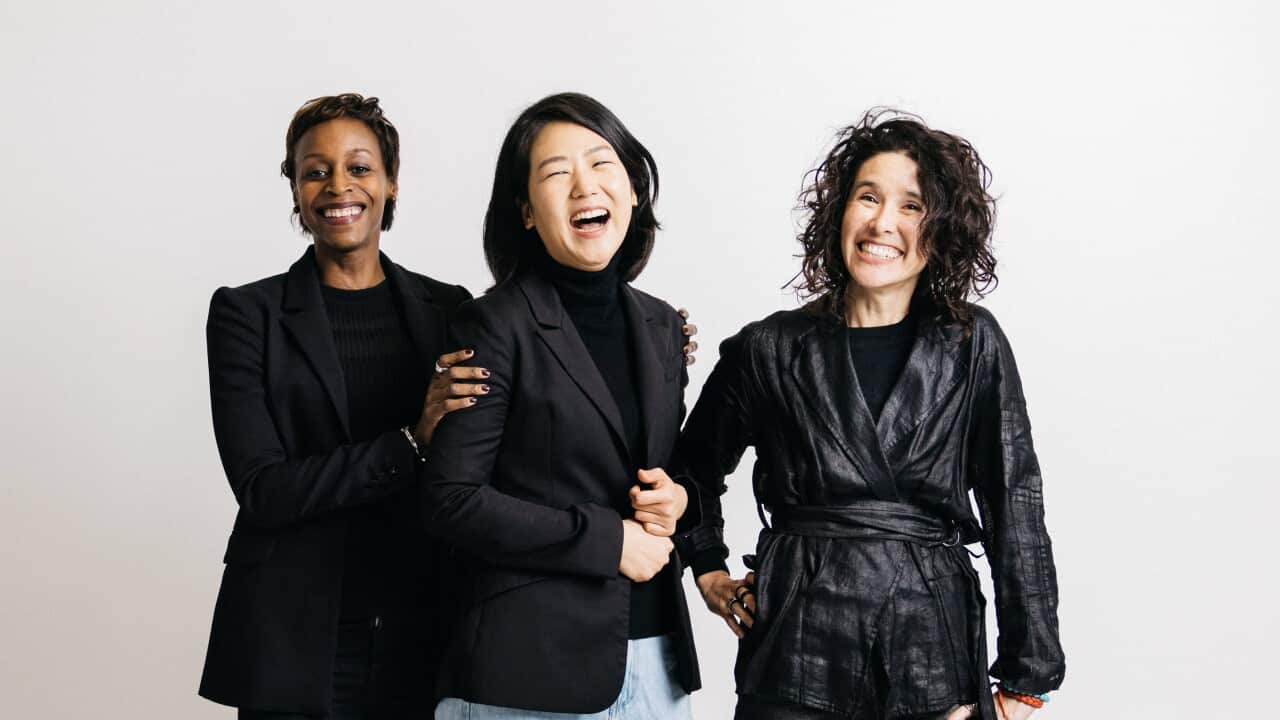
In this episode of Like Us, Anna Yeon, Noè Harsel and Zione Walker-Nthenda deep dive into their relationships with their mothers, how they were mothered, and how they are now mothering their children.
Anna needed to teach her mother how to verbalise love, Zione found herself parentified by age 13 and Noè is still waiting for some parental praise.
If I brought home an A, the first question I was asked by my mother was who got the A plus?Noè Harsel
Understanding how we were parented and how that differs to how we are now mothering shows how social attitudes towards expressing love have changed in a generation.
My mum one day actually lashed back out at me and said, ‘Just because I don’t say those words, don’t you know that I love you’. Like, I love you so much that putting words to it is useless.Anna Yeon
Follow Like Us in the SBS Radio app, at www.sbs.com.au/likeus or in your favourite podcast app such as Apple Podcasts or Spotify.
Like Us is hosted by Anna Yeon, Noè Harsel and Zione Walker-Nthenda.
Recorded and edited by Michael Burrows, Brand Music.
Transcript
Noè: We would like to acknowledge the traditional owners of the land we are broadcasting from, the Boonwurrung people of the Kulin Nation, we pay our respects to their Elders past and present. We would also like to acknowledge all Traditional Owners from all Aboriginal and Torres Strait Islander lands you are listening from.
What do you get when a Japanese-Jewish woman, a Korean woman and a Nigerian-Malawian woman get together to chat about living, working and raising families in Australia? You get ‘Like Us’, a podcast that is Anna Song, Noè Harsel and Zione Walker-Nthenda. Three Australian women from different cultural backgrounds, discussing their personal relationship with Australia and Australia’s relationship with them.
Noè: Hello ladies!
Anna: Hi Noè, hi Zione!
Zione: Hi, hi Anna, hi Noè!
Noè: Ah thanks everyone, thanks for the greeting. Ok, I’ve got something. I’ve got something that’s, this is a topic I think we’re going to I don’t know, go over and over…
Anna: Do I need to hold your hands at this point, for that extra bit of oomph and courage…
Noè: This is going to be something that…We are going to talk about a lot, a lot!
Anna: Are we going to cry, do we need tissue?
Zione: We could…
Noè: I’m crying at the thought of bringing it up…
Zione: I’m crying inside…
Anna: Let’s get on with it!
Noè: Ok ok, I want to talk about motherhood, alright folks. I want to talk about all these aspects of motherhood and how we understand it and it’s brought on by, so I’ve recently read some of my favourite books, 100 Days by Alice Pung.
Anna: I love that book.
Noè: I love Alice. And also even another book called Pachinko which I know is a shared favourite.
Anna: Yes, yes between Noè and I…
Noè: And also look, as you know I’m writing my manuscript which is all about mothers and daughters; it has to do with, you know, cultural narratives and it has to do with mothering, basically. And how we do we ‘mother’. This whole thought process, for me, was brought on by some recent conversation I had with a friend who is expecting her first baby…
Zione: Oh wow…
Anna: Hold on, I’m just; Zione, like she [Noè] has friends other than us, so let’s just check that for a moment. [laughs]
Zione: Yes…
Noè: Did you notice the air quotes? There were air quotes.
Zione: Yeah… we will revisit that.
Noè: That’s another episode. But this poor woman having her first baby was brave enough to ask me about motherhood; and I was… you know, in my own stupidity splurted out a lot of, you know, nonsensical wisdom…
Anna: advice…
Noè: Yes, ok, advice…
Zione: Standard or like deep intuitive sort of advice?
Noè: Deep intuitive advice and as I was just…vomiting… stuff. I was thinking to myself of all of this stuff is just me thinking about how I am parenting and how I was parented; but with the benefit of hindsight, right? Like, for example, I was raised with a very distinct sense of who I was or where I belonged but I was only aware of it you know I don’t know, like thirty years later or something and by this I mean, I don’t know who can understand this but, there is a very distinct way of being raised where I wasn’t praised a lot.
Zione: Hmm…
Noè: And I wasn’t praised a lot…
Anna: Oh goodness…
Noè: Ok. So, Anna, maybe you’re getting me here… that I wasn’t given a lot of “I’m a great person”; I wasn’t given a lot of “you’ve done a great job”. If I brought home an A, the first question I was asked by my mother was who got the A plus
Zione: Yeah
Anna: Exactly, so I resonate with that 100%. And it has been, it still is, a contentious issue that, in essence, I am still trying to ‘train’ my Korean mother into praising me, genuinely.
Zione: Hmm…
Anna: Not too fake praise me, just so that she can get me off her back, but it was really difficult and raw for a while not to be praised when I felt I deserved it…
Noè: So it’s an Asian thing, is what you are saying, to me… it’s a like not “tiger mum-ming”, but it’s more like…
Anna: It does have to do with that value of humility.
Zione: Yes!
Anna: Being humble and modest
Zione: 100%!
Anna: And I think any cultural upbringing where the modesty and making the self smaller…
Zione: Yes… that resonates with me. When I remember going back to Nigeria, there were a lot of these childhood stories that centred around humility and modesty; so the humble and modest - are usually the female - always wins the day. Always - every story!
Anna: The virtuous!
Zione: That one! Right, the one who goes for the smaller pot, agh, and it breaks and all of a sudden all these amazing things and that’s because she was humble and made herself small and she chose the smaller thing, and therefore she was the winner in the end. Oh, you know…
Anna: Oh wow…
Zione: Those types of narratives definitely resonate. But the notion of ‘mothering’ and ‘being mothered’ that also resonates really strongly with me and I think I was talking about a book I read by Edith Eger a very powerful writer, she has written I think two or three books that is life changing but she does ask a question and I can’t remember it properly and I can’t even paraphrase it, but it’s something around knowing when your parents stopped parenting you.
Noè: Hmm
Zione: Right? For some people and I realise for me that, that ended when I was about 13
Noè: Wow - that’s early?
Zione: That is very early but I didn’t realise that…
Anna: I’m still getting parented by my mother, I’m sure
Zione: But I didn’t realise that until I started noticing how I was parenting my daughter with this sense of “but you’re 13, how could you not know how to do this that and the other” and I was expecting all these amazing things, and I realised “oh my gosh, she’s just 13”... And the reason I was doing that was, when I was 13, I moved to live with my dad in Japan, right? And, so he had a very very free way of parenting, right? Which was this notion of, “you do what you want to do”, right? Or you want to go to the school camp? Absolutely! You want to… whatever it is! Why do I have to sign all these papers, you know what I’m going to get an engraving of my signature, just stamp away…”
Noè: Oh, wow… Actually, I’m I’m going to do that. That is, that is so brilliant! I’m doing that…
Zione: Stamp away! Anything you want to do, fine! Here’s some money, go off and so be it, right? And I think he lived in Tokyo and we lived in Yokohama so it wasn’t like he was there every single day, either. But then being in a different country that is completely different in language and culture… I remember going to the supermarket and buying a thing and the realising, oh I thought it was milk - it’s detergent…
Anna: [gasp]
Zione: because you don’t know!
Noè: Because you don’t know any different…
Zione: Because you can’t read it… So, there’s all of these references that we take for granted like if there is a cow on the box, it’s most likely milk.
Anna and Noè : Yes!
Noè: But not necessarily in a different country
Zione: Right! All of those sorts of things. And so I guess because I feel like, I was 13, my sister was 12 and my brother 11 and we pretty much parented ourselves successfully for a couple of years, I was having the same expectations of my daughter.
Noè: Sure
Zione: And seeing her crumbling under the weight of my expectations and I really needed - and still having to take - many steps back to say, she is entitled to be a child.
Noè: Can I ask you a question about this, because I am also wondering about the expectations of us - or parents - in a Western or ultimately white culture, is different. So do you think, and I wonder this myself because, I felt being raised in white societies, that my white counterparts got a lot more praise, like they were… like it was ok… they were…
Anna: We are returning to the praise thing here…
Noè: Yes…
Anna: This is an issue. We need to discuss this and nail it on the head.
Zione: [laughs]
Noè: Yeah… because first of all, a) your daughter, Zione, she deserves to be a kid…
Zione: Yes!
Noè: …that’s what I am hearing, that sympathy; and Anna, yes!!! Mama Song should be singing your praises…100%
ZIone: 100%
Anna: [laughs]
Noè: And is that because where we are living and what we are growing up in, and that’s the cultural norm of, and that is of the dominant culture here?
Anna: So I do want to make a couple of key points here… Like, when growing up, so, back to the having hindsight. When I was a teenager and so forth, I did get hurt from the lack of praise and I internalised it as ‘lacking’ or not being good enough; but now I realise, my mother was always very proud of me and there was a devotion and the love that I never questioned.
Noè: 100%...
Anna: But there was always an equal level of, you know Mama Song’s desire for me to be better; to improve on the status quo. But I think when you are young, I think you kind of conflate the two: as you know, if she doesn’t think I am enough that must mean I am lacking. But it’s not that linear.
Noè: No.
Anna: So, I think that’s one good thing, about being older, and reflecting on how you were parented. But the second thing about sort of praise, and sort of “training my mother to praise me’; my mother and I have a very different dynamic in our relationship to the relationship my mother had with my grandmother, her mother. Because.. there was just absolute, total… obedience, to a point of reverence, that my mum was, you know, she was raised that way and she didn’t question it. So even when she was, I think, in her 40s, when my mother visited Korea and my grandmother was still alive, my grandmother would dictate what my mother would wear out.
Zione: Wow
Anna: Both women, you know, love clothes and fashion was a big thing in their bonding,...
Zione: And it wasn’t contentious, this notion of…
Anna: No
Zione: …you wear this. It was oh, my mother has said this, so that’s the end of it?
Anna: Exactly. So after my grandmother passed away, my mum started saying ‘I really didn’t like that’.
Zione: Oh, wow
Noè: See, isn’t that incredible. I think that’s incredible… and I think I’ve done the same thing, of understanding how we were parented, as your daughter will…
Zione: Hmm
Noè: …as my children will…Like, how our kids will understand and how you are parented is also the story of how they are parented. How we were parented. And the legacy of mothering, the legacy of parenting, as we go on and on in this historical narrative…
Anna: And I do want to weave back Alice Pung’s book, because there is, kind of that, young woman who becomes pregnant, who is the protagonist. And Zione, like, I kind of see that young protagonist in that book raises herself to a point…Umm, but also, she is grappling with this very complex, non-linear, expressions of motherly love from her mother.
Noè: Exactly.
Anna: Trying to figure out how she is going to break some of the cycle - of what she didn’t like, about her Asian mother’s parenting - but then, there is also that recognition of love. And what Alice said to me, because I did do a review of that book: Alice was really surprised at the reaction, by readers and reviewers. Some found certain portrayals of Asian motherhood in that book kind of shocking in a bad way…
Zione: In what way?
Noè: As in abusive.
Anna: Yeah, as in borderline abusive… but other readers and reviewers, like me, for example, knew…
Zione: Recognised…
Noè: …could see it as love!
Anna: …that complexity. Rather than be [seen as] abuse. It’s just a very different expressions of motherly love.
Noè: It’s a love language.
Zione: and a very different way of expressing that.
Noè: And it’s interesting when you are in a different type of society; where the expression of love is…
Zione: Different!
Noè: Yes! And how do you, how do you navigate that? How do your children navigate that when they are being shown love that is being expressed in a totally different way, and you are showing love in a way that you have been shown… it can be really difficult.
Zione: And confronting for them, because they are like I want what their friends are having.
Anna: Exactly.
Noè: And that’s exactly what I see love as…which is exactly what you were saying, Anna for yourself and that’s what I experienced myself as well. I was seeing love, being shown in one expression…
Anna: of praise...yeah…
Noè: Correct! And I was experiencing it in a different way and same as you; thinking that doesn't mean, that means I’m not being loved and ….
Zione: Yeah…
Anna: So my mother didn’t say ‘I love you’ out aloud, I think it was in my 20s; and it was another thing that…[laughs] I “trained her” to praise me, I “trained her” to say I love you [laugh]...
Zione: Ahh, that’s amazing… So my mother wasn’t the ‘I love you type’ of a parent even though she was a very soft and nurturing mother; she wasn’t an ‘I love you type’ parent, either. But the difference I suppose is, I was living in a majority Nigerian culture where ‘I love you’ wasn’t really part of the parenting lexicon.
Anna: No…
Noè: Interesting…
Zione: So it still felt like love, until I came here and I kept hearing people saying ‘my parents never said they love me therefore I think they didn’t love me’. And I’m like no, that’s got nothing to do with it.
Anna: So, exactly on that point; my mum one day actually lashed back out at me and said, ‘just because I don’t say those words, do you not know that I love you’, like ‘I love you so much that putting words to it, is useless’ is what she said to me.
Noè: Aww….
Anna: And that does make sense in hindsight, yet again…
Noè: Exactly, when are you living through it as a kid…
Anna: It’s hard!
Noè: Correct!
Anna: It’s raw!
Noè: Correct!
Anna: You know…
Noè: So I’m curious, Zione, for you … how as the love known, how was it shown to you growing up?
Zione: And I think this is the same challenge I’m having with my daughter; with my mother I knew she was a soft place to land, right? So when I was talking about being parented before, by my father and being parented separately from my mother, he was also trying to understand it from my context and I said ‘that the difference is, with my mother is always felt unconditional’.
Anna: Wow
Zione: I literally knew, even if I hurt someone in the worst way, while she recognised that it was a bad thing, I would still be loved. That was the distinction, for me.
Noè: Yeah, wow
Zione: Whereas, I feel that, I haven’t given my daughter that same amount of softness… And I’m having to navigate ‘I think I want to be tough for her so that she’s tough; so she can navigate this world’, right? Like the world where we were living was more accepting of me. But she is in a different world, so I want her to be tougher, so I’ve got to be tough to prepare her for that world - or this world rather - and so, I feel like I’ve conditioned myself to be harder because I think if I’m soft, then she’ll be soft, and she won’t make it.
Noè: That’s hard…
Anna: I’m about to cry; just this point. Because I think that is the exact struggle that a lot of people of, you know, diverse backgrounds, migrant backgrounds whatever you want to call it - this, this hurts. I mean to me, this is pain, having to make your love for your child tougher because society is so tough on you. And, kind of - I don’t know - that kind of cuts me up inside…
Noè: It’s a hard one, because you want to be able to survive; you want your children to survive; and you need to be able to teach them to survive in a culture that is not.. where they are not going to be the majority, and yet at the same time, by doing that, you are worried that ‘are they going to feel that same sense of acceptance and love within themselves and understanding… in the moment…
Zione: Yes…
Noè: Because retrospectively, they are going to go ‘oh I get it, I get it’
Anna: So does this make you feel any better, Noè about not being praised, regularly? [laughs]
Zione: Has this healed that psychic wound? [laughs]
Noè: You know, to be honest, I think that there is a part of me that understands and has always understood that it was part of love, and that’s where we were going with that; and that always, that my mother, of course, same, love. And of course this is part of her journey; this is the kind of love she can give, because of what has happened in her life.
Zione: Exactly.
Noè: You know, she is a product of World War II, she was born in a torn up troubled country, from a torn up troubled family history and she’s giving love in another language in another country to another child, you know? Who is being raised in a nationality and in a nation that is not even her daughter’s own in some ways, you know?
Zione: Yes
Noè: I mean, when you think about that..
Zione: It’s layered
Noè: It’s layered as all of our stories are layered. So I think, when we go forward and thinking about motherhood and mother love and how we love, and [how] we love others - even how we give out love to partners and friends and family - all those stories have to come back and haunt us, in a way.
Zione: Yeah.. definitely
Anna: Wow
Noè: That’s gotten deep
Anna: That toughness and the war time background and all those historical legacies does remind me of my mother’s reaction, mama Song’s reaction to Pachinko which she watched. And it such an experience actually watching it with her..
Noè: Interesting.
Anna: …and for my mother it wasn't actually Sunja the main protagonist that was stayed with her the most, it was Sunja’s mother.
Zione and Noè: Wow
Anna: And the character but also the actress and there is a scene where they say goodbye, and for my mother, Sunja’s mother was the toughest woman of them all.
Noè: Do I have time to tell you one thing about Pachinko? So I love this book, Pachinko which is about, you know, about Japanese…Korean-Japanese…
Anna: Korean-Japanese family over 4 generations
Noè: Also clearly tells… it talks about how badly Japanese people treated Korean nationals in Japan, right? So I gave my Japanese mother a copy of Pachinko, very early on, after I had read it.
Anna: Yes, that’s right
Noè: And I had loved it, you remember this right?
Anna: Yes, yes
Noè: So I give this to my mother and she doesn’t say anything about it, and I’m like oh interesting.. Strange that she doesn’t say anything about it, right?
Zione: Yeah, you would expect a reaction?
Anna: Umm
Noè: Right, right … so many many months later, my mother says to me: ‘I read the most fantastic book, you must read it.’ And I said, ‘oh my gosh, what is it?’ Pachinko.
Zione and Anna: [laugh]
Noè: ‘I cannot, I cannot believe you haven’t read it’, and I said ‘not only did I read it but I gave it to you’. ‘You did not, you did no such thing [she said]’.
Zione and Anna: [laugh]
Anna: And we’ve just come full circle
Zione: We’ve come full circle
Anna: ...with the lack of praise and now just just forgetfulness of the literary contributions you make to your mother’s life, Noè!
Zione and Noè: [laugh]
Noè: Thank you, ladies.
Zione: Thank you.
Close: Thanks for listening to Like Us, a new podcast Brought to you by SBS. You’ll find more episodes of Like Us on the SBS website: www.sbs.com.au/likeus. You can also subscribe to Like Us from the SBS radio app, apple or google podcasts or wherever you get your podcasts. Your hosts are Noe Harsel, Anna Song and Zione Walker-Nthenda. We are produced and engineered by Michael Burrows at Brand Music and would also like to thank everyone at SBS radio, especially Caroline Gates for their help and support.