Richard Baker: This podcast was recorded on the lands of the Wurundjeri Woi Wurrung people of the Kulin Nation. We pay our respects to elders past and present and recognise their continuous connection to culture. We would also like to thank the people of Norfolk Island, Aotearoa, New Zealand and the Pacific for
allowing their stories to be told.
Darren Bates: Yeah, we're going back 40 years ago, so me and my mate would have been young teenagers back then. We used to do a lot of shark fishing either at Cascade Pier or Kingston Pier. And we also carried rifles and we would shoot chooks. We also shoot cattle and stuff. Target practise. We used to shoot
Richard Baker: It's July 1985. Darren Bates and a mate are at a remote jetty on Norfolk island hunting sharks.
Darren Bates: We're down there catching the whalers and we'd keep the jaws and use the teeth for carvings and stuff. We caught one shark and then there wasn't much else happening.
Richard Baker: It's pitch black. Two hours since the sun slipped away. It's just two teenage boys and their semi automatic rifle staring out into the vast emptiness of the Pacific Ocean. Only on, this night it's not quite empty.
Darren Bates: This particular night there was a yacht out there. It would be at 8:30, 9:00 o', clock, just anchored up at Cascade Bay.
Richard Baker: The lights are on inside the cabin of a 30 foot yacht named Nuvaya.
Darren Bates: So we let off a couple of dozen rounds with our rifle out into the ocean, semi automatic and, echoed the whole valley.
Richard Baker: Whoever's on the Ouvea reacts immediately.
Darren Bates: And then the lights all went out in the yacht and we thought, oh shit, they're going to report us, we better get out of here.
Richard Baker: Because the men on board the yacht that Darren Bates aimed his rifle towards were dangerous and trained to kill. And they're on the run after carrying out an act that's about to become a global news story.
Darren Bates: So we left the scene and the next day we heard reports saying, they could be the guys that bombed the Rainbow Warrior. And, we were probably quite lucky that they didn't shoot back at us.
News Archive: The flagship of the environmental group Greenpeace was sunk today at the harbour in Auckland, New Zealand. One crew member was killed. There were two explosions on board the ship and police call them suspicious.
Richard Baker: I'm Australian journalist Richard Baker. I was 7 years old when the Rainbow Warrior affair took place in July of 1985. I remember seeing reports on the TV news. As I got older and learned more about it, I found the whole thing fascinating. Almost unbelievable. The French Secret Service plot,
deliciously codenamed Operation Satanique, was designed to sink Greenpeace's flagship Rainbow Warrior in the waters of Auckland Harbour and resulted in the tragic death of photographer Fernando Pereira. The more I've looked into it, the more I've been drawn to the strange events that took place on
Norfolk Island. This historic and savagely beautiful 34 square kilometre island 1000 miles to the east of Sydney and 600 miles to the north of Auckland. Because the men on board the yacht that Darren Bates aimed his rifle towards were French navy divers working for France's intelligence agency, the
D.G.S.E It's France's version of the C.I.A. These guys have just been involved in the blackest of black ops. They hold up on Norfolk Island for a few days as they make their way back from New Zealand to New Caledonia, a French Pacific territory. This brings Australia into the picture because Norfolk
Island is somewhat reluctant. Australian external territory. With the 40th anniversary of the Rainbow Warrior bombing on July 10, 2025, mystery still surrounds what went down on Norfolk Island with the French agents. And big questions remain about why they never faced justice. So I've come to
Norfolk Island to find out. Turns out the locals have been waiting a long time to tell their part in the story. Like me, many still think there's something that just doesn't quite add up. This is Fallout Spies on Norfolk Island, a new six part podcast series for SBS Audio.
Alan 'Kissard' Buffett: It's a different ball game to anything that you have over there. It's totally different here.
New Archive: Explosions rang out from the 40 metre ship at about midnight and the crew scrambled to get off the vessel to safety as she began going under.
Maurice Witham: We had a very senior detective inspector there and he sort of said, oh, I think we've got some real life spies.
News Archive: None of us could speculate as to who would want to do such a thing.
Dennis Muray: We had to strip search him and he had a huge scar, down his chest. Something he carved him up.
Geraldine Brooks: My editor, sat on the corner of my desk and he said, I think the French did this. And I said, oh, come on, Brian.
News Archive: So the one big question mark in. Your mind at the moment is what happened, happened on the boat last night? Was it an accident or was it not an accident?
Richard Baker: Episode 1 I smell a rat.
News Archive: Today during this current Covid outbreak. It just speaks to the fact that this is not over.
Richard Baker: I began chasing this story in the dark days of COVID lockdown in Melbourne. I was bored and decided to take a sniff around the online holdings of the National Archives of Australia. The archive is crack cocaine for historians, academics, investigative journalists and nerds. It holds millions of
pages of documents created by Australian government departments and agencies since Federation. Out of curiosity, I punched in Rainbow Warrior into the search function, and there it was, a 374 page file. Rainbow Warrior Incident, Norfolk Island involvement. The file was marked access status not yet
examined. This meant it hadn't been open to the public before I had to see what was in it. So I applied for access and paid more than a thousand bucks to see what was inside, all on a hunch. And what I saw made me wonder. Could Australia have been a better friend to New Zealand in its time of need?
Why did things play out the way they did on Norfolk island all those years ago? The Rainbow Warrior file also got me thinking about what's happening in the Pacific right now as the battle for influence over this ocean, its islands and their people heats up. So now I'm jumping on a plane to visit one
of the world's most unique places.
Darren Bates: Well, ladies and gentlemen, as you may.
Richard Baker: Have noticed, we have hit Norfolk Island. There's a seatbelt sign is still on. Please remain seated until the captain has turned it off. You may then disembark through the forward and rear doors. The international airport at Norfolk Island is little more than an oversized tin shed. There's a healthy
crowd to greet the arrivals, and today I'm, one of them. First thing I need to do is to find the bloke who's helpfully offered to be my chaperone and guide. His name's Alan Buffett, but he goes by the nickname of Kissard Lots of people on the island are known by a nickname. Yeah, yeah, I'm meeting
Alan 'Kissard' Buffett: Are you?
Alan 'Kissard' Buffett: Yeah, well, he's right here.
Richard Baker: Oh. How are you? Good to see you. I'm looking around. I'm not sure if you're out there or not. How's things?
Alan 'Kissard' Buffett: Really good.
Richard Baker: Thanks for coming to get me.
Maurice Witham: No, no problem.
Alan 'Kissard' Buffett: We'll wander through here.
Maurice Witham: Yeah, let's do it.
Richard Baker: Kisard's a descendant of the Pitcairn Islanders, who were offered Norfolk as a home by Queen Victoria in 1856, after its time as the harshest of penal colonists was over. History is everywhere on Norfolk Island. In the convict era buildings, the windswept cemetery in the turquoise water and the
majestic pine trees. And it's in the people who never fail to lift a finger from the steering wheel in a polite way to greet me and every other passing Motorist on the island's potholed roads. The modern story of Norfolk Island starts in 1789, when a bunch of British sailors on the Royal Navy ship
HMS Bounty overthrow their captain. You know what? How about I shut up and give Kissard the mic?
Alan 'Kissard' Buffett: I think he was the first officer, Fletcher Christian, he was on the ship also. After quite a fair bit of time on Tahiti, they headed back on what was to be the return journey to England. But during that time, quite a number of the crew had sort of made it up with the Tahitian women and so they had
a, mutiny and they set Captain, Bligh adrift and then they went back to Tahiti, then they picked up the women and they then took off and looked for a place to sort of hide so that the British government couldn't, get them. and that's when they sort of decided to set, up on Pitcairn Island.
Richard Baker: Pitcairn Island's far more remote and even smaller than Norfolk Island. The islands are separated by 6,000 kilometres of ocean. By the 1850s, the island was overcrowded. It was time to move to the vacant and larger Norfolk Island. Today, the names of those Pitcairn settlers remain prominent on
Alan 'Kissard' Buffett: I know there's Buffets, Adams, Christians, McCoys, Quintals, and I, hope I haven't missed anyone.
Richard Baker: About a quarter of Norfolk's 2,200 permanent population trace their lineage back to the Pitcairn settlers. There's certainly a unique look to many of the islanders. Lots of them are fairly tall, lean and tanned, with an elegant mix of Anglo and Polynesian features. I got talking to Kissard in 2024.
He reached out after I published a shout out in the Norfolk Islander Gazette looking for locals who remembered the French agents from 1985. Kisard's wife Sue has teed me up with a place to stay and her mate Peter has a hire car waiting for me at the airport. That's a ripper. It's going to get me
about nice. Never driven one of these. I've never seen one of these little toots, little Toyotas before. Yeah, And Kisar drowned up a crew of locals to greet me, arranging things in distinctive Norfolk tongue, a mix of 18th century English and Tahitian.
Alan 'Kissard' Buffett: Hey, what time would suit you for Have a bit of a chat with Richard, mate.
Unknown voice: Ah, well, this afternoon. Anytime.
Richard Baker: Some of them have interesting nicknames like Slick, Mutmart and Puk Kissard says it's a Norfolk thing. We Jump in Kisard's old ute so he can show me around.
Alan 'Kissard' Buffett: We're at Cascade Bay. This is where the Ouvea came into on its way to New Zealand and I think it might have pulled in here on the way back also.
Richard Baker: This is where Darren Bates was firing his gun into the water around the lonely yacht back in 1985. Yachts like the Ouvea boats of any size in fact can't moor at the pier at Cascade nor at the other pier at Kingston on the opposite side of the island. There's too much reef and rough water.
Alan 'Kissard' Buffett: They just anchor out from the pier there and just come ashore in the little dinghy.
Richard Baker: She's pretty rough out there though.
Alan 'Kissard' Buffett: Oh that's not too bad today. It can get quite rolly at times. It's a bit of a swell running.
Richard Baker: Cascade Bay is on the eastern side of the island and about a three and a half kilometre drive from Norfolk Island's main hub, Burnt Pine. But it feels much further away as you wind through narrow roads, uphills and down valleys to get here. Steep jagged cliffs overlook the pier. Back in 1985 Kissard
held an important job that put him face to face with the French spies when they downed anchor.
Alan 'Kissard' Buffett: I was a collector of customs, and when the yacht the Ouvea came from Noumea, to Norfolk on its way to New Zealand,
Richard Baker: The Frenchman stopped at Norfolk Island for a few days in June 1985 en route to New Zealand. The crew told the locals they were on a South Pacific sailing and diving adventure.
Alan 'Kissard' Buffett: It called in here and they got a few provisions and things like that and I must say that the crew sort of stood out a fair bit because they had really nice gear all. To us they didn't look like rough type yachties
Richard Baker: Kissard worked for the Norfolk island government then, not the Australian one. As collector of customs. Skippers of visiting boats had to give Kissard a clearance form from their previous port and declare all goods they had on board. These days there's no local Norfolk government. A sore point. I'll
hear lots about on this trip. The more we talk about the Frenchmen, their yacht and the Rainbow Warrior, the more Kissard seems to recall he was actually in New Zealand on holiday when the Rainbow Warrior was sunk and on his way home, Kissard remembers looking out the window of his plane on its
approach to land at Norfolk Island.
Alan 'Kissard' Buffett: here's the yacht sitting down. So got off the aircraft and asked the staff work and they said oh yeah, it's just come back from New Zealand and it was over.
Richard Baker: He also remembers a customs colleague pulling him aside to talk about the visiting Frenchman.
Alan 'Kissard' Buffett: He said I smell a rat. And in Norfolk that means you think there's something fishy going on.
Richard Baker: It's late May 1985, six weeks before the Rainbow Warrior bombing. A dashing moustachioed, wavy haired Frenchman introducing himself as Raymond Velche Bob's up in Noumea, New Caledonia, a French territory in the Pacific. He puts the equivalent of $17,500 cash down at a yacht charter company and takes
command of a sleek 11 metre sloop named the Ouvea. Soon Velche is joined by his crew, two other athletic looking Frenchmen going by the names of Eric Andrenc and Jean Michel Berthelo Andrenc's mugshot shows a somewhat shaggy dark haired young man with high cheekbones and an Al Pacino tough guy
glare. Berthelo has similar dark features but looks a bit younger and softer than his compatriots. They fit out the yacht with some of the most sophisticated satellite navigation and radio technology of the day. Next to arrive is a deep sea diving medical specialist, sailor, acrobatic pilot,
parachutist, shark expert and all round adventurer, Dr Xavier Maniguet He looks a bit older than the others, stylishly dressed, wispy blonde hair, blue eyed and suntan. Maniguet also has the best English of the group. The four men say they're about to embark on a month's adventure of sailing,
diving, partying and pleasure seeking. Sounds like fun to me. But the men on the Ouvea aren't who they say they are. Their real names are Roland Verge, Jean Michel Bartelo Gerald Andries and Xavier. Well he was who he said he was. Dr. Xavier Maniguet and these are the names that I'll refer to them
by all are working for France's secret service, the D.G.S.E on a top secret operation against Greenpeace, a high profile peaceful protest group focused on environmental issues. and its flagship, the Rainbow Warrior, which is carrying out an important mission of its own. Rongelap Atoll is part of the
Marshall Islands. It had been run by the US since World War II until gaining independence in 1979. Between 1946 and 1958 the US conducted a whopping 67 nuclear weapons tests at nearby Bikini and Enewetak Atolls.
News Archive: The top of the fireball at this time, 40 seconds after detonation was 5. Miles above sea level.
Richard Baker: The radioactive fallout from these tests has been slowly killing Rongelap and its 320 strong community since. You'll hear more about that later on. In May 1985, Greenpeace did what the US government wouldn't and evacuated the entire Rangelat community and 100 tonnes of their possessions aboard the
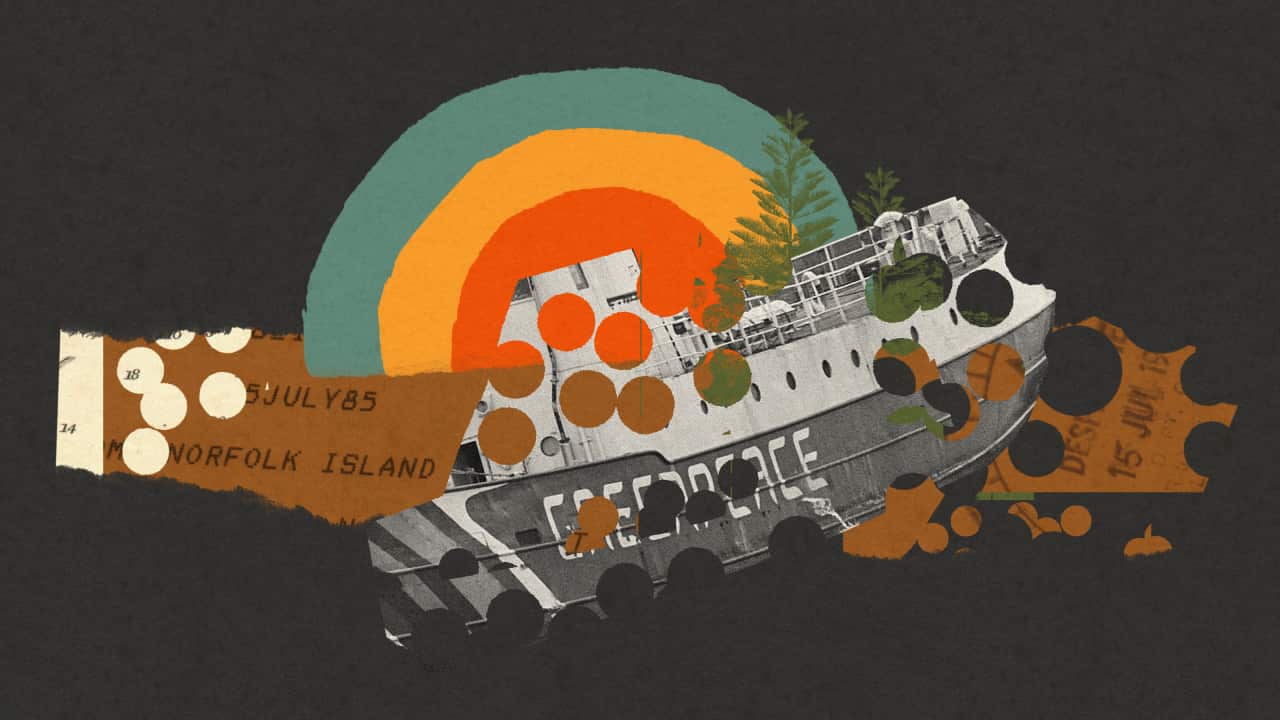
Rainbow Warrior, a converted fishing trawler, built in Scotland 31 years earlier. New Zealand journalist David Robie was part of that mission.
David Robie: It took four voyages, 320 people and all their homes is probably the most incredible, assignment I've really had as a journalist. But because I was on so long, I had to come to an agreement with Greenpeace. I'd actually be assigned, to the crew in the sense that I was on a watch, did all the things
that the crew did, but I was there as a journalist. But for everybody who was on board in that crew that took part in the evacuation, they were really affected for the rest of their lives.
Richard Baker: Resentment and anger at the nuclear testing in the Pacific is building. And the US aren't the only ones testing here. The French are too.
David Roby: I mean the ramifications are both, you know, the Marshall Islands and also Tahiti. With the French nuclear testing, the French really learned nothing from the American experience. They just really repeated all the bad mistakes, particularly with the atmospheric. The underground testing wasn't much
better because they basically destroyed a whole atoll and made it look like a Gruyere cheese.
Richard Baker: The Rainbow warriors next mission is leading a flotilla of boats to Mururoa Atoll in French Polynesia to blockade a planned French nuclear test.
News Archive: The warriors of the Rainbow, heroes of many famous campaigns, are now in Auckland on a new campaign to try to stop French nuclear testing in the Pacific. We really do hope that we can get the harbour so full of boats that, there just won't be room for a big boat to get in. Each new arrival was
greeted by a growing protest movement and television images showed us all that it was ordinary New Zealanders who, who were taking up the cause.
Lopeti Senituli: So we were constantly being scrutinised by the, by the Fiji police, that is of course the French and the Americans, they were taking photos of who we were. And so yes, we were aware that we were on constantly monitored.
Richard Baker: Tongan lawyer Lopeti Senituli was one of the Pacific's leading anti nuclear campaigners back in the 70s and 80s. Lopeti studied at the University of the South Pacific in Fiji and then became the director of the Nuclear Free and Independent Pacific Movement in the early 1980s. He remembers meetings
with American and French ambassadors who sought to reassure him that nuclear weapons tests in the Pacific were nothing to fear.
Lopeti Senituli: The French keep saying, oh it is safe, we are only testing these is not a problem, there's no medical problem, nothing in Tahiti, nothing in Tonga, in Fiji. And we say, yeah, then why don't you go and test it in Paris or test it closer to home? And of course they didn't have a response to that. And
Richard Baker: By 1985, anti nuclear activists like Lopetti and groups like Greenpeace had big targets on their backs and so did New Zealand.
News Archive: Through the 1970s and early 80s there was a growing protest against the visits of American warships to New Zealand. The Labour Party opposed the visits of nuclear armed vessels. A significant slice of its left wing wanted out of ANZUS altogether. The Americans on the other hand, refused to confirm
or deny whether their ships were carrying nuclear weapons. This left any nation protesting against the admission of their vessels having to ban all their ships if they were to be definitive about keeping nuclear weapons out.
Richard Baker: Niky Hagar is one of New Zealand's finest investigative journalists. He holds an Officer of the Order of New Zealand award for his work exposing intelligence networks, environmental cover ups and political skullduggery. Back in the 70s and 80s he was part of the push for nuclear free New Zealand.
Nicky Hager: I think I was a very typical teenager in that we had reached the age of understanding a bit about politics and then we were appalled to learn that not only were we in a darker part of the Cold War, but that just north of us in the sunny, safe seeming Pacific, there were nuclear tests going on as
well. So it was a politicising issue for lots of people like me.
Richard Baker: Nicky got to know people in Greenpeace going up to Mururoa Atoll in boats to protest against the French nukes. But as important as this was, concern over the French tests was playing second fiddle to another issue. The fallout caused by New Zealand's decision to block nuclear powered and armed US
Nicky Hager: The country had a very angry response from the United States.
Richard Baker: The US retaliated by blocking New Zealand from receiving information from the vast American intelligence network. This was pretty big news as New Zealand, along with Australia, Canada, the UK and America had been part of the so called Five Eyes arrangement where member countries agreed in theory not
to spy on each other and to share information. The usa, Australia and New Zealand had also had a mutual defence pact known as Anzus since 1951. From the Americans perspective, New Zealand's position on no longer accepting their nuclear armed ships tore the fabric of this agreement apart. Nikki says
the Yanks weren't the only ones pissed off by the nuclear ship ban.
Nicky Hager: We also had a very angry response from Australia. The Australian government had been elected a year before our one and promised pretty well exactly the same ban on nuclear armament powered ships in your harbours. And then the government had sold ours on that.
Richard Baker: The government Nicky's referring to is the Labour government, led by PM Bob Hawke. Labour did in fact have a policy to ban nuclear, armed ships from docking in Australian ports, but it never acted on it.
Nicky Hager: And so the Australian government was not only helping the, United States to tell New Zealand off, but it was also embarrassed and angry that it was being shown up by its little neighbour across the Tasman.
Richard Baker: It's important to know a bit about the dynamics between the us, Australia and New Zealand at this time, because I reckon it had a bearing on the way things played out with the Rainbow Warrior incident. Talking about the Rainbow Warrior, Nicky alerted me to one important implication of the US
retaliation over the Kiwi nuclear warship ban.
Nicky Hager: I've got New Zealand Eyes only intelligence document which explains this in detail is that the main type of intelligence that was cut was ocean surveillance satellites data which was exactly what they needed for the Ouvea.
Richard Baker: The same Ouvea that was carrying the four Frenchmen and the explosives used to blow up the Greenpeace ship.
Nicky Hager: Until that time, New Zealand as a long and loyal five eyes ally, could access the sweeps of satellite surveillance going over the Pacific north of New Zealand and see any ships that were around. Just three months earlier, United States Navy, which was especially angry at New Zealand, had cut that
off. So just at a crucial time, they cut off New Zealand's access to exactly the main kind of intelligence which might have helped them to track the ship. But the attack had happened, a man was dead, a boat was sunk in a friendly harbour. They could have just said, look, in these circumstances we'll
let you have maritime surveillance satellites dasa. But they didn't. It existed, it had been cut off and they were happy to just leave us hung out to dry.
Richard Baker: G', day, mate. How are you? I'm Richard. I'm journo. Here to see your dad, I presume? Yeah, dad. Oh, wow. That's a very cool old car there.
Maurcie's Son: 1919 Model T. Gee. Kind of like the same as, you know. Peaky Blinders.
Richard Baker: Yeah. That's so cool. G'. Day. G', day, Maurice.
Maurice Witham: How's it going?
Richard Baker: Good, thank you. I'm Richard.
Maurice Witham: You're Richard
Richard Baker: I'm at Maurice Witham's house at Orewa a half hour drive north of Auckland. His place is on a hill and has a great view of the nearby coastline. He's got a vintage car in his garage and I soon find out he has another on set for a Netflix drama. I've come to see Maurice because several people have
told me there's probably nobody on the planet who knows more about the Rainbow Warrior bombing.
Maurice Witham: I was a detective inspector and my role was to receive, all the information, receive phone calls, receive data from wherever it came and to assess the validity of it and to direct inquiries. I was sort of like, I was the 2IC to the inquiry for the second in charge of the inquiry with, Alan
Galbraith, the D superintendent was the boss guy.
Richard Baker: Maurice is now in his early 80s and his mind's razor sharp. For example, recalling car licence plates from 40 years ago. Easy
Richard Baker: We soon get on to the events of July 1985. Maurice tells me he was aware of increasing tension between French officials and Greenpeace in the lead up to the Rainbow Warrior bombing. Things had become heated at previous Greenpeace protests at the Mururoa test site.
Maurice Witham: And previously, when they had gone up, their, captain had been assaulted. They'd been hit with batons and all the cameras had been stolen, taken by the French and thrown overboard, except one lady had put one down her front and we got photos of, Captain Peter Wilcox being assaulted with the big,
Richard Baker: Maurice says Greenpeace had new recording technology on board the Rainbow Warrior that would make it harder for the French military to stop the world from seeing what was happening at the test site.
Maurice Witham: They could film what was happening on the day and they could, transmit it live. But like the live TV coverage we had now
Richard Baker: I get why the French would be worried about a potential public relations problem if there was fresh footage of its troops beating up protesters. But is it really enough motivation to blow up a ship docked in the port of a friendly country?
Maurice Witham: It was like drawing with a longbow, if you like that. Well, maybe the French did this because they didn't want their actions to be broadcast to the world.
News Archive: It was such an unexpected crime, such an unlikely act of terrorism, it's still difficult to believe it really happened.
Richard Baker: New Zealanders wake on the morning of July 11th, 1985, to the news of the bombing at Marsden Wharf in Auckland and the death of a Rainbow Warrior crew member. If the explosives had gone off a few hours earlier, when more people were on board, the death toll would have been far higher. People are
stunned. New Zealand's a small place. Bombings happen elsewhere in the world, not on these quiet and calm shores. Almost immediately the public swings into action. The phone at police HQ is ringing off the hook with tip offs. The New Zealand Secret Intelligence Service is also getting calls the
morning after the bombing. One in particular raises eyebrows. It's from a French accented man calling himself Dupont. He says to check passenger flight lists for aircraft travelling from Tahiti or New Caledonia for the names of French servicemen who are navy divers. Maurice is busier than he's ever
Maurice Witham: We were getting so many inquiries every day. I was doing 50 or 60 directional job sheets a day. I was reading stuff, analysing stuff. I had a notebook which I was writing it all in and we had no computer in those days. We had a word processing system that couldn't analyse data so we had to do card
index systems and stuff. And so I had two clerks working with me. Basically I was the filter. If you like to receive information, send it out. I would advise, the superintendent what was going on.
Richard Baker: The first inkling Maurice has that maybe the French are connected to this is when he hears about a mysterious Frenchman who came on board the night before the bombing. He introduced himself as Francois Regis Verlet, saying he was visiting from Tahiti and was a supporter of greenpeace There about.
Maurice Witham: 8:30 at night, just before 8:30 and inquiring about what they were doing. He was very sympathetic towards their cause.
Richard Baker: Rainbow Warrior crew members also tell police of another French connection, 33 year old Frederique Bonlieu who turned up in April to offer her services to Greenpeace as a volunteer. Frederique claimed she was a French aristocrat with a passion for environmental causes. In reality she was Christine
Cabon, a French spy sent to infiltrate the Greenpeace movement in New Zealand. The police get another big tip off later on July 11th when a member of the Okahu Bay Boat Club reports a camper van from rental company Newman's doing strange things near the shore of Auckland Harbour on the night of the
bombing. Maurice steel trap memory kicks in again.
Maurice Witham: That'll be 8945 that's seen this campervan come down the road, drive back again near the boat club, near the Ngapipi bridge on Tamaki Drive in Auckland. And the campervan did a U turn and came back again and then pulled onto the wrong side of the road.
Richard Baker: The informant tells police how he saw a small Zodiac motorboat on the water heading towards Some rocks. He watched a man step off the boat, tie it to a tree and deliver something to the waiting camper van.
Maurice Witham: And this is about 3k away from Marsden Wharf, where the Rainbow Warrior was birthed.
Richard Baker: A few hours later, two massive holes are blasted in the hull of the Rainbow Warrior, by limpet mines. Coincidence? Maybe, but it's worth chasing up this camper van to find out who's behind the wheel.
Maurice Witham: So we sort of put out an all stations like an APB.
Richard Baker: APB is police jargon for all points bulletin. An electronic message sent to all police to alert them to keep an eye out for a suspicious person or vehicle.
Maurice Witham: Especially notified Taupo police that if they're looking, Taupo's in the middle of the north island to keep an eye out for the camper van and hopefully we'd pick these people up on the way. Heading to Wellington,
Richard Baker: Newman's rental company is also told to report to police as soon as the van is handed in.
Maurice Witham: Friday morning I come to work and. And Becky Hayter, a receptionist at Newman's sort of bus late in the morning, rings up and said, oh, are you still looking for this campervan, LB8945? And we said, yeah, yeah, of course we are. I said, oh, they just returned the campervan and they're here in the
Richard Baker: The they Becky refers to are a Swiss newlywed couple, the Turenges. Well, that's what their passports say anyway. A trio of detectives race out of the police building to drive the 20 minutes to the Newman's rental yard to find the Turenges patiently waiting for Becky's boss to approve a refund for
the early return of the van. A bloody brilliant cover story that the receptionist has made up on the spot to hold them for police under questioning. They say they're in New Zealand on their honeymoon. They admit to being around the harbour on the night of the bombing to pick up a friend who'd been
Maurice Witham: His name was Peter.
Richard Baker: They can't say where they dropped him off. Eyebrows are raised when the husband, Alain, says the passenger sat in the front, but the wife, Sophie, says he sat in the back. Their passports are sent to Interpol for a check and the French police, who are unaware of their spy agency's operation at this
stage, do background checks on Alain and Sophie Turenge
Maurice Witham: They come back and said, no record of Sophie Turenge at Nanturne University. She's never been a lecturer here.
Richard Baker: With doubts growing, police turn up the heat on the couple. They interview them in separate rooms over 15 hours we were going through trying.
Maurice Witham: To break them down.
Richard Baker: While taking a break from questioning, a plainclothes French speaking female officer is placed in the vicinity of the couple to eavesdrop. Sophie is wilting.
Maurice Witham: She was almost tearful, very nervy. And Alain Turenge was saying to her, remember the mountain, remember the Montagne or whatever it was and stay strong. We will be okay and Uncle Emil will help us. Whoever Uncle Emil was. But later on we presumed he was some high official. So that was a code. That
was a code. It was a code for the boss of the D.G.S.E
Richard Baker: The Turenges are eventually released and will be monitored closely for the evening as they leave. A hard case detective quips, I think.
Maurice Witham: We've got some real life spies or something.
Richard Baker: But another veteran isn't convinced.
Maurice Witham: If they're spies, I'll eat my head.
Richard Baker: The New Zealand Secret Service has set up a motel room for the Turenges to stay in. Listening devices have been installed and plainclothes police are in the room next door. The supposed honeymooners continue to act a bit sus.
Maurice Witham: Every time they wanted to talk they would go outside on the the balcony to talk. They wouldn't talk in the motel either.
Richard Baker: When police trace their phone calls, one number leads straight to the French Ministry of Defence. The next day, Maurice and his team catch another break, one that leads them to our Frenchman on board the Ouvea Forestry workers lopping trees north of Auckland call in to say they saw the Newman's van
in their area about three days before the Rainbow Warrior bombing. The van was in a lay by beside a road. Its occupants, a man and a woman, looked like they were waiting for somebody. Eventually the van took off heading north.
Maurice Witham: And then about quarter now later, a grey Holden station wagon, silver station wagon, the LR8 double one four arrives and there's two guys in it. And they parked the station wagon just where these guys were dropping some trees in this car park area and the motor was running. Been there for probably
10 minutes waiting. And one of the guys came over to them and said, oh if you leave your vehicle there any longer it's going to get a tree dropped on it. They said, well there was a French guy, spoke with a French accent, said, we are looking for a camper van. You know, we're waiting for a campervan
to arrive. And they said, oh there was a Newman's camper van came in about quarter of an hour ago and he came in, they sat there for a bit, then they turned around and which way did they go?
Richard Baker: While one of the forestry workers talked to the driver, the other one took a walk around the back of the Commodore wagon. He noticed something in the back of it.
Maurice Witham: Dark blue outboard motor with, red and white stripes on it. In the back he noticed, some petrol tanks. There was a big grey thing in there as well, but it was in a blue canvas or plastic type cover over it.
Richard Baker: The workers told the Frenchman the camper van was heading north. Next thing, the station wagon sped off.
Maurice Witham: They didn't just drive out. This was urgent. They had to meet these people. So they did a bit of a wheelie and out of the gravel headed north.
Richard Baker: The rental company tells police the renter of the Holden Commodore station wagon, a Frenchman, has given a yacht called Ouvea as his address while in New Zealand. Soon the police get another lead, this time from two teachers picnicking in a remote place. The teachers report seeing a camper van
sitting idle in the same picnic area. Minutes later, a grey Commodore station wagon reverses up behind it and opens the back hatch. Items are transferred from the wagon to the van.
Maurice Witham: The guy thought it looked like a Zodiac, a big grey thing with a blue cover over it. He remembers seeing the two petrol cans. He saw a blue outboard motor with red and white stripes on it.
Richard Baker: Police had already seized a distinctive blue Yamaha outboard motor with red and white stripes. It was found at the spot beside Auckland Harbour where the Turenges campervan was sighted on the night of the Rainbow Warrior bombing.
Maurice Witham: So we had them linked with the OVEA crew.
Richard Baker: After a check with New Zealand customs, police discover the Ouvea arrived a few weeks earlier via Norfolk island en route from New Caledonia on June 22, 1985. The Ouvea made an unusual and dangerous move, bounding over a sandbar to enter the practically deserted Parangaranga harbour. A local
shopkeeper, reports the presence of the yacht to park ranger Hec Crene. He goes to see the Frenchman and asks what they're doing. Do they realise how dangerous that sandbar is? Dr. Xavier Maniguet the only crew member travelling under his real name, invites Heck on board to check out the yacht and
offers him a beer, which Hec accepts. Maniguet says he and his crew have come to New Zealand to do some diving. This strikes Heck as strange. Yachtys never come at this time of year to dive. The water's too cold. Hec tells the Ouvea crew to report to the closest customs office and phones ahead to
warn the officer on duty. Police believe the Frenchman deliberately chose the Empty Parangaranga harbour to unload the limpet mines and other gear that would soon be used to blow up the Rainbow Warrior. Before declaring their arrival to New Zealand Customs, Australian journalist Geraldine Brooks is
chasing the Rainbow Warrior. Acting on her editor's hunch that the French were behind it, she meets with the customs officer who checked out the Ouvea
Geraldine Brooks: He'd been on the boat just for a contraband inspection and it just didn't sit right to him because it was very clean boat, not a boat that looked like it had been on a Pacific cruise. And also the guys were different, you know, he said usually the kind of guys who did those sailing trips were one of
two kinds, either very glossy rich people or complete bohos. Long haired yachties, salty guys. And these guys had a more like. They all had short, neat haircuts and they're all three, three of the four anyway. Not the doctor. He stood out as a little different and he was very chatty apparently.
Anyway, when he heard about the bombing and when the French scuba tanks linked to the military were discovered, it piqued his interest and he reported it to his superiors. And then they tracked the boat and.
Richard Baker: While they wait for their fellow French agents to arrive in New Zealand, it's time to party.
Maurice Witham: The young fellows off the Ouvea went to the strip clubs in the massage parlour and met up with numerous women around the place. We actually spoke to a number of women who took photographs of these fellows and met these guys. And I probably don't want to go into it too closely but it was very close
Richard Baker: The wife of a New Zealand police officer is among those they got to know more intimately. On Friday, June 28, the Frenchmen are out for dinner in Whangarei. Over several bottles of wine, they charm some local women. In the visitor book of the restaurant, someone has written Voila France and drawn a
picture of a man in flippers. Beneath that there's a cryptic sentence reading perhaps there's something else. In New Zealand, three days after the sinking of the Rainbow Warrior, Maurice and his team get an adrenaline shot when Interpol confirms the Swiss honeymooners, the Turenges are travelling on
Maurice Witham: They weren't Swiss and we had an admission from them that when they arrived in New Zealand they had given us an immigration arrival card to say that they were a married couple and they were honeymooning. They admitted they weren't a, married couple honeymooning and obviously that's passports were
false and that gave us quite a bit more to interview them about.
Richard Baker: Soon the Kiwi cops find out the pair are, French military officers. Real names Alain Marfart and Dominique Prieur They charge them with making false declarations and other offences under the Immigration Act. While all this is happening, Maurice and his team still have to find the French party boys
Maurice Witham: We had this ova out and about. We didn't know where it was going.
Richard Baker: The weekend after Wednesday night's bombing, the New Zealand Customs Service has fresh information for the police.
Maurice Witham: You're still interested in that boat over here? It's turned up in Norfolk Island.
Richard Baker: Next time on Fallout Spies on Norfolk Island.
Chris Martin: We had to jump on it, an Air Force plane and fly and find them and talk to them.
Ed Hooker: You don't go and anchor a yacht down at Cascade and everyone comes ashore and goes, and that's a party
Rhona: charm. Pants on the whole three of us. Mum, me and Lee,
Maurice Witham: we're talking about checking in the doors of their two rooms. This became a case of make sure they didn't go anywhere or if they did where and. Or that they weren't going to go. Back out on that boat.
END OF TRANSCRIPT