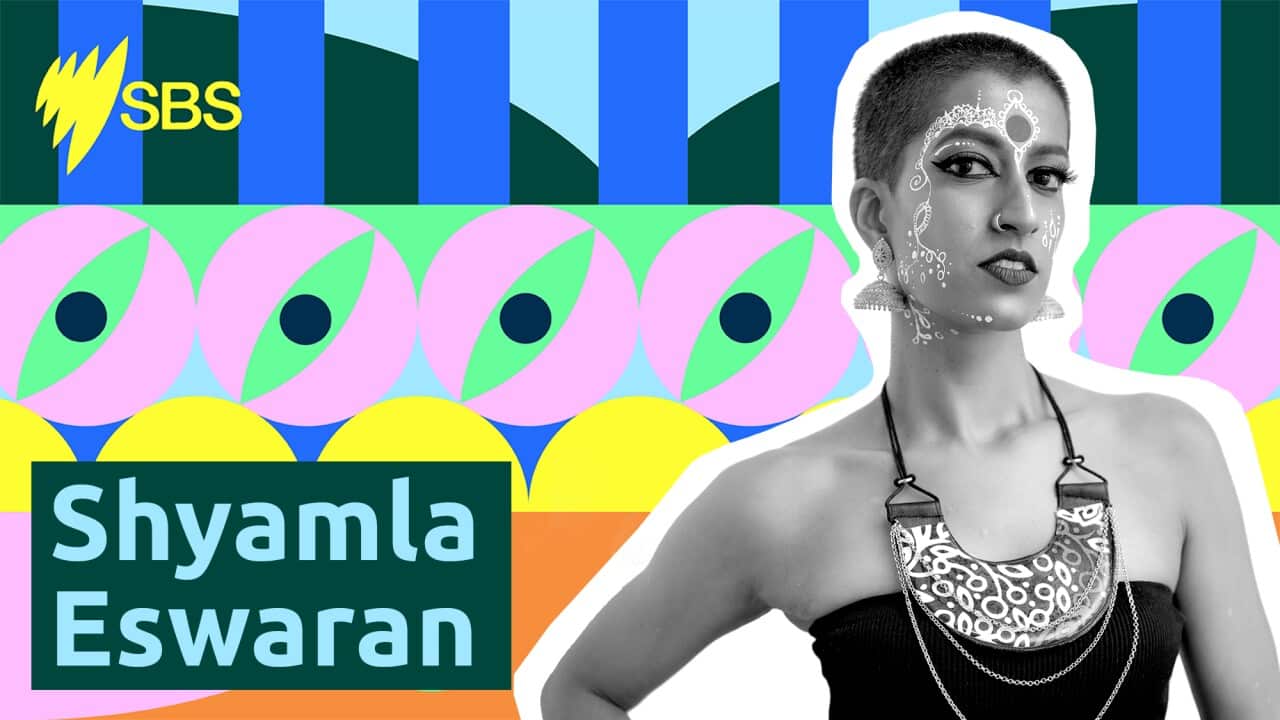

When Shyamla Eswaran sat down for a portrait with Archibald prize-winning painter Blak Douglas, he saw Shyamla in a light they weren't ready to see themselves. Yumi Stynes chats with the dancer and artist about growing up South-Asian in Sydney’s Shire, reckoning with their gender fluidity, and connecting with their culture through dance.
For Shyamla Eswaran, dance has offered a channel to explore their culture, gender expression and identity.
I really think of myself as genderfluid and queer, and that's enough for me to express. Because within that, I sense that fluidity... I feel like it can bring it back to dance. Dance has been that space for me where I've been able to be it without having to label it.Shyamla Eswaran
In this episode of Seen, Yumi Stynes chats to dancer and artist Shyamla Eswaran about spirituality and culture, finding their identity in dance, and being seen through the eyes of others.
Hosted by Yumi Stynes, Seen is a podcast series about cultural creatives rising to excellence despite arriving in a role-model vacuum. Hear from trailblazers like journalist Narelda Jacobs, writer Yassmin Abdel-Magied, Olympian Ellia Green and more about the transformative moments they felt seen.
Follow Seen in the SBS Audio app, Spotify, Apple Podcasts or wherever else you get your podcasts.
Host: Yumi Stynes
Created by: Bernadette Phương Nam Nguyễn
Executive Producer: Kate Montague
Producers: Bernadette Phương Nam Nguyễn and Cassandra Steeth
Junior Producer: Alison Zhuang
Sound design and mix: Ravi Gupta
Theme music: Yeo
Art: Evi-O Studios
SBS podcast team: Caroline Gates, Max Gosford, Joel Supple
Transcript
(Theme music building)
Shyamla Eswaran: So there was this one time we're hanging out, it’s probably over ten years ago now, I think. You know and we're all having a good time. He’s like, “I'm going to sketch you.” I was like, “Oh, I'm so hot tonight, too. This is going to be fabulous.” This is like, so I'm sitting in this leather chair at, you know, at his studio, so he was sketching away furiously with charcoal.
Yumi Stynes: You’re hearing from movement artist Shyamla Eswaran, who, about 10 years ago was lucky enough to be sketched by Archibald Prize-winning painter Blak Douglas.
Eswaran: Yeah, there was just a whole energy going around then he's like, “There you go.” Handed it to me. It was a dude as far as I looked, I was like, “This looks like a man.” And he just said, “I sketch what I see.” That's your spirit. And I was so offended, like, I didn't even want it. In the moment, it was so confronting because I was like, “I can't hide in front of this person.”
Stynes: Shyamla’s the founder and director of Bindi Bosses, a South Asian Fusion Arts company that blends traditional Indian dance with influences from South Asian Cinema and global street dance.
I’m Yumi Stynes and this is Seen, a podcast about cultural creatives who in spite of arriving in a role model vacuum, rise to excellence anyway.
We start by acknowledging the Traditional Owners of the land on which we record, whose culture includes a rich tradition of storytelling and dance, the Cammeraygal and Gadigal people, and their Elders past and present.
(Music fade out)
Stynes: Shyamla, I met you in person a couple of years ago at an event and you were in your deep femme phase.
Eswaran: I was, yeah. Did you believe me?
Stynes: Yeah, I did. I didn't think about it. (Yeah) But if you had’ve said, “look me in the eye, what do you see?” (Laughing) It might have been a different answer.
(Music)
Yumi Stynes voice over: On today’s episode of Seen, we get an insight into what exists beyond gender binaries.
Most of us understand what’s meant by ‘trans men’ and ‘trans women’ - people who - hopefully - affirm their gender identities as men and women in ways that are right for them, but those are still binaries. Something I know less about, is what it’s like to exist in fluidity.
When I first met Shyamla, they had long glossy hair, big lashes, bright red lips and their pronouns were she/her. Shyamla came out as non-binary in 2021, and self-describes as gender fluid.
Seeing them now, with their short hair, masculine clothing and bright orange eyeliner, they feel like a completely different person to who I first met. And in fact, when I ran into them a couple of months before our interview, I didn’t recognise them.
Shyamla says presenting more masc is like returning to the person they were as a kid.
(Music fade out)
Eswaran: So I was the kid who refused to wear the skirt and the tunic. I was like, I want to wear the pants and the jumper. I don't want to even do my hair. I just want to pull it through the hole in the back of my cap and then put my ponytail there because I wanted to run and I wanted to play tip and I wanted to be able to just basically just run around. Even at two, I've got photos of me where my mum has like tried to put me in little dresses and I just looked miserable. Like I've like sunken into my neck and just look like the saddest thing in the world. But then I also have photos in my culture at the age of two, the kids get their head shaved. It's like a rite of passage. You have not seen a happier child than when they lopped all my hair off and I was just bald, like all the photos of me, like bald and just wearing shorts and pants, are me happy.
Stynes: Shyamla grew up in Dharawal Country, also known as The Sutherland Shire. It’s the southernmost part of what can technically still be called ‘Sydney’ before you hit nothing but national park or ocean. It’s nicknamed ‘God’s Own Country’. And is famous for its natural beauty, sunny beaches, the Cronulla race riots and it’s complete cultural close-mindedness. As it is for a lot of queer kids of colour, the most urgent battle was not about sexuality or gender presentation - it was about race.
Eswaran: Well, I was the only South Asian kid at school. There was another person of colour who was Maori, a maori boy, but he was also the one who bullied me the most. So yeah, there wasn't a lot of solidarity.
Stynes: Do you remember when you realised that you were the person of colour? You were the only one?
Eswaran: I was forced to realise it. I mean I grew up there so I was already used to not seeing people who carried my skin tone outside of my family home. But I think the moment where, yeah I guess my bullies dubbed me cockroach because and I asked why and they said, “because your skin's brown like a cockroach.” I guess that was the moment, because then I was like, “Oh yeah, I guess no one else has brown skin. So I guess that does make me a cockroach.” Yeah I kept that for years, I think. I didn't tell my parents for like three years.
Stynes: Oh, that's horrible.
Eswaran: I know. Poor little and little Shyamla was cute, can I just say?
Stynes: I bet you were!
Eswaran: Like ringlets and I'm like, “I don't get it. I don't feel like a cockroach.”
Stynes: Right, oh gosh.
These first experiences in school were formative for Shyamla’s self-perception. The culture they practised at home felt like something to hide… To be ashamed of… Something that was less-than whiteness.
(Musical transition, sound design: waves)
Stynes: Their family’s journey to get to Australia had been roundabout and inauspicious.
Eswaran: My mom is Indo Fijian Girmitiya, which means that her grandfather was tricked onto a boat from India to go to Fiji to work as a so-called indentured labour, which is a glorified way of saying a slave. That’s how a lot of Indian people got to Fiji. Girmit is actually the Indian like Indian peoples’ pronunciation of the word agreement (Oh!) because they didn’t understand.
(Music fade out)
Eswaran: So they’re like, “Oh yeah, I signed the Girmit. I signed the Girmit” because they didn’t understand. They were told they were not going to go very far from India. Next thing they know, they're on a ship packed tightly like mackerel in a, you know, from India to Fiji.
So because of that, my mum speaks Fiji, Hindi or Fiji, but which is a mixture, a mixture of a range of Indian languages of people who are from the north and the south, who got tricked, stolen, taken, thought they knew what they were getting into all different ways, mixed with Fijian, mixed with English words, which is its own kind of dialect. That’s what she spoke.
My dad spoke Tamil. He's from Chennai. He migrated here when he was 14. The White Australia policy was in place, so he was indoctrinated to believe that the best thing to do for his children would be to only teach them English so they could fit in. So the combination of them not speaking the same Indian language, plus growing up here meant that I'm the first person in my lineage who can't speak any Indian languages.
Stynes: Losing language is a common experience for children of migrants. When we’re young we don't recognise how important language is to connect with culture - Indian, for Shyamla, or Japanese in my case. And because it’s not mainstream, we miss a lot of the learning around our cultures - like, the Easter Hat Parade is mainstream even for non-Christian kids, but there’s no Hindu, or Buddhist equivalent for example.
So if culture doesn’t come from school, then it has to come from family, and some families aren’t populated with natural teachers …or maybe the parents are just too busy just getting by that they don’t have time or education to be cultural torch-bearers.
Eswaran: We always had a shrine in the home. My dad's a carnatic singer, so, you know, that's a very ancient practice. We grew up going to the temple. But a lot of the things weren't explained to me. And I think now I'm understanding that when you grow up in a place you don't need to have things explained to you, you kind of absorb a lot through osmosis. But when that's removed, probably my dad didn't even have the answers for the questions I was asking. So we go to the temple to be like, “Why are we walking around, at this many times?” he's like, “Just be quiet and do it.” And after a number of those sort of responses, I stopped taking an interest. And because of the pressure from school, I just wanted to be as white and western as possible.
Stynes: What image of beauty did you hold in your mind when you were a teenager?
Eswaran: Light hair, a tan, light eyes. I grew up like watching Home and Away and literally growing up by the beach as well. So seeing that like tans were valued, so light skinned but tanned light skinned, plus blondish hair. Like I remember putting lemon through my hair to try and get some, like, blonde streaks. Like, no, that’s not going to happen. So the idea of beauty for me wasn’t even possible.
I remember someone seeing my grandmother wearing pottu, which is what we call it in Tamil bindi in the north, which is the marking we wear in the centre of our forehead. And them saying “your grandmother look like looks like she's been shot in the head.” So every time I've sort of don an aspect of my culture, it would be shut down. And that I guess was my experience.
So I didn't really grow up identifying with being South Asian at all. Like I'd actually see it as a badge of honour. Like, I remember feeling when I was younger, being in a cultural space where my dad was performing and feeling like ‘I speak English so well. And I'm so proud of that.’
Stynes: What you describe is such a common experience for young kids, maybe born here or at least moved here very young, that shunning of their parents culture. And part of it is, I think, to try and fit in.
Eswaran: Absolutely. Because you learn you're conditioned very early that any sign of difference or stepping outside of these lines is going to get you bullied or hurt.
(Music)
Eswaran: Like I was physically getting punched, I was physically getting pushed over in the playground. I was coming home with bloody knees and lying about it, saying that I'm just really clumsy. And that's actually why my mom put me into dance classes because she was like, This kid is just so uncoordinated. Let's put them in dance.
The references I had that were people of colour were all black on TV because hip hop was a cool thing. So yeah, Janet, Michael, they were sort of my idols and Missy Elliott, Missy Elliott! (Giggle) That was acceptable, like that was acceptable reference (Mmm) but it still wasn't me and it still wasn't my culture.
Stynes: Black artists like Janet Jackson and Missy Elliott who set the bar with their music and choreography showed Shyamla that you didn’t have to be white to be valued and respected for your talent - but you did have to be excellent.
Shyamla was naturally gifted at dance – but the metrics used to decide who was good, and who wasn’t – were rigged.
(Music fade out)
Eswaran: I was not allowed to dance with the seniors or, you know, or the people who were at my same skill level. I was always kept in the back. I was excluded within being included, if that makes sense.
So all my photos of dance and me standing in the back line and that's something I've definitely noticed. And a lot of it didn't make sense because I would dance was sort of the closest space I got to feeling like perhaps I could have a quality based on something other than my skin colour because it's a skill-based thing. But even within that I would, yeah. Be put in the back or, if I needed to be put in a place where people could see me because I actually knew what I was doing, it would still be sidelined. It was never front centre. It was never in a position of visibility.
Stynes: Did you ever sort of stick up for yourself and go, “Why am I not? Why am I not the leading dancer here?”
Eswaran: No again, because when you're conditioned and when you've been bullied, you learn that it's consistent with your already existing experience in a place. So yeah and I grew up dancing in so-called Cronulla. I was living in so-called Oyster Bay, so it was just a consistency of experience. I didn't actually know I was a good dancer until I went to high school. And the reason was then I entered a world where I had to audition for things on my own merit. And it was also interesting because whenever we'd go to comps, I'd place in the comps.
I remember very distinctly it was year seven and I'd just make up dances in my room like that was all I’d do. I do either song write or make up dances. And I remember auditioning for Talent Quest and not knowing I was a good dancer until everybody was like, you're a great dancer in that space. Because I wasn't being told that where I was learning dance (wow!) you know?
And I remember my dance teacher saying to me because she had her favourites as well. I remember beating her favourite. Are you ready for this? In clog? Like I was really good at clog. Like I'm and I'm talking like a full little Dutch outfit. The pigtails, a little dress, like, talk about overperforming femme stamping around in wooden shoes.
Stynes: Yeah, so euro as well.
Eswaran: It's very European and I nailed it like I won and I play like I came first and I beat like the darling of the dance school (right) and the comment, you know, and you can't help it. You're always when you're because I would also it took me a while to realise that I was being treated racistly by my elders as actually as well. It wasn't just my peers, it was teachers, it was in all sorts of spaces. And I remember because you're looking to them for affirmation. And she looked at me and I'm like, this is the moment, you know? You know what she said to me? She said, Well, that was a surprise, wasn't it?
Stynes: Oh, God.
Eswaran: So even when you excel, those spaces and those people are there to sort of bring you down and keep you in your place.
Stynes: Invalidate your success.
Eswaran: Yeah. And it did, because like I just wanted her to be proud of me. Now I'm just trying so hard. So in those outside spaces of the, what do you call it, the little silo that was the dance school. I was excelling. But yeah, within that space itself. Nah.
Stynes: It’s so heartbreaking to imagine this apologetic little child, so earnest and trying so hard, dancing their heart out in a space whose gatekeepers couldn’t bear to shuffle an INCH to make room for them.
(Musical transition)Stynes: Once Shyamla got out of the “insular peninsula” that is the Shire and started to train in the big city, it became clearer that cultural influence and ethnicity beyond bloody “clog” dancing - was actually valuable and cool.
Eswaran: Getting exposed to the world of cultural dance and doing West African dance and then starting to hear dancehall. Obviously always growing up with hip hop, but just being more drawn to the energy of those rhythms and the people who made them and wanting to be in those spaces. So when I started getting exposed to other dance forms outside of Eurocentric, you know, jazz, tap, ballet, my world started opening up and then that's when things started changing. But I had to go through being everyone else's culture first before I could feel comfortable returning to mine.
Stynes: Shyamla was getting paid doing the thing they loved and was good at: dance. But it became increasingly awkward and inauthentic, because as someone from a rich and nuanced multi-racial background, Shyamla felt confined to the Bollywood dance trope.
(Music fade out)
Eswaran: So I stepped into the world of Bollywood and even that for many reasons didn't feel right because in the lyrics there's a lot of privileging of fair skin. It's all Gori, Gori, this. There's a lot of privileging. There's a lot of exclusion, a lot of problematic behaviour in Bollywood films. Aside from the fact that I couldn't understand it, what I'd see on screen was a lot of white backup dancers, like even in Bollywood films, and a lot of fair skin as well. (Mmm) But it's what I could make money off.
I had to become my ethnicity to be able to be a full time dancer. So I spent a lot of time, being the Bollywood dancer, doing parties and things like that. And it's actually only now that there's that sense of ‘this still isn't me,’ fading away and understanding what I am and who I am and who my ancestors are and what their culture and practises are now, that is still allowing me to, I guess, return.
Just literally in the in the last few weeks, I've taken up Silambam. I don't know if I'm pronouncing it right, which is an ancient martial art that comes from Tamil Nadu. I want to return to Carnatic singing, but I was shunning when I was you know, a kid. I'm more interested in Kuthu and Kuchipudi which are dances that link to my south Indian heritage. So I don't think that that moment has quite come yet and I don't know that it ever will. (Mmm) For as long as I don't have language, I don't think I'll ever feel like I've returned.
Stynes: Remember when I mentioned fluidity? It can be about more than just gender. The thing I am really enjoying about this conversation with Shyamla is that while we expect our artists to arrive in acclaim fully formed, sometimes their creation is still in motion - and may well remain so, in perpetuity. As is their right.
(Music transition, fade out)
Stynes: There's something I want to discuss with you. To illuminate something for our listeners. So actors are interpreters of text, whether it be a play or a screenplay. And I think when they do it well, they understand the written word better than most of us because they really have to embody it. (Mhmm) And dancers similarly have to embody music so that they have a gift and an curse, almost, of being a conduit of their culture, of the culture of that music, which they perform. And I think that's something that really helps to understand your story. Is it, a dancer is not just somebody who's good at moving their body to music, to rhythms.
(Music transition)
Eswaran: I love- Are you sure you're not a dancer? (Laughter) Because I don't know many dancers that can explain it the way you just did. Because for me, dance is my way of worshipping music.
(Music transition)
Eswaran: And it's been hard for me to even call myself a dancer because it's actually not about the movement. It's, I feel like my body is my instrument. And when music comes on, I lend my instrument to that existing piece of music. I interpret it and I embody the music. And within that process, depending on what the music is and where it's come from and where it's being made, informs what you channel to meet it. And I think that's such an important thing to understand about dance (Mmm) and the fact that people don't need the spoken word to be able to do that. Dance for me has now become a letting go of self so that I can channel spirit.
Stynes: This fluidity that makes Shyamla such a good dancer was beginning to push and chafe at the boundaries of her rigid gender expression.
(Music fade out)
Eswaran: You google me, you will see so many pictures of me over performing my femme. I spent a lot of my dancing life overperforming my femme to try and be and fit in to what people saw me as and or thought I should be. I definitely felt a lot of dysphoria doing samba, and I never really understood what it was. I'd see all the other women around me just being so comfortable in their skin and feeling so comfortable standing. I'd be fine when I was performing because I could tap into my femme and perform it. But outside of those performances, when you actually see me in those photos standing, I look, I don't know if anyone can see it, but I'd always feel like a boy in a girl’s costume that's just kind of playing a role. It didn't really feel like who I was.
Stynes: Like a lot of us, Shyamla went through an awakening during the long months spent cooped up at home.
Eswaran: It might have been through lockdown. I was watching a lot of Pose (Mmm) and just breaking down like constantly and not understanding ‘why I'm like, why do I keep, like, completely losing my shit over these experiences of trans women? Because I'm not trans. And yeah, like, why do I care so much?’ Like, I'm not that nice a person that I'm that like, it wasn't like and my partner, he's very sweet. He's like, “You're just got a big heart, babe.” I'm like, “Nah, it's not that.” Oh, it's not that. (Nice try). It's not that. I'm like, There's something. It's really hitting. I can feel it now when I'm talking about it. It's hitting deep in my heart. There's a resonance there that I don't understand.
Stynes: Shyamla’s life in and out of lockdown was punctuated by queer events fully populated by gender diverse people completely embodying their identities.
Eswaran: That space and being in that was enough for me to just wake up one day and go. I feel like I just need to get rid of this hair because a lot of my femininity has been attached to my hair when I want to, I've got big, very curly, very feminine kind of looking hair.
I would always put it up. I did not like it because when I'd let it out, I didn't like the way I was responded to. I didn't like the way I was treated by the world. I didn't like the sort of competition vibes I get from other women. I didn't like the way men would objectify me. I didn't feel good. So even though I had this beautiful sort of mane of hair, I would either keep it very short or I would tie it back. In the process of tying it back, I like my hairline. It started receding because that's how much I was just like and I was like, ‘You know what? I just want to shave it all off.’
Stynes: It may perhaps be a conversation for a different podcast but a lot of people who go through a big life event, like having a baby for instance, are seized by the urge to shave off their hair. Hair - one of the greatest and most global signifiers of gender.
Eswaran: And I lopped it all off. And it was very confronting. I was like, “Woah, what have I done?” I literally, like, have lost. But then it was just this renewal process of like every couple of weeks I kept shaving it and I kept letting go of the history that was attached to that hair. And the interesting thing is, the more masc I'm presenting, I feel much more comfortable. I'm being treated a lot better by other women. I'm enjoying that. I'm not getting the same kind of attention from men that I didn't really want.
It's allowed me to just feel like myself. And then entering trans and non-binary and gender diverse spaces like that has allowed me to feel just so seen, so, so seen, so, so safe outside of culture, even as well.
Like I went to an event called Queers of Joy and there wasn't the amount of diversity in the room that I would personally like. And I haven't had a great time in white spaces. But with the intersection of queerness and gender diversity, it was one of the safest spaces I've ever been in and the safest I've ever felt and the most seen I felt as well. And being around people that can see past your exterior and perceive your spirit and interact with that. That's what's been, I guess, the most liberating thing about coming into myself and allowing myself to reflect on the outside. How I've always felt on the inside.
(Music)
Stynes: Ten years since Blak Douglas, who is known as ‘Adam’ to his friends, sketched the infamous and confronting portrait, Shyamla now sees that charcoal drawing with a new perspective.
(Music fade out)
Eswaran: I felt so seen. That was - my, one of my first moments, when it comes to my gender of feeling very seen because Adam recognised the dominant masc spirit with which I have always operated within and lived through despite my physical form. And, look, what he captured is something that even the, the picture of it is something that I've seen in my mind's eye when I've meditated, when I've had hallucinogenic experiences, I've seen it within myself. And that's not something I've expressed to anybody. And it looked like this warrior looked like this sort of yeah, this kind of male warrior. And I've seen that spirit. And for someone who you haven't explained that to, to just perceive it and, you know, sketch it out was a very special moment that probably only now as I'm going through my gender journey, am I really realising the significance of. (Mmm) And the irony was, yeah, so I didn't ask for it and I knew he had it. And then he only gave it to me this year.
And when I opened it it was so affirming and I opened it in front of one of the new friends I've made in my journey of coming out who's queer and South Asian. And opening in front of another person who is gender diverse and who also can see me was just the most affirming thing. He was like, “Wow, that is you.”
I spend a lot of time now in queer spaces and I feel very comfortable around Queer Femme Boys, and when I'm with them, I feel like the most masc person there and they sense me as the most masc person there. And it's so beautiful to feel that, like I remember we were around for dinner the other night and we were joking about penis size or something like that. And I don't know, it was this dumb thing where like if you touch your middle finger to your palm, that's apparently the size of your. Yeah, I don't know. I was doing it and you know, one of my friends was like, “yours would be bigger than all of ours.” (Laughing) And it was so affirming. “I'm like, yes, thank you for being able to recognise that!” I do feel like I feel like whatever reason I was put in this female body, I think I would have been a terror in a male body, like really. (Laughing)
Stynes: With all your big dick energy.
Eswaran: With my big dick energy.
Stynes: And it’s not only their friends who can see Shyamla as they truly are.
Eswaran: I was told this by my mother at the age of ten, I was having very vivid dreams of having both body parts. (Mmm) I was actually to the point where I felt like I had to ask my mother if something had been changed at birth. I'm like, Are you sure? I'm 100%, yeah. (Oh wow) And she's like, Of course you are. And she got very offended. But then she said, but when you were born, your grandmother, her mother said to her in Hindi, “The Almighty changed their mind at the last minute, this should have been a boy.”
My grandmother is amazing. She could speak Tamil and Hindi. And when I came out to my mom, she reminded me of those words. And I thank you, Nani. Like, I feel like that's given me the space where it's like my elder recognised it and I'm now saying it and therefore it must not be coming from nowhere. (Mmm) She's like, uh oh, this should have been a boy. This should have been a boy.
Stynes: I've got head to toe goosebumps. Yeah.
Eswaran: And I'm so grateful to my Nani because just from her saying that back then, that's the reference point. And also to my trans cousin Diwesh, who, you know, tragically passed away in Fiji, my mum grew up seeing like she had the reference of having a trans person within our family. She had those words from my grandmother and the combination of it has meant that. She hasn't tried to talk me out of it. (Mmm) And she's known me for my whole life. She's seen me sort of, you know, trying to overperform my femme and she knows who I am.
And she's like, “Yeah, you know, we've spent a lot of time telling you to calm down and not be so direct. And, you know, tone it down, tone it down and tone it down.” I'm like, well, “this is who I am. This is who I've always been. I know how I feel.” And it's not a binary experience. I actually am now, not even this is only in the last few, you know, the last week, because you're constantly evolving. I don't even feel comfortable with the term nonbinary because I'm still referring to myself in terms of what a norm is meant to be. (Mmm)
I really think of myself as genderfluid and queer, and that's enough for me to express. Because within that, I sense that fluidity. I'm dominant masc in the way I feel most of the time. But there are times where I feel that femme energy charging through in that I want to unite that with my external. But then there are most of the time I don't and I feel like it can bring it back to dance. Dance has been that space for me where I've been able to be it without having to label it. And I think most dancers have that understanding of gender diversity because sometimes we have to channel masculine energy, sometimes we have to channel feminine, and sometimes we just have to channel spirit, which is not gendered at all.
Stynes: In a lot of cultures, expressions of gender fluidity existed and were praised and accepted.
Eswaran: I've always experienced my masculinity very dominantly on my right side. And this is, you know, without me knowing anything, and my femininity on my left.
Being able to identify within myself how I relate to my gender, allowed me to feel safe expressing it to my auntie, who then said, she's like, “Oh, like Ardhanarishvara.” And then I started looking into it and it's Shiva on the right and it's Parvati on the left, and that's how the God is depicted.
And it's that idea that within every single being, whether you identify as having a binary experience of gender or not, there is duality (yeah) and there is an existence of masculine, feminine and divine. And you know, there's something within the creation stories of the gods and goddesses in my culture. They take different forms depending on what their task is, depending on what they need to do. (Mmm) And I feel like that, I feel like depending what it is that I need to do, I need to pull on my masc and my femme and we all have it within us. We absolutely do. But for me, that experience is quite loud. You know, I feel most myself when I'm kind of not consciously being either of them and I'm just being.
Stynes: Shyamla, how important do you think it is for people of colour to see non-binary or genderfluid people of colour represented?
Eswaran: Oh, so important because when you can't see it, you don't believe that it's valid. That's why there's so much mental health you know, mental health crises within the queer community, because if we don't see valid expressions in our self that are validated by the rest of the world, we're like, ‘well, whatever I am is all in my head (Mmm) and there's something wrong with me. And I need to figure out how to fit within these binaries that I've been prescribed and that I'm meant to be fitting within.’
(Theme music building)
Stynes: How do you define being seen?
Eswaran: Feeling safe to be and express who I am. If I feel safe to be this. And the person who receives it doesn't try to fit that into a place that makes sense to them, but just meets me where I am. Then I feel seen.
Stynes: This has been Seen. Hosted by me, Yumi Stynes, created by Bernadette Phương Nam Nguyễn with Audiocraft, in collaboration with SBS.
From Audiocraft this show was produced by Bernadette Phương Nam Nguyễn and Cassandra Steeth, our Junior Producer is Alison Zhuang. Sound design and mix is done by Ravi Gupta, and executive producer Kate Montague.
The SBS team are Caroline Gates, Joel Supple, and Max Gosford.
Our podcast artwork is created by Evi O Studios. Music is by Yeo.
(Theme music fade, music sting)
Eswaran: People have asked me, you know, to do drag and I’m like, I don’t even know what drag would look like for me. Like what drag looks like for me because of my gender experience would just look like a straight person dancing to you.
Stynes: Oh! (laughs)
(Music sting)









