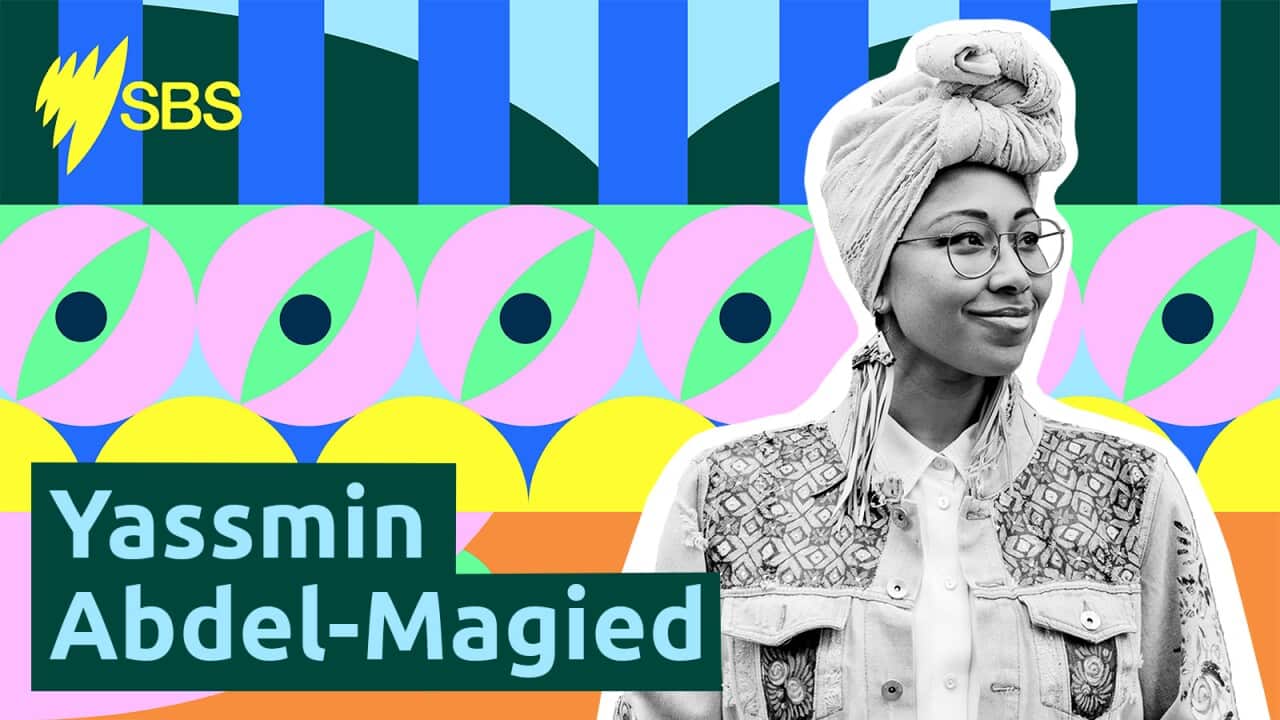

Writer, activist and broadcaster Yassmin Abdel-Magied is, for better or worse, one of the most visible women in the Australian media. The negative backlash that followed a couple of social media posts in 2017 left her questioning what she’d done wrong and where she belonged. In this episode of Seen, Yumi Stynes and Yassmin chat about the limitations of the model minority myth, what it’s like to be ‘cancelled' and what moving on looks like.
Before 2017 Yassmin Abdel-Magied was the picture perfect model minority. A successful engineer, a founder of Youth Without Borders, a media presenter with a unique perspective.
Her world changed when a violent backlash to one of her Facebook posts led her to decide to leave Australia.
That was the sense of my world shattering to be like, Oh, I genuinely believed that I was one of you. I was one of us. We were all kind of in this together. But nobody could explain to me why there were different standards for me.Yassmin Abdel-Magied
In this episode of Seen, Yumi Stynes and Yassmin Abdel-Magied have a heart to heart about how being canceled gave Yassmin the freedom to create a new life on her own terms.
Hosted by Yumi Stynes, Seen is a podcast series about cultural creatives rising to excellence despite arriving in a role-model vacuum. Over the series you'll hear from trailblazers like disability advocate Hannah Diviney, artist Atong Atem, Olympian Ellia Green and more about the transformative moment when they felt seen.
Follow Seen in the SBS Audio app, Spotify, Apple Podcasts or wherever else you get your podcasts.
Host: Yumi Stynes
Created by: Bernadette Phương Nam Nguyễn
Executive Producer: Kate Montague
Producers: Bernadette Phương Nam Nguyễn and Cassandra Steeth
Junior Producer: Alison Zhuang
Sound design and mix: Ravi Gupta
Theme music: Yeo
Art: Evi-O Studios
SBS podcast team: Caroline Gates, Max Gosford, Joel Supple
Special thanks to Georgia Moodie, Yousra Elsadig, Najiah Ahmed, Nibras Ahmed.
Transcript
(Theme music building)
Yassmin Abdel-Magied: I don't think people quite realise how much I really did feel like I belonged. Like I really believed it through and through. I really believed that I had the right to say whatever I, you know, wanted to say it to, say what other people could say.
Yumi Stynes: At 26, Yassmin Abdel-Magied was a thriving example of the model minority in Australia. She was an engineer, recognised as the Young Queenslander of the Year, she had a hosting gig on the ABC and she had a huge enthusiasm for participating in our culture.
Abdel-Magied: So the fact that like things crashed so extravagantly and in such a public way and for all to see. Ultimately that was the tragedy. That was the sense of deep betrayal. That was the sense of my world shattering to be like, ‘Oh, I genuinely believed that I was one of you. I was one of us. We were all kind of in this together.’
But nobody could explain to me, you know why there were different standards for me.
Stynes: This is a different episode of Seen. Seen is usually a podcast about trailblazers who are ignored by the mainstream but rise to prominence and success anyway.
(Music fade out)
Stynes: But today we’re talking to someone who wasn’t invisible. She was, in 2017, the most famous, and most hated woman in Australia. It was kicked off by an innocuous post she made on social media and ended up being a free-for-all for racists, misogynists and islamophobes to direct their fury and venom at one very young, single woman.
And for those of us who were there at the time, watching and seeing this woman being torn down, threatened, vilified and raged against, literally raged against by drooling, powerful, adult men… What we saw was evidence of the precarity of our own positions. We saw the lie in the myth of the Model Minority. We saw the thin veneer of civilisation fall away and the fangs of the powerful revealed.
(Theme music building)
Stynes: This episode is a story of what we have Seen… and the woman at the centre of it all - who was torn apart and has put herself back together… to be seen anew - wholly, on her own terms, scars and all.
(Music fade out)
Stynes: Just when you're ready Yassmin.
Abdel-Magied: Hi! I'm Yassmin Abdel-Magied, a writer, a broadcaster, a recovering engineer, and always a social justice advocate.
Stynes: I’m Yumi Stynes and we’ll start by acknowledging the Traditional Owners of the land on which we record, whose culture includes feats of engineering and a rich tradition of storytelling, the Cammeraygal and Gadigal people, and their Elders past and present. And language warning: there is swearing ahead.
Yassmin’s calling in from London. She’s got another book out, she’s fairly freshly married and things are looking really bright for Yassmin.
But the thing is, things always looked really bright for Yassmin. If we go back in time to her childhood, she’s from a family of quite brilliant engineers who had to leave Sudan following the military coup in the 80s.
Abdel-Magied: We were different to everybody else. But in my mind that just made us extra special.
Stynes: She’s well-liked, extremely bright, gregarious and confident.
Abdel-Magied: I was way too enthusiastic for my parents. I would genuinely go up to random people in the park like Southbank and sort of like sit at their picnic blanket and start eating their food. And my mum would have to sort of run after me and apologise and promise them that she was actually feeding me. I just liked making friends with strangers.
Stynes: And you would have been very charming with your huge smile.
Abdel-Magied: Big smile, big afro, really chubby like I really, you know, the you know, the rolls like the rolls on the thighs. That was me, 100%.
Stynes: Did you have a moment when you realised that you were different?
Abdel-Magied: I was sort of a modest dresser from a young age anyway. I didn't own any shorts or anything like that. At after school care one time, the one of the sort of teachers or volunteers or whatever said to me, like, “it's summer, like you have to wear shorts you know, aren't you hot in those trousers?” And I was like, “well, not really.” And she was like, “no, I want you to go home and buy some shorts.”
This is such a bizarre story, but I remember my mom picking me up that afternoon being like, Mom. The teacher said we have to buy some shorts. And we both kind of looked at each other. We're like, “where are we going to find shorts?” (Laughing) Like we had, we had no idea. It was just like such a bizarre thing for us to have to do. So we would like go to the shops. I think we went to like Best and Less or something (laughing) and I bought these white shorts and I wore them once because I felt so weird I was like, ‘Oh my God, my knees are in the air.’ Like, ‘What is this?’
Stynes: Ha! I love that. I love the teacher. Must have been so oblivious to ask you that.
Abdel-Magied: Oh yeah! She was like, “you're very hot. You need to wear some shorts.” Like, that's the normal thing to do. And I was like, ‘Oh, God,’ you know, it was really a mission. It was a real mission for us to go to secure the shorts.
Stynes: Clearly that childcare worker, in early 2000s Queensland, didn’t have much of an understanding of the modest dress codes that Sudanese Muslim kids tended to follow. Positive representations of muslim children were not very visible in the media at the time.
So a couple of years later when a young hijabi Australian Sudanese kid in suburban Brisbane picked up a book with a girl on the cover that looked like her? That was completely new.
Stynes: What happened when you saw the book Does My Head Look Big in This?
Abdel-Magied: Does My Head Look Big in This? Yeah yeah yeah. I distinctly remember the moment I was in the Sunnybank Hills Shopping Town Library and I had read every single book in that, you know, in the young adult section, big nerd. And they had this name and I pulled it off the shelf and it was this picture of this girl in a headscarf looking up. And it's like, you know, Does My Head Look Big in This? And I was like, ‘Oh, my God. What is a hijabi doing on a book? This is unbelievable!’ And of course, it was Randa Abdel-Fattah's book, and I think it was maybe the first book with a hijabi Muslim protagonist in, you know, written in English in, in modern times, you know, it was revolutionary.
And I like, I ate that book up straight away. I mean, it's iconic, right? You know, it was just a slice, like a slice of life story. The fact that I can remember that moment where I pulled the book off the shelf and looked at it and was like ‘what? How is this possible? This is unbelievable. (Laughing) Can we be on books?’
Stynes: The only other book Yassmin had seen featuring a hijabi main character was ‘Pavana’ - written by a white Canadian woman about a girl struggling to survive under the Taliban.
Abdel-Magied: It was a book about like an Afghan girl. We had to read that for class in like 2003. There were a few other books around, but like, they always kind of had this sort of like faintly exotic kind of cover. It was never just like a normal Muslim girl looking up at you and being like, ‘hey, I'm normal.’ Like, you know what I mean?
Stynes: Yeah. There's not. wisps of hookah smoke.
Abdel-Magied: Yeah, yeah, yeah. Yeah.
Stynes: And Sitars and, like, sort of mist. Yeah, yeah, yeah.
Abdel-Magied: Calligraphy. Like desert dust. (laughing) You know, a camel, maybe.
Stynes: I love it. Just somebody situated in a place that you could relate to that looked like you. (Yeah, yeah, yeah) Amazing.
I asked Yassmin about what it actually means to be seen.
Abdel-Magied: I think that in a way, the desire to be seen is the desire to, to feel like valued as a human. To not be seen is an incredibly invisibilising experience to not be seen. You know, people will do all sorts of things to be seen. They will go to all sorts of violent ends to be seen and recognised and have their pain or their existence acknowledged.
It’s also incredible because the act of seeing another person or another community doesn't require very much from us. But it has incredible, like weight. It's so profoundly vital, I think for human dignity. For the sense of people feeling like they belong. For the sense of people feeling like they are understood. For the sense of feeling like a whole human.
(Music)
Stynes: One of the things that young Yassmin loved with an unyielding passion - was cars. It started as a minor obsession with a heist movie that involved hotted-up go-karts and then evolved to fully running the university race car team, studying mechanical engineering and understanding on a fundamental level - what the hell goes on under the bonnet of a car.
Abdel-Magied: I also didn't have enough money to buy all the tools, so I just made friends with really, you know, with guys with big garages, right? Which is not a euphemism. It's just like genuinely guys with big garages. Where I could like go in and, you know, help them change out their gearboxes or, you know, whatever it might be.
(Music fade out)
Stynes: You know, I want to ask you about staying safe in those male dominated, male dominated spaces, like a big garage, you know, surrounded by cars and tools and blokes, because this is something that I find prohibitive for people - like, how will I be safe in that space? How will I conduct myself in a way so as not to attract sexual harassment or physical assaults? What's your answer to that? Is there something about your enthusiasm for the task at hand that kind of makes people forget that you're actually a female?
Abdel-Magied: I think number one, Yumi, it's important for people to remember that I was growing up in Brisbane in the 90s and 2000s. The window of who and what was attractive did not include headscarf wearing Sudanese women. The guys in my mechanical engineering grade put together a list of, they ranked the hotness of all the girls in class. But I didn't make the list. Like, I literally was not even on the list. They were like, “Well, you don't count.” And I was like, “I mean, obviously this is a terrible thing because this is really objectifying. But also, how could I not make the list, you know?” (Laughing)
So it's like, you know, and I remember another time one of the guys being like, “well, we're just, you know, you're really nice and everything, but we just don't know what to do with all of this, you know?” (Laughing)
And so, like in a way, my, like, my wild difference just meant that the guys… you know, I had my own category, right? I didn't even fit the category of, like, sexually desired object, which, you know, is not a category one wants to be in, but also kind of was useful but also was kind of useful for like, for navigating these environments.
(Music)
Stynes: Was there a point when you actually did feel like, oh my goodness, I am qualifying as hot and, and feeling seen as somebody sexy?
Abdel-Magied: Honestly, Yumi, only when I left Australia.
Stynes: I'm not surprised by that answer.
Abdel-Magied: I genuinely like in all my time in Australia, never felt genuine. I mean, and maybe it would be different now. I went to the U.S., I was in Texas. And it was the first time and this is going to sound really bizarre, but it was the first time I started getting catcalled on a regular basis. And I was like, ‘Oh my God, me? No!’ (Laughing) And I would go up to the guys and they were all obviously black men and they would be like, “Awww are you're Muslim. Like, you know how to treat your man,” like just stuff like that. And I'd be like, “Yeah, sure, whatever. You know, like, let's go out.” (Laughing) My standards were so low, so low.
Stynes: It's so bad. And then when they give you a compliment, you're not sure if they're taking the piss, right?
Abdel-Magied: Oh yeah, 100%. You're like, are you sure? Like what? I remember so, this is. This is. I don't even think I've ever told the story, but it is actually hilarious. I was in this shop called Bass Pro Hunt, which is like Bunnings for hunting people. Like literally, they just sell guns and camouflage like it was. It's a whole situation. (Laughing) I just wanted to see what people were like. So I walk in and this guy's like, “hot damn, walk by me again!” And so I walked by him again. I literally went and walked by him again. (Laughing)
Stynes: Sure, I'll do a twirl.
Abdel-Magied: Yeah yeah yeah!
Stynes: I can't believe you went into a store like that. Did you feel okay? Were you kind of on alert?
(Music fade out)
Abdel-Magied: I think the thing is, I often, like, have too high a sense of confidence. Like, I was just like, ‘oh, yeah, this will be fine.’ Like, and I like, just don't really I don't necessarily always see myself the way that others see me. I'm like, Oh, yeah, I belong here. Why not?
(Music transition)
Stynes: Before the interview, my producer on this podcast, told me that Yass did not want to talk about 2017 and the toxic media storm around a totally uncontroversial Facebook update she posted on ANZAC Day, suggesting Australians should also remember the suffering on Manus Island and Nauru, in Syria and Palestine.
She didn’t want to talk about it, not because it was sensitive or upsetting to her but just that everything that could have been said about it had already been said.
But I had been the subject of a media shit storm myself a couple of years earlier, and watching it happen to Yassmin had been extremely triggering to me. Like, I felt deeply heartsick for the many months that she was front-page news.
And so talking to her now… I was getting this picture of this wide-open girl, fearless with a gigantic smile and an absolutely swaggering sense of entitlement to spaces that, frankly, would scare me. And I wanted to ask - but without asking - if being brutally shut down and trolled and threatened and hounded had changed that openness.
(Music fade out)
Stynes: So you just said that, you know, you didn't you didn't sort of see yourself the way others see you or that you just sort of felt like you fitted in. Did that feeling go away, Yassmin?
Abdel-Magied: You mean at any point in particular?
Stynes: Well, yeah, I do mean at a definite point in particular in your history, which I was here for, you know.
Abdel-Magied: Don’t know what you could be talking about Yumi!
Stynes: I know, I'm tip toeing because I don't want to drag you into your trauma particularly. But I do think it's written so large in your life story that it would be weird (yeah) to pretend it's not there.
Abdel-Magied: No. I mean, I think that's ultimately the the tragedy of my experiences in 2017 were that, like I don't think people quite realise how much I really did feel like I belonged. Like I really believed it through and through. I really believed that I had the right to say whatever I, you know, wanted to say, to say what other people could say.
So the fact that like things crashed so extravagantly and in such a public way and for all to see. Ultimately that was the tragedy. That was the sense of deep betrayal. That was the sense of my world, like, shattering genuinely to be like, ‘Oh, I genuinely believed that I was one of you. I was one of us. We were, we were all kind of in this together.’
But nobody could explain to me why, you know, why there were different standards to me. And the only explanation, the only reasonable, rational explanation was that because of who I was, I wasn't allowed to kind of to, to say particular things. And so. I think and that's the thing that you can't really I can't unsee, you know, I can't unsee that. I can't unfeel that, you know, it. It was such a shattering of a sense of self and of understanding of how the world worked that, you know, putting it-putting it all back together was not something that I felt was possible.
Stynes: Have you put yourself back together?
Abdel-Magied: I think so. I mean, I feel pretty proud of where I've been able to sort of, you know, I’ve like moved country to a place where I didn't really know anyone without a job. You know, as my dad constantly reminds me, I'm no longer working in engineering. And essentially started again from scratch. And Alhamdulillah, you know, I think, I think I'm doing a pretty good job and I'm, I really like the life that I've been able to, to build since.
(Music)
Abdel-Magied: And I guess like as well somebody asked me recently like, oh, you know, “can you, what would your life have been like without that experience?” And I actually couldn't answer that question because it's such a part of who I am and how I see the world. It's shaped me and my politics and, you know, my friendships and my expectations. It's it's, you know, it's so formative, that I, like I, I couldn't imagine like I would never have left Australia.
Stynes: I'm really grateful to you for saying that. And as much as I'm loathed to talk about myself.
Abdel-Magied: Please.
Stynes: Especially on this podcast, I really did feel when I experienced a cancellation that was by no means comparable to what you went through. But I felt myself changing at a molecular level.
Abdel-Magied: Oh, yeah. Oh yeah.
Stynes: And being radicalised, which I can, is a word that is very loaded. If you say it, it's safer for me to say a word like feeling radicalised. But that thing that you just said about you couldn't unsee what you saw when you were in that fire of censure and judgement and pile on. I completely understand what you mean. It changes you.
Abdel-Magied: Oh yeah.
Stynes: Really in your soul. So you had to leave Australia, which. Which I also completely endorse as well.
(Music fade out)
Abdel-Magied: Yes! Thank you. Thank you. Because also, do you know how many times I have, like even my own father? You know what my father's wedding present to me was? A ticket back to Australia. (Laughing) I was like, for crying out loud dad.
You know, there’s this - I really quite often people are always like, “when are you coming back? When are you going coming back?” I'm like, “never,” you know, like it's just, you know. If I came back, it would it would be as if the thing didn't happen or it would be like everything is okay again, you know? (Mmm) And I think that's what people want. And I thought, I don't wanna give that to them. (Laughing)
Stynes: That's so interesting. So it would be like forgiveness or, not the prodigal son really so much as saying I accept. (Yeah) I accept what happened.
Abdel-Magied: Mhmm. Yeah, yeah yeah, I like, I'm like, if no accountability has been taken, why should I change my course of action?
Stynes: Did anybody in, you know, with those big platforms like a Ray Hadley? Did any of those people ever apologise?
Abdel-Magied: Oh no, no. Only two people who've ever apologised. One was Virginia Trioli. I was in Australia for some sort of event and I walked into the audience, and she was sitting in the seat in front of me and she stood up and said to me, like very loudly and publicly. She was like, “I'm very sorry that I never said anything at the time. I really you know, I regret that. And and I just wanted to tell you I'm sorry.” And I was like, “thank you.” I didn't really know what else to do, so I just kept walking. And the other person, interestingly enough, is Rick Morton. So he in particular, he wrote a number of really bad pieces about me.
Stynes: Did he?
Abdel-Magied: Yeah. On the front page of The Australian. Like I had a particular bone to pick with Rick because, you know, he implied that I had like implied all sorts of really scary things. He wrote a number of damaging pieces. I think he'd sort of said something on Twitter and people on Twitter were like, “have you ever actually reached out to Yassmin, you know, personally?”
And so he reached out and said, look, I, you know, “I apologise for everything that I did,” you know. And I can't remember the exact wording. But I think on both those. You know, for both those cases, I'm like, I'm not here to be the moral arbiter. I'm not here to, like, hold you. I accept the apology and, you know, and release, you know, that's all I really want is like an acknowledgement of the pain that's been caused. And to hear that from from those two journalists in particular, I think meant something.
I think beyond that, it's it's it's just. It's really, you know what it is, Yumi? I've moved on, you know, like I've built a new life. And I appreciate that like, the experience that I went through, everybody else has a relationship to that experience. Everyone has their own story about it, which has been a really interesting thing for me to come to terms with as well. I'm not sure if you found the same, but you know, everyone's got their opinion on it. Everyone has their opinion on what you should have done or what you did or didn't say and blah blah blah blah blah. But for my own peace of mind, I had to find a way to make the story make sense to me. And then keep moving.
Stynes: It's so true. I am appreciative of you agreeing to kind of spend a bit of time in that space because it's tedious and it's repetitive. And I know from experience it doesn't make you feel less stressed about it necessarily. But I did, I did think it was important that we did visit it because it's such a kind of a turning point in your life. And as you said, it deconstructed you and you had to kind of reconstruct yourself. And I want to know, I think this is what I want to celebrate with you. When did that point arrive where you realised that not only were you going to be okay, but you were going to be fucking great?
(Music)
Abdel-Magied: Mmm. I think I mean the first point probably was when I like made the decision to leave. I had come to London to visit for an event. And I was telling some people about it and and sort of talking about how awful the experience was and whatever. And somebody said something along the lines of like, “what's keeping you there? Like, why are you why are you staying there? You can leave. You don't actually have to like just take it.”
And that was the first moment where I- I was reminded of the fact that I had agency. And I made the decision essentially then and there. And I remember I slept on it. And then I called my mum the next day and I was like, “I think I'm moving to London.” And she was like, “I think that'll be a good idea.” And then I went back, put in my visa application, waited, and as soon as that came through, I was on a plane.
Stynes: I have to say, as an observer, I remember seeing you post that you got a scholarship to go to Paris.
Abdel-Magied: Oh, yeah.
Stynes: And I was like, ‘that bitch is succeeding! Oh my God,’ I got goosebumps. I'm getting goosebumps now just thinking about it. But I was like ‘Paris!’ We've got somebody that we rejected as a nation. We cast her out. And then another nation that is way more cultured. Way more populace than ours and they have said, ‘we love you, we're going to throw money at you.’ Can you see what is happening? Can you see what you threw away, you morons? That was where I felt. Oh, she's, they see her. They see her gifts and her offerings and her beauty. Anyway that’s me talking about me again, but I loved that for you.
(Music fade out)
Abdel-Magied: I mean getting the residency in Paris was incredible. It was life changing for my art and for my sense of self, I guess as an artist and as a creator and as somebody who wasn't just a former engineer now writing books, but was somebody who was actually engaging in, in artistic work I guess. I then applied for a whole bunch of residencies in the U.S. and this year I attended my first residency in the U.S. and getting recognition. Not like, the first time can sometimes be beginner's luck, but getting it a second time and in the United States, where it's very, very, very competitive.
I was like, ‘Oh, my God.’ Like, I'm genuinely, like, doing the thing. I'm genuinely off my own back. And it's not a story about, it's not a personal memoir. It's not essays about how hectic my life was. I'm writing fiction, and that's enough to get me through the door. I don't know, I feel like really it's been like 2021, 2022 has been a slow realisation that I've actually built a life, a new life, one that is very much my own one that is not in the shadow of, you know, of what happened to me in my twenties. Alhamdulillah.
Stynes: And in a way, it's a migrant story, too isn’t it.
Abdel-Magied: Oh, totally. I feel like when people ask me where I'm from, I'm like, I'm just a migrant. You know? Like, I migrated when I was a kid. I migrated in my twenties. My story is one of movement and one of being in the diaspora and one of constantly changing and reinventing. And actually, that's, that's not even just okay. It's more than okay. It's a privilege and it's an experience that I find so fascinating and invigorating.
Stynes: When you’re coming in at customs, and you have to fill in those forms and it says, What's your occupation? What do you write?
Abdel-Magied: I've actually now started writing, writer. Can you believe it for years? And even, like even after I stopped working on the rigs and, and, you know, 2016 for years I still would write engineer but now I you know I can't write ‘boss ass bitch’ (laughing) because that's not, there's no guild for that. But so writer it is.
(Music)
Stynes: Yassmin has published four books so far, including two that are written for kids aged roughly 8 to 12. The central character of these books is the feisty Layla….
Tell me about Layla, because I feel like this is a way that you're kind of bringing your own experience into and letting it be seen by people who really, really appreciate it, which is young girls. Young kids, but in particular, young black and brown girls.
Abdel-Magied: Yeah. Oh Layla. I love Layla, the character. So I've written two novels about Layla. You Must Be Layla and Listen, Layla and Layla is like she's a funnier, bolshier version of me. You know, she's like, loves inventing things…
(Music fade out)
Stynes: Funnier and bolshier? Could it exist? (Laughing)
Abdel-Magied: And, yeah, it's great. All of the things that I wish I could have done at the age of 13 and 14. Layla is doing. It's such a good vibe. And I've actually really enjoyed writing fiction. I think this is one of the things, even in this, the adult novel that I'm working on, I'm enjoying exploring the world through these characters in a way that, you know, in a way that lets my imagination run free, but also is true to a particular experience and world.
And so, you know, in the first book, Layla gets a scholarship to a fancy private school, gets into a fight with a racist bully pretty much straight away. The bully turns out to be the chairman’s son or whatever. You know, you can kind of see how it's going. But in the end, you know, Layla finds a way to get through the drama.
And then in the second book, actually, which is mostly set in Sudan, you know she gets involved in the revolution there. You know, not always in the best way either. And that's a kind of part of it.
It's been really fun. And I'm working with a production company in Australia Goalpost Pictures who made like The Sapphires and Lockie Leonard back in the day working with them to bring it to screens. So that's really exciting, for me the idea of being able to like cast a little Sudanese family is like very exciting.
Stynes: Have you had feedback from people, particularly young Sudanese Australian girls, about the Layla series?
Abdel-Magied: Oh, it's actually like, so nice. I, I get like the most adorable emails and, you know, and when I have been, when I have had the chance to take the book out and actually meet the readers and stuff. It's just, it's fantastic.
I mean, it's why I write these books. It's because kids say to me, I see myself in this character, all Layla’s family’s like my family or, you know, I love that there's, you know, that Layla loves making things.
Parents and, you know, aunts and uncles and teachers also love bringing the book to their classes because quite often, even though there are some books out there, there aren't that many books with a muslim protagonist, a Sudanese protagonist, especially for that age group, especially, yes, the books about the trauma are very, very important and valid. But that's not the only experience of Sudanese kids or of young Muslim kids. And so I wanted to, to have something that was more slice of life. It's just been amazing.
Stynes: Do you get tagged in Book Week photos?
Abdel-Magied: I do. It's adorable. It's adorable. (Laughing) It's really it's too adorable. I'm like, I can't handle all this cuteness. (Laughing) Ahh!
Stynes: It's, I'm interested Yassmin, about how your work so this production company making an adaptation of the Layla books for something that's going to happen here in Australia. The books themselves, certain things in your life keep steering your lens, the lens of your focus back to Australia.
Abdel-Magied: I really it's it's a- I'm like, this has got to be the last thing guys. Please let me go.
Stynes: Let go of me, let go of my leg.
(Music)
Stynes: You talked about how everybody has a story about their experience of what happened to you. And, and I think that that is one of the things that I just wanted to reflect back at you, which is that when, when terrible things happened to you.
Sorry, I'm having a moment now, but it was very frightening for a lot of us to see that happen to you because it was fucked and so unjust and I’m… It is sickening and we want to keep seeing you succeed because that's the message we want to internalise. You know, that's the joy we want to take from you.
And um, whether you do it in London or Paris or Sudan or America or whether you come back here, it - it's I don't think that's relevant to us. People watching from Australia, I think we're just really, really fucking thrilled for you to be doing amazing things and being loved and liked by people and you know, having a community and being celebrated and also putting all the good stuff out in the world that you always wanted to do anyway before all that shit. And now after that shit, you've just really, really a beacon and I see that. So this show is called Seen. I didn't realise how important it was to see you.
Abdel-Magied: Oh, Yumi. The fuckers won't win aye? We won't let them. I know.
Stynes: They fucking do win.
(Music fade out)
Abdel-Magied: I know. And I think this is like. I think this is one of the really hard things is that like as much as it is about my, you know, individual personal experience. It is something that everyone has a relationship to because it is something that people can see themselves in.
And you know, and as you know, having been in a similar situation, one of the worst things about it is feeling like nobody. Is helping right? Whether people tried or not is also kind of beside the point because it's this sense of feeling completely alone and completely isolated. But the thing that I always say is that we just have to make sure it doesn't happen to anyone else. You know. I went through the worst experience. I wouldn't wish it on my worst enemy. But I survived. And in fact, I have built a life that is full and thriving. Alhamdulillah.
And I'm doing it on my own terms. And it is possible. It is like. Of course, it is hard and. And when people ask me these days like, you know, I get asked like, “what is your advice for young women who want to go into the media?” And all these sorts of things like. I don't know whether to, to warn them against it or not. Because I also. I don't think that people should just walk in afraid. Like that's, that's not what I want for people.
Firstly, thank you for sharing that, Yumi. Because I think I left, and I also left- I left the the bad and the good in some ways, you know? I left the scene of the crime and my home, and it just happened that those things were the same. And I think that only very recently am I able to recognise that there is still a lot of love or there is, you know, there is a community that, that my experience resonates with and speaks to. But I didn't turn away, you know, like, it's like. Yeah, I took my time and I- I had to pull myself back together and rebuild from scratch.
But here I am on your podcast, right? Talking about it and, and, and writing my own damn story and telling it myself. (Laughing) The number of people that have wanted to write my story for me. I'm like, ‘no, you don't get that.’ I will tell my story on my own terms and. And I will tell it to you straight. You know, a lot of y’all fucked up and fine. But let's make sure it never happens again.
If my experience does anything, that is what I want it to do. Is to remind people, we just can't ever have it happen again to anyone and we must protect each other at all costs. I think and if I can help do that from halfway across the ocean, so be it.
(Theme music)
Stynes: Yassmin Abdel-Magied, thank you for joining us. And we shall continue to watch and see as you do amazing things across oceans, and maybe even here once in a while if you want. But don't feel like you got to! (Laughing)
This has been Seen. I’m your host Yumi Stynes, created by Bernadette Phương Nam Nguyễn with Audiocraft, in collaboration with SBS.
From Audiocraft this show was produced by Bernadette Phương Nam Nguyễn and Cassandra Steeth, our Junior Producer is Alison Zhuang. Sound design and mix is done by Ravi Gupta, and executive producer Kate Montague.
The SBS team are Caroline Gates, Joel Supple, and Max Gosford.
Our podcast artwork is created by Evi O Studios. Music is by Yeo.
(Theme music fade out, music sting)
Najiah: Hi my name is Najiah.
Nibras: Hi my name is Nibras.
Najiah: I love the Layla books because I think the plot is something you wouldn’t usually find making it really interesting and fun to read.
Nibras: I like Layla because she is really strong and when she has mind set to something her goal is to achieve it no matter what gets in her way.
Najiah: I relate to Layla and I think Layla is a bit like me because she’s from Sudan and I’m from Sudan as well. And that’s really cool because they’re aren’t a lot of Sudanese book characters that I can really look at and be like ‘oh wow, she’s like me!’
Nibras: And a little message to Yassmin, thank you so much for making a book that me and my sister can relate to and me and her are definitely waiting for the next book to arrive.
(Music sting)