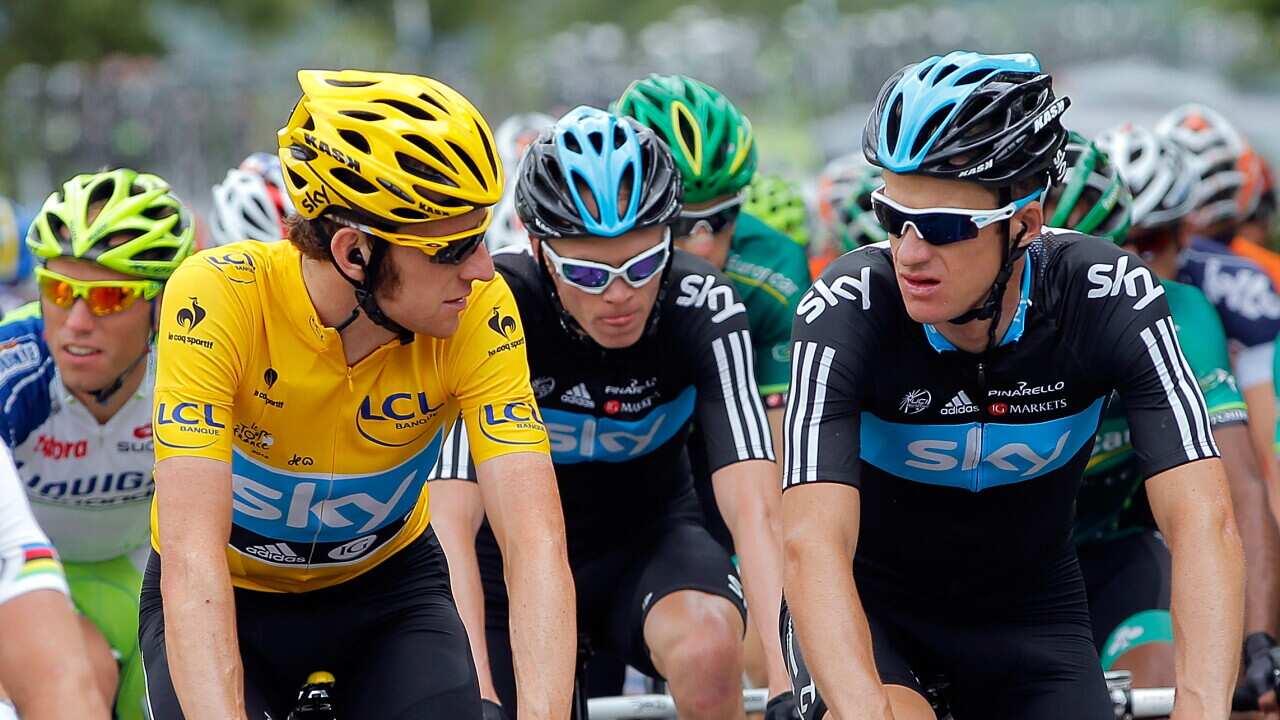
Rogers supported Wiggins to victory in the 2012 Tour de France, a period that the refuted House of Commons Digital, Culture, Media and Sport Committee (DCMS) account into Therapeutic Use Exemption (TUE) refers.
Speaking exclusively to Cycling Central, the former Tour stage winner called out and challenged a source cited in the report, who MPs drew on to suggest Wiggins and “a smaller group of riders” in preparation for the 2012 season “trained separately from rest of the team” and “were all using corticosteroids out of competition” to improve power to weight ratios.
“An anonymous source, I mean, they can’t even name who it was, nor name the riders? That speaks for itself,” Rogers said in a phone interview.
“I’m not saying it’s being taken out of proportion but it is way above the athletes. I think there is something going on at a political level. This report, without naming the source and just making a statement like that is definitely below the belt. It’s got no basis.
“The anonymous source, come out and name yourself and name the people.”
Rogers referred to what he has read in the press of the 52-page multisport report that was compiled from evidence given through a parliamentary inquiry Sky, British Cycling and UK Anti-Doping figures, including Wiggins, David Brailsford and Shane Sutton, were subject to in the wake of the Fancy Bear and ‘Jiffy bag’ scandals.
The 38-year-old, who rode for Sky from 2011-2012, echoed sentiment from Wiggins in surmising the select committee findings as a political smear campaign.
Rogers said he believed Sky didn’t, counter to DCMS allegations and written evidence from Sutton, purposefully cross an “ethical line” in regard to medical administrations, or generally in its preparation for key races.
He furthered that he didn’t take triamcinolone, or corticosteroids with or without a TUE.
“I’m not in position to comment on other people’s medical records or details,” he said, later adding, “I had multiple doping tests during the 2012 season, including leading up to the Tour de France and during the Tour de France, and not one of them tested positive for corticosteroids.”
The former triple time trial world champion said he was issued one TUE in October 2012 – some two months after his season ended that year - related to a tonsillectomy.
Rogers concluded it was ultimately up to the UCI to eliminate perceived grey areas around TUEs.
There has long been conjecture over the governance of TUEs, some arguing rules should be made stricter and others that they are even now too severe and don’t allow for reasonable measures of treatment within context.
“Sport is being pushed into the position where if you need a TUE you’re not fit to race,” Rogers said.
“The rules need to be clarified so there is no room for interpretation by anyone except the governing body. It’s the UCI and WADA’s job to make a decision about TUEs because if you have a grey rule there then that rule will be utilised.
Whether it’s for wrong or for right I have no idea. I do not know the medical details of Bradley, I do not know the medical details of the other riders in the team.
“Everyone is talking about a grey area – eliminate the grey area. Make it black, or make it white.”

Watch the FIFA World Cup 2026™, Tour de France, Tour de France Femmes, Giro d’Italia, Vuelta a España, Dakar Rally, World Athletics / ISU Championships (and more) via SBS On Demand – your free live streaming and catch-up service. Read more about Sport

Have a story or comment? Contact Us