spk_1
A lot of my work around this question is to both report critically about Israeli actions in Palestine, but also the role of the Jewish diaspora, including here in Australia.
spk_1
Anti-Semitism in its most basic form is a hatred of Jews, I would say often an irrational, obvious example of catastrophic anti-Semitism perpetrated by the Nazis, but anti-Semitism these days, I think has been weaponized very dangerously.
spk_2
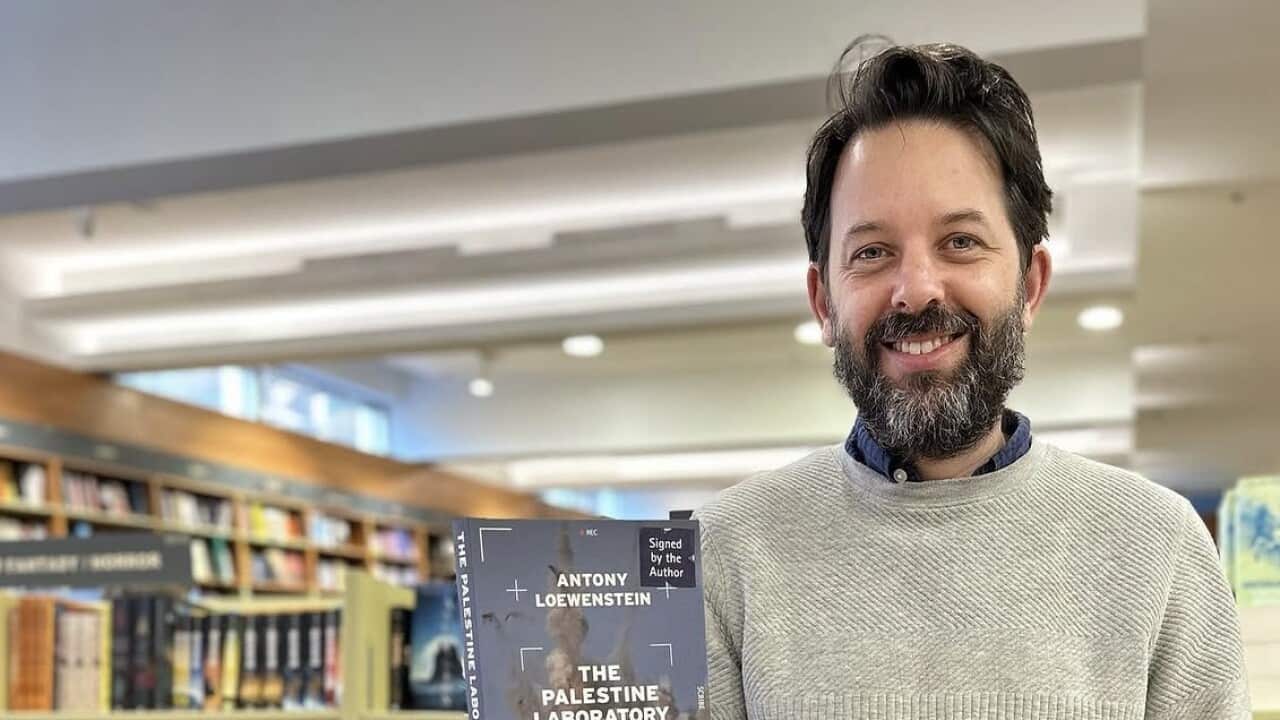
Anthony Lowenstein has built a body of work that refuses any categories, part investigation, part witness account, and even part moral challenge. As an independent journalist, filmmaker, and author of the Palestine Laboratory, now published in 17 editions and 12 languages, Anthony has spent years examining the machinery of power, surveillance, and conflict and the human cost that comes with it. In the lead up to his Sydney Writers' Festival appearance on the 24th.
spk_2
May in what we know about Gaza, this conversation is an opportunity to go beyond the headlines and into the deeper questions his work raises about truth, accountability, the role of writers in moments of crisis, and what it means to speak honestly in an increasingly contested public square. Antony, thank you so much for joining us on Arabic.
spk_1
Thank you so much for that lovely introduction. Great to be here.
spk_2
Your work often sits at the intersection of
spk_2
Journalism, literature, and even a bit of activism or a lot of activism. When you sit down to write, I'm, I'm curious, how do you decide whether a story should be told as reporting, as a book, or maybe something more essayistic, um, if I, if I should say and personal?
spk_1
I guess it depends what I'm writing about. So I've been a journalist for about 25 years. I was born in Melbourne, but I've spent a lot of that time in Sydney, although I've also been based overseas in Africa, in the Middle East, in Palestine.
spk_1
And if I'm writing about Israel, Palestine, which is not all I've written about in the last 20 years, although people often know me just for that, it's not always personal, but it's hard to avoid an element of that. And what I mean by that is that I am Jewish, although I'm not religious at all, I'm secular, and a lot of my work around this question is to both report critically about Israeli actions in Palestine, but also the role of the Jewish diaspora, including here in Australia.
spk_1
Which is, generally speaking, at least the more mainstream elements, much more pro-Israel, I would say uncritical towards Israel, and myself, along with lots of other people, Jews here in Australia, in the US and the UK, and this was happening long, long before October 7th. The book came out just before October 7th, actually. The book is not about me. I mean, I mentioned myself in there about my Jewish identity, but it's an investigation into how Israel uses the occupied.
spk_1
Palestinian territories as a testing ground for surveillance and weapons, which they then export to the world, to countless countries and say that it's been battle tested in Palestine. That thesis was unbelievably relevant before October 7th and it's become even more so since. So I guess it depends on the story, just briefly, for example, my book, my book before then was about the war on drugs. Now I have no direct connection to the drug war, particularly, but I was fascinated in how power has.
spk_1
used and abused in that issue. So it depends on the issue is the long and the short answer.
spk_2
At the same time, Antony, debates around Israel and Palestine have increasingly been accompanied by concerns about rising anti-Semitism both globally and even here in Australia. How do you approach writing and speaking about this issue in a way that's critical yet responsible? How do you draw the line between legitimate political critique of Israel and the risk of
spk_2
Feeding into anti-Semitism.
spk_1
Well, I'm very alive to it and it's something that when I was growing up in Melbourne as a Jew, I was brought up in the 70s and 80s, certainly in the mainstream Jewish community, I would say then and still now, though it's changing a little bit, it was generally seen that any real criticism of Israel was anti-Semitic, which of course is complete nonsense. I mean, you should be able to criticise Israel, Israeli government policy as a human being, whether you're a Jew, no.
spk_1
Jew, Palestinian, whatever, can it cross into anti-Semitism? Yes, anti-Semitism in its most basic form is a hatred of Jews. I would say often an irrational hatred of Jews. That could be for a range of reasons. Obviously the Holocaust is the most obvious example of catastrophic anti-Semitism perpetrated by the Nazis, but anti-Semitism these days, I think, has been weaponized very dangerously to the point where in Australia, in many Western countries, US, UK,
spk_1
Before October 7th, but certainly much more since, we are constantly told, we being the wider community by many in the mainstream media, by our politicians, not just the One Nation or Liberal Party, but certainly labour politicians as well, that there's a line that needs to be drawn, but it's not appropriate, for example, not allowed to say that Israel commits genocide in Gaza. That apparently, so we're told, makes Jews feel unsafe. And one thing I've often,
spk_1
Thought about and articulated a lot over the years is to say, I'm not denying the fact that there are many Jews who do feel unsafe, not necessarily just in a physical sense, but they feel challenged by hearing those kinds of things. The idea that a state that they often associate themselves with Israel is causing massive amounts of insecurity, and someone like myself has
spk_1
Constantly said that Israeli actions in fact is making all of us more unsafe, not just Jews, but
spk_2
everybody. When you look at the current state of freedom of expression in Australia, especially in light of the controversies such as the withdrawal of Randa Abdel Fattah from Adelaide Waters Festival, the border fallout that we all know the details of, when you see these moments, do you see them as isolated?
spk_2
Cultural flashpoints, or do you see part of a deeper shift where political pressure, public backlash, and even institutional risk are increasingly shaping who gets to speak in the arts and media space because you're in it?
spk_1
Yeah, I think Australia is currently going through what a lot of other countries are experiencing. I'm thinking particularly parts of Europe, the US, UK.
spk_1
A massive restriction in free speech, in the ability to speak freely, openly about Israel, Palestine, about anti-Semitism, about anti-Zionism, about the fact that these issues should be discussed. What worries me is that so many writers' festivals and institutions, they are deferring to what they think or what they believe so-called mainstream Jews would find acceptable, and that is, in my view, either little to no discussion of.
spk_1
The Middle East or in a very kind of mild way that essentially defers solely to the loudest Jewish voices which are principally blindly pro-Israel, uncritical towards Israel, and in fact the impact of that, and I see this day in and day out, is in fact a rise in anti-Semitism. There is a difference between threatening someone with violence. If you threaten someone with violence, that's illegal and unacceptable. I don't support that and I've never.
spk_1
that making someone uncomfortable, if you talk critically about Israel or Palestine or Trump or whatever it may be, I would like to think that's something that a democracy can not just hold, but would encourage, and yet the spaces for that are decreasing, and that worries me greatly.
spk_2
How do you cope with staying in that uncharted waters in that space for so long? How do you navigate the emotional and psychological cost?
spk_2
Staying in that circle.
spk_1
I've been a journalist for nearly a quarter of a century, which makes me feel very old, but look, in some ways, there's two ways to answer that. One, you need to grow a thick skin. I mean, that is maybe obvious to say, but if you don't grow a thick skin, you will be devastated by all the attacks. I mean, this is an example. Overnight I received, and I get this constantly, um, emails or DMs on my social media. How do I cope with it? Look, it, it's taken a toll, uh, hasn't stopped me doing the work. I do.
spk_1
I feel as I get older, and I felt this 20 years ago, but I feel it even more now, that there is a growing groundswell of, and this is not the only reason I'm doing it, but it's important, a growing groundswell of Jews, particularly younger Jews, 18 to 35, with one generation younger than me, who are not accepting the old narratives about Israel and this belief somehow that we automatically have to support Israel because we are Jews, because of the Holocaust. No, we see
spk_1
What Israel is doing, and we rise up. I mean, in the US, for example, there's been huge amounts of polling since October 7th that finds a sizable proportion of young Jews see Israel's war in Gaza as genocide, see it as committing war crimes. This is what Jews are thinking, a sizeable proportion. And for them, they are creating new Jewish organisations. These are people mostly who are not religious, who don't necessarily believe in God, but who think, as I feel, that Jewish.
spk_1
Energy, whatever that looks like is important, and that's why I've been saying along with others for the last 3 years that there needs to be a profound moral reckoning within the Jewish world about what the Jewish community has been supporting in Palestine for years.
spk_2
You haven't exclusively written on Israel and Palestine, but if you look at your body of work as a whole, there is this consistent willingness to interrogate uncomfortable truths.
spk_2
And which takes us to another question about the political mood in Australia today. It's shifting in ways we haven't quite settled on yet. Like there's a growing economic anxiety. Yes, yes, that's correct. But does it justify the shift towards the right voices like Pauline Hanson and One Nation. From your perspective, Anthony, what does that say about where the country is right now, like politically and socially, and how, how should writers and public think?
spk_2
Like you be engaging with this kind of sentiment without either dismissing it or normalising its divisive edges
spk_1
today. Look, there's no doubt that Australia has always had really for a long time a racist undercurrent those who don't like newcomers, those who don't like Aboriginal Australians, those who don't like migrants, those who don't like Muslims. That's always been in Australia in various degrees. But I can't say on the one hand I'm overly shocked by the rise.
spk_1
Of One Nation, it does worry me though. It worries me greatly because so much of what Hanson articulates and people around her is really grievance politics. There's no real solutions that are viable for what she's arguing. The liberal opposition party, Angus Taylor recently talked about huge amounts of removing Palestinians from Gaza who have come to Australia since October 7th. The idea somehow that those people are a threat to Australia, there's
spk_1
zero evidence of any of that. It worries me that it's being normalised. So to me, the role of a writer, an intellectual, a journalist, a critical thinker, is to push back on that and to say, I'm not denying for a second the dark history of Australia. I'm not denying the dark reality for many refugees. A lot of my work in the last 20 years, in fact, has been investigating Australia's immigration policy, much of which has been unbelievably brutal. People I speak to who are older, who were in Australia before the huge immigration that started in the 70s, say Australia was in
spk_1
Incredibly dull place when it was a monoculture. Like Australia has benefited hugely, in my view, from multiculturalism. I'm not saying it's perfect. I'm not saying there aren't issues with certain groups not assimilating as much. Of course, nothing, you know, it's not utopia. Ultimately, Australia and any country benefits from a diversity of cultures and peoples and ideas and thoughts, and it requires politicians and journalists and intellectuals to support that. I'm not saying blindly, be critical.
spk_1
Ask questions, but not to dog whistle
spk_2
as you prepare for the Sydney Writers' Festival. What do you hope audiences leave with after hearing you speak about Gaza and the wider questions surrounding it in a time when so much debate is reduced to slogans? What does a serious public conversation still need to be in order to have an honest, humane, and useful conversation? Look, I'm
spk_1
really glad that the Sydney Writers' Festival is making space for these conversations. Palestine's a big part of it.
spk_1
Huge amounts of public interest and concern about what's happening in Palestine. We've seen that based on close to 3 years now of massive public protests, week in, week out about Palestine and Lebanon and Iran. I think at that event I'll be speaking with Tariq Bekoni, who's a Palestinian-British man. He's an analyst, he's a writer, he's an incredibly astute. I think he and I am with Noora Haidar, who is a journalist with The Guardian here. We're going to talk honestly about what we're facing here.
spk_1
What is happening in Palestine and Gaza, and I'm sure we'll talk beyond that, the West Bank and other parts of the Middle East, none of that could, could be happening if the West, and when I say the West, I'm talking mostly about the US and Europe and the UK and Australia, supports it. I mean, the only way Israel gets away with it is because of that. I'm keen for people to hear that conversation openly and frankly, without censorship or fear of censorship. Some listeners who come to this event might be made uncomfortable. I'm not trying to make people
spk_1
Feel unsafe. There's a difference. Discomfort is not lack of safety, you know, hearing someone say Israel's committing war crimes does not make you, does not make you unsafe. It might, it might make some people uncomfortable. OK, well, that's what's going on. So the only supposed solution to that in some people's minds is to not have that conversation. Well, I refuse that idea. It's going to be a pretty heavy
spk_2
conversation. Thank you so much, Antony, for your time. It was lovely to talk to you on SBS
spk_1
Arabic. My pleasure. Thanks so much for having me.
spk_2
7th attacks in 2023 in which Hamas militants killed around 1200 Israelis and Israel's subsequent military operation in Gaza. Over 60,000 Palestinians have been killed. Since then, Australia has seen a sharp rise in both anti-Semitic and Islamophobic incidents. These trends reflect how the conflict is affecting public discourse in Australia, amplifying social tensions across communities. Fares Hassan.