Syrian President Bashar Assad and an envoy from ally Russia Sunday discussed “removing the obstacles” to forming a constitutional committee demanded by international powers to help end the seven-year war, the presidency said. The leaders of Russia, rebel backer Turkey, Germany and France last week in Istanbul called for the committee to be formed by the end of the year to discuss a post-war constitution, “paving the way for free and fair elections” in Syria.
Issuing a joint statement, they also spoke of “the need to ensure humanitarian organizations’ rapid, safe and unhindered access throughout Syria and immediate humanitarian assistance to reach all people in need.”
Assad held talks Sunday with Russian envoy Alexander Lavrentiev on “forming the committee to discuss the current constitution”, the presidency said in a statement.
The two men agreed “to continue joint Syrian-Russian work toward removing the obstacles still in the way of forming this committee,” it said.
A Turkish-Russian deal for Syria’s last major rebel bastion of Idlib has revived a push toward a diplomatic solution to the country’s conflict, with international efforts focused on setting up the 150-member committee.
Under a U.N. plan, the regime would choose 50 of the committee members, the Syrian opposition another 50 and the U.N. would nominate the final 50, composed of representatives of civil society and technical experts.
The opposition has pushed for an entirely new constitution, but the regime has said it will only discuss altering the current one.
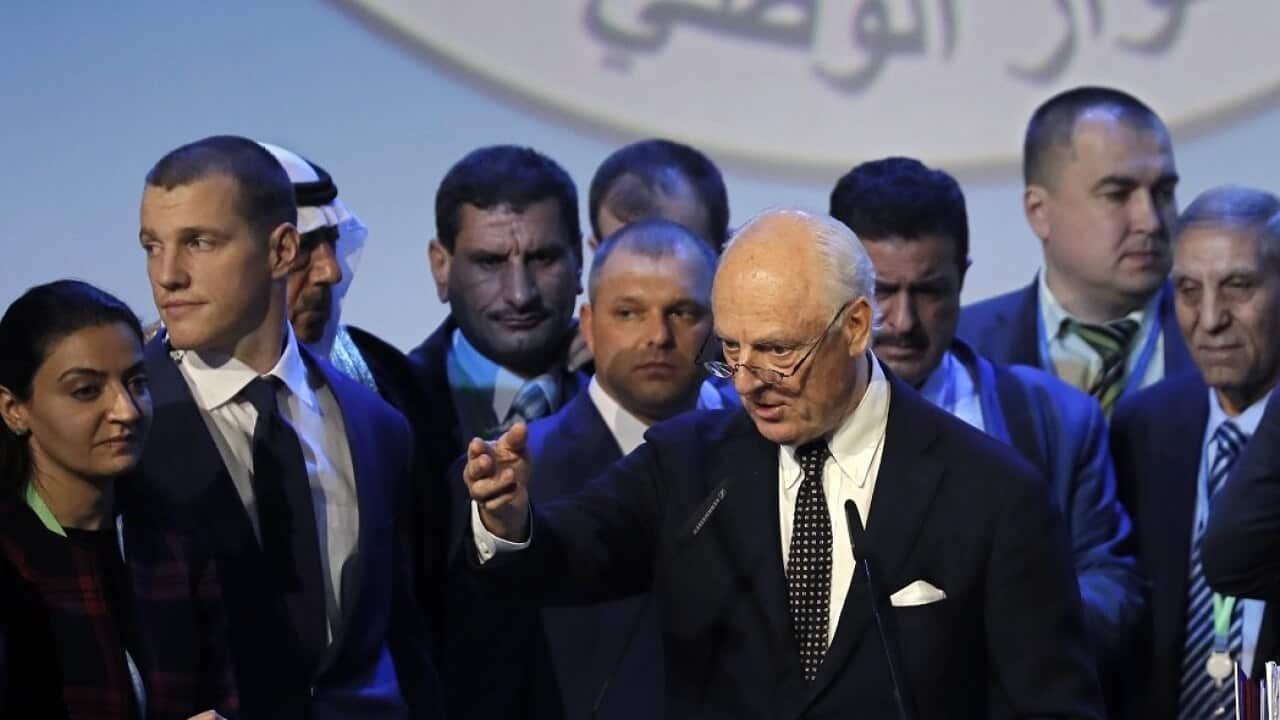
Last week, Damascus rejected a U.N. list presented by the world body’s outgoing envoy to Syria Staffan de Mistura.
Instead, the Damascus regime is to draw up its own list, along with Russia, Iran and Turkey, according to de Mistura, who is set to step down at the end of the month.
The conflict, now in its eighth year, has killed more than 400,000 people, displaced half of the country’s population and left entire neighborhoods and towns in ruins. It has also drawn in international powers, with Russia and Iran backing the Syrian government and a U.S-led coalition and Turkey also sending in troops.
Nine rounds of U.N.-led peace talks, most of them in Geneva, have failed to bring the warring sides together.



