
The world's fastest growing major religion
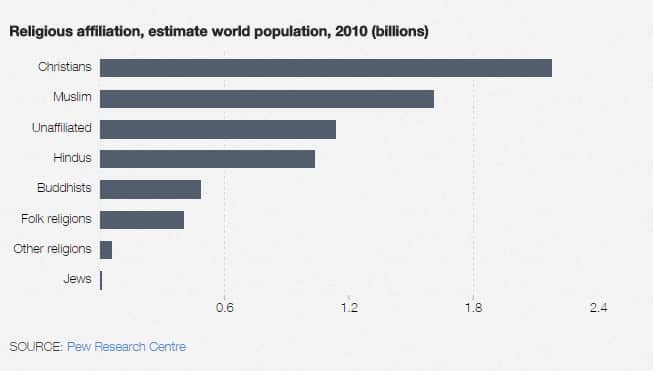
Islam is said to be the fastest growing religion with the world's population of 1.6 billion Muslims predicted to expand to 2.3 billion by 2050, according to the Pew Research Centre.
"By 2050, Muslims will be nearly as numerous as Christians, who are projected to remain the world’s largest religious group at 31.4 per cent of the global population," the report said. Muslims are predicted to make up 29.7 per cent of the global population by 2050.
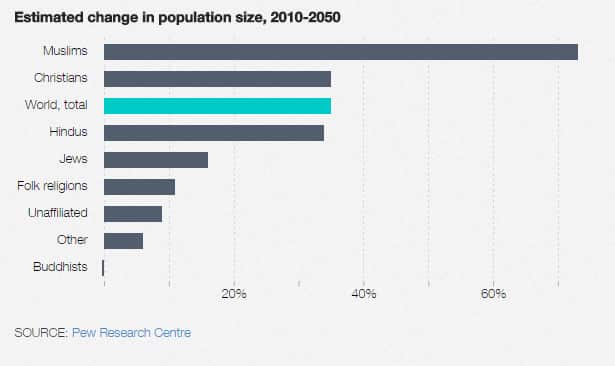
Two population growth rates help explain this. The world's Muslim population is expected to grow at a rate of 73 per cent in the 40 years between 2010 and 2050; while the world's Christian population will grow at just 35 per cent during that period, which is roughly in line with the world's total growth rate.
Professor of Demography at Australian National University Peter McDonald said the accuracy of the Pew Research report would depend heavily on what assumptions were used, of which there would be many. Predicting a population of Muslims would be problematic, he said, since there were so many groups of Muslims.
Non-religious ideologies
Between 2010 and 2050 it's predicted Christianity will lose 60 million people to agnosticism and atheism, or other "unaffiliated" ideologies. And while the absolute number of unaffiliated people will grow (particularly in western nations like US and parts of Europe), the overall proportion will drop.
The global "unaffiliated" population was estimated to be 1.13 billion in 2010 and is expected to grow to 1.23 billion by 2050. But the share of "unaffiliated" is predicted to drop from 16.4 per cent to 13.2 cent in this period, according to Pew Research.
The unaffiliated population was concentrated in places with low fertility and ageing populations, such as Europe, North America, China and Japan.
In contrast Hinduism, which is currently the world's fourth largest religious group, is projected to have flat growth at around 15 per cent between 2010 and 2050.
Growth of Australia's Muslim population
While an estimated 23.5 per cent of the world's population were Muslim in 2010, the last Australian Census revealed a different population make-up in Australia.
Just 2.2 per cent of Australians, or 476,300 people, identified as Muslim in the 2011 census. The actual number is likely to be larger as many people do not state their religion at the Census. Pew Research estimated 2.4 per
Image
Image
Proportionally, the number of Muslim migrating to Australia is quite small. Yet perceptions about Australia’s Muslim population show a different picture.
A poll by research company Ipsos Mori last year found Australians who participated, on average, thought 18 per cent of Australians were Muslim - much higher than the actual figure of 2.2 - 2.4 per cent.
This could be because of the growing visibility of Islamic symbolism, said Mehmet Ozalp, Islamic Theologian at Charles Sturt University.
Islam was experiencing two kinds of growth: a quantitative growth of Islam's increasing population in Australia and around the world and a qualitative growth of Islam itself among Muslims who did not practice previously, he said.
“In Australia, 20-30 years ago, you would hardly see a woman covering her hair. There were Muslims then as well, in large numbers, but they weren’t really practicing that much," Prof Ozalp said.
Are more people converting to Islam?
Conversion, or "switching", is a factor in the forecast growth of the world's Muslim population, the Pew Research report said.
A "modest net gain" of 3.2 million people is forecast by 2050 as a result of conversion, but it does not account for the total population gain of 1.16 billion Muslims.
Prof Ozalp said conversions were a contributor to Muslim population growth, but not in the same magnitude as growth through fertility.
Fertility rates in 2010
Fertility rate represents the number of children who would be born to a woman if she were to live to the end of her childbearing years and bear children in accordance with current age-specific fertility rates.
The $US GDP figures were divided by midyear populations in those countries.
NOTES: Some countries have been excluded, since data for one or more factors were unavailable. 2010 data was used as a common point of reference.
SOURCES: Fertility rates: World Bank, 2010 GDP per capita: World Bank, religious share of population: Pew Research. Get the



