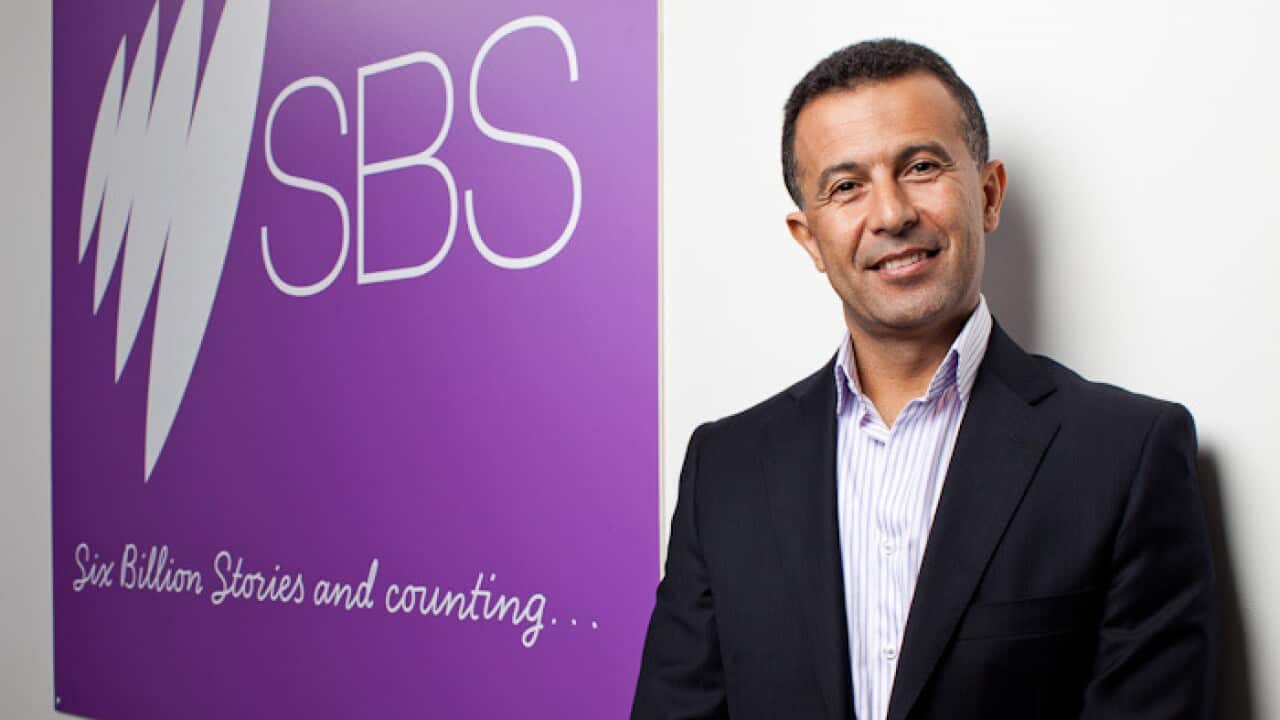

Among the seven other Australians from Arabic background, Michael Ebeid, SBS Managing Director, made it to the Queen's Birthday 2017 Honors List and has been made a Member in the General Division (AM) for his significant service to the broadcast media and multicultural affairs as an executive, innovator and business leader.
The Managing Director of SBS started says he feels honoured to receive one of the country’s highest awards, but at the same time says considers it as humbling because he couldn’t have achieved what he did by himself and without the help of his team.
Sylva Mezher and Stephanie Andary BouZeid from SBS Arabic 24 program Good Morning Australia spoke to Mr Ebeid about the importance of the award and his achievements throughout his work journey.
Listen to Michael Ebeid's full interview (in English with an Arabic introduction) with SBS Arabic 24 in the player above
Ebeid, who has been managing SBS since 2011, explains how proud he is of how much the organisation has changed in that period, which he sees as one of the most important achievements during his 30 years professional life in Australia.
"I'm really proud of how much we've changed SBS in the past six years," says Ebeid. "There's more people watching and listening to SBS now than anytime in SBS history - and that's just fantastic."
"14 million Australians now watch SBS television each month."
"It's wonderful that a young migrant boy from Egypt, who couldn't speak a word of English when I came to Australia, can contribute to Australian society and the economy. So I'm very proud."
Ebeid also reserves high praise for SBS Radio and in particular, SBS Arabic 24. "I'm really proud of what we've been able to achieve in the radio area," he says.
"The SBS Arabic program now is doing so well across all our platforms - particularly in digital."
Of course, it's not just at SBS that Mr Ebeid has made contributions to the world of Australian business and communications. He says, "Even before my time at SBS, I'm really proud of having grown Optus Communications."
"I joined the company when we were $300 million a year and I left ten years later and it was $7 billion in revenue a year - so it was fantastic growth.
"It's wonderful that a young migrant boy from Egypt, who couldn't speak a word of English when I came to Australia, can contribute to Australian society and the economy - so I'm very proud."
"I think that, given that multiculturalism is a little bit under threat at the moment, that our job at SBS is probably more important now than it ever has been in our 40 year history."
Mr Ebeid also addresses the vital contribution that SBS is making in a world that seems to be increasingly fearful of cultural diversity.
"For a long time Australia was very much built on immigration and diversity," he says. "I think Australia's strength is our multicultural nation - I really believe that."
"And right now, when you look around the world, multiculturalism is under threat - it's being challenged.
"The best way for Australia to continue being a multicultural nation is for us to understand each other better.
"That's one of the things I love about SBS - whether it be on television, on radio or online - a lot of our programming is to try and explain other cultures, other religions, other cuisines, about people from all over the world.
"If we can understand each other better I think we'll have a much better society and that's one of the things that is the objective and purpose of SBS."
"I actually think that given that multiculturalism is a little bit under threat at the moment, that our job at SBS is probably more important now than it ever has been in our 40 year history."
"One of the things I love about my life is that I'm enriched by the Egyptian culture."
"One of the things I love about my life is that I'm enriched by the Egyptian culture," says Ebeid.
"Yes, I'm Australian first, but I don't think I would be who I was without the Egyptian culture and Egyptian values that my parents instilled in me."
"Our Egyptian values - the same with a lot of middle Eastern cultures, are very much about family first, respecting your elders, respecting community."
"Those things are very important values that drive me and is probably one of the reasons why I love SBS so much."
"I don't think I would be who I am today without my Egyptian heritage and Egyptian values."
"The best way for Australia to continue being a multicultural nation is for us to understand each other better... lot of our programming is to try and explain other cultures, other religions, other cuisines, about people from all over the world."
As to how he sees the future of the broadcaster, Ebeid says, "We're wanting to grow the SBS audience so that more people can understand their neighbours, their colleagues at work and friends from all over the world.
"49 to 50 per cent of Australians were either born overseas or their parents were born overseas.
"It's a big multicultural melting pot in Australia and we always have to remember that when people like Pauline Hanson and others say 'stop immigration, we want to return to Australian values.'
"Well Australian values are very much multicultural values and so I want to make sure that we continue to help migrants - in their own language - understand Australia, Australian values, Australian culture and who we are - including Indigenous culture.
"And we do that through our 70 plus languages and I think that's really important."
On that note, Mr Ebeid also addressed the Radio Services Review that is currently underway, which will see certain changes as to which communities SBS Radio will continue to service.
"So we're doing a radio schedule review at the moment to have a look at which languages we're broadcasting in," he explains.
"The society in Australia has changed - we've got new migrants from different parts of the world - particularly from the Arab zone and African - and central Asia as well."
"The fastest growing at the moment is Arabic, Hindu and African languages."
"So we have to make sure that we continue to support those new migrants - in the same way that SBS supported those migrants coming from Central Europe in the early 1970s when we started SBS Radio - it was predominantly central European languages."
Listen to Michael Ebeid's full interview (in English with an Arabic introduction) with SBS Arabic 24 in the player above