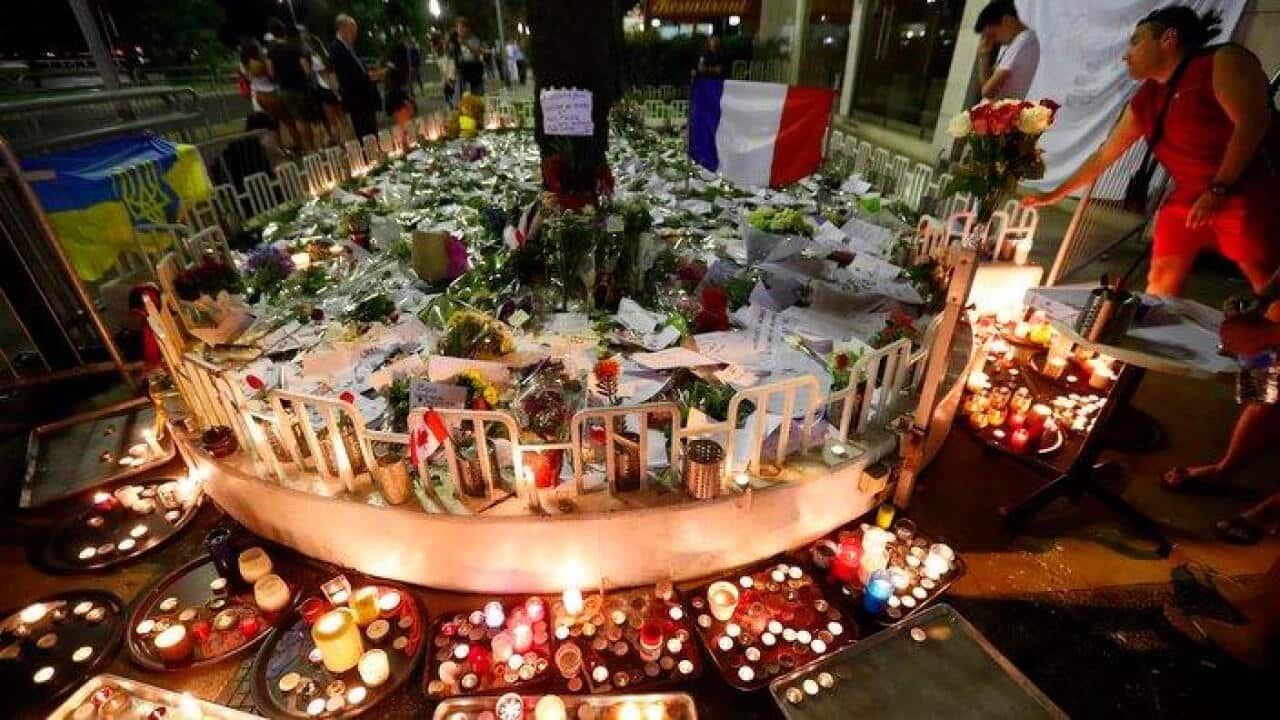
The man behind the Bastille Day truck attack that killed at least 84 people in Nice had recently been radicalised, French Prime Minister Manuel Valls says.
Thursday night's attack in the Riviera city of Nice plunged France into new grief and fear just eight months after gunmen killed 130 people in Paris. Those attacks, and one in Brussels four months ago, shocked Western Europe, already anxious over security challenges from mass immigration, open borders and pockets of Islamist radicalism.
Authorities are yet to produce evidence 31-year-old Tunisian Mohamed Lahouaiej Bouhlel, shot dead by police, had any links to Islamic State, which claimed the attack, but Valls said there was no doubt on the assailant's motives.
"The investigation will establish the facts, but we know now that the killer was radicalised very quickly," Valls said in an interview with Sunday newspaper Le Journal du Dimanche.
"The claim on Saturday morning by Islamic State and the fast radicalisation of the killer confirms the Islamist nature of this attack."
Officials said on Saturday that people questioned by police had indicated that he had undergone a rapid transformation from someone with no apparent interest in religion.
Relatives and friends interviewed in Nice painted a picture of a man who at least until recently drank alcohol, smoked marijuana and according to French media even ate pork, behaviour that would be unlikely in a devout Muslim.
Speaking from his home town in Tunisia, Bouhlel's sister told Reuters he had been having psychological problems when he left for France in 2005 and had sought medical treatment.
As authorities were trying to better understand his motives, two more people, a man and a woman close to Bouhlel, were arrested in Nice early on Sunday, bringing the number of people in detention over the killings to seven.
The Amaq news agency affiliated with the militant Islamist group said that Bouhlel "was one of the soldiers of Islamic State".
Valls, who said security services had prevented 16 attacks over three years, indicated that at play on Thursday was the group's modus operandi of cajoling unstable individuals into carrying out attacks with whatever means possible.
"Daesh gives unstable individuals an ideological kit that allows them to make sense of their acts ... this is probably what happened in Nice's case," Valls said, referring to the Arabic acronym for Islamic State.
The group, which is under military pressure from forces opposed to it, considers France its main target given its military operations in the Middle East, and also because it is easier to strike than the United States, which is leading a coalition against it.
Despite mounting criticism from the conservative opposition and far right over how President Francois Hollande's Socialist government is handling security, Valls said there was no risk zero and new attacks would occur.
"I've always said the truth regarding terrorism: there is an ongoing war, there will be more attacks. It's difficult to say, but other lives will be lost."
With presidential and parliamentary elections less than a year away, French opposition politicians are increasing pressure and seizing on what they described as security failings that made it possible for the truck to career 2km through large crowds before it was finally halted.
After Thursday's attack, a state of emergency imposed across France after the November attacks in Paris was extended by three months.
但是她说现在的首要任务是医疗护理,包括精神上的治愈,“在未来几周内,将对事情发生始末进行一个总结分析报告,但是今天我们还在一个医疗治理的阶段,对最终检查以及分析的时期,之后将是对问题的回顾”。
另据报道,巴黎市政厅发表声明说,巴黎地标艾菲尔铁塔将从15日起点亮红、白、蓝法国国旗三色灯光,哀悼尼斯卡车攻击案的死难者。声明表示,「巴黎市长伊达戈已决定,今晚和举国哀悼(3天)期间,艾菲尔铁塔将点亮红白蓝三色灯光」,并称将从每晚10时30分起点亮三色灯光。
法国总理瓦尔斯稍早前表示,从15日起降半旗,并从16日起举国哀悼3天。瓦尔斯也表示,法国政府打算延长紧急状态至10月。巴黎去年11月13日遭遇恐怖攻击后,法国宣布进入紧急状态。
法国国会下院国民议会表示,它也将点亮国旗三色灯光。



