Australia has a particularly rich linguistic culture and according to 2016 Ethnologue data, we speak a total of 260 languages.
Indigenous language accounts for a large portion of these, with about 150 individual tongues still being spoken. When European people first came to Australia, it is estimated that 250 Indigenous languages were in use, however now all but about 20 are considered either endangered, critically endangered or extinct.
Here are how other countries around the world fare:
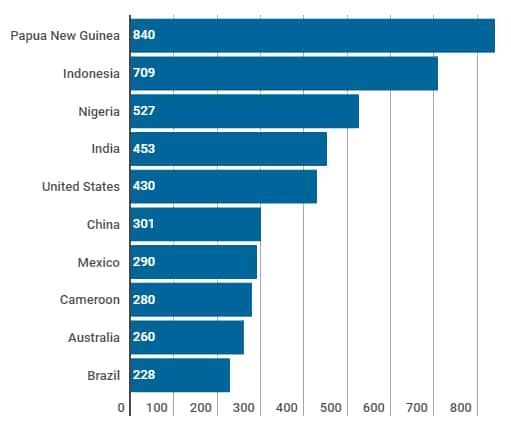
Ethnologue data shows that Papua New Guinea is the world's most linguistically diverse country ahead of India, China, Mexico and Bazil
Papua New Guinea
While the small Pacific nation of PNG has a population of just over seven million, they speak more than twice the number of languages that are used across the whole of Europe.
The country’s dense rainforests and difficult terrain has meant that many groups of people have remained in considerable isolation, preserving their unique languages.
Indonesia
The second most linguistically diverse country is another of Australia’s near neighbours, Indonesia, where 707 distinct languages are spoken. The majority of these are Indigenous, with some having an effect in shaping the nation’s official language, Bahasa Indonesian, which is a form of Malay.
Nigeria
Meanwhile in Africa, Nigeria boasts the most amount of spoken languages. Their official one is English but Igbo – a language spoken by 24 million people – Hausa, Yoruba, Fulfulde, Kanuri and Ijaw are also very common.



