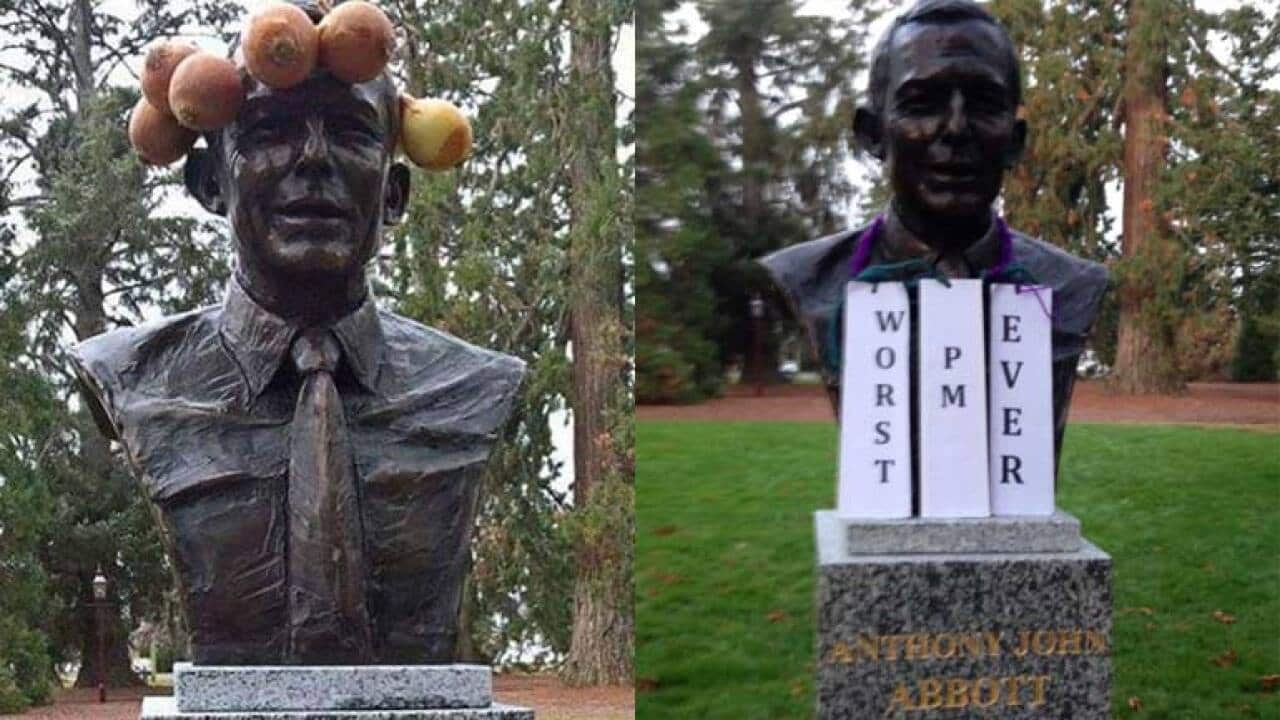

The recent unveiling of the newest addition to 'Prime Ministers Avenue' - a strip of sculptures located in Ballarat Botanical Gardens commemorating the PMs of years gone past - introduced the world to the bronze bust of Tony Abbott.
With it's controversial subject, it didn't take long for the statue to start gaining attention - particularly for the embellishments that were added by some visitors:
SBS Czech caught up with its creator Linda Klarfeld, a sculptor with a Czech background, to ask about the inspiration behind it.
Listen to the full radio interview (in Czech) with SBS Czech above.
Klarfeld has been sculpting for years in her studio in Artarmon - in Sydney's leafy North Shore - just a hop, skip and a jump from SBS's Sydney studios.
Now though she is packing up and ready to move to the Gold Coast. Even though people are her bread and butter, Linda says: “I’ve been making sculptures in Sydney for 25 years, but it’s too many people and cars here, so I’m moving to the warmer Gold Coast.”
Linda's path to sculpting was not that direct: “I could have become a psychologist, which was what I studied," she tells SBS Czech. "But I felt too sympathetic for that, therefore I gave back money for studies from my grandfather and I became a sculptor.”
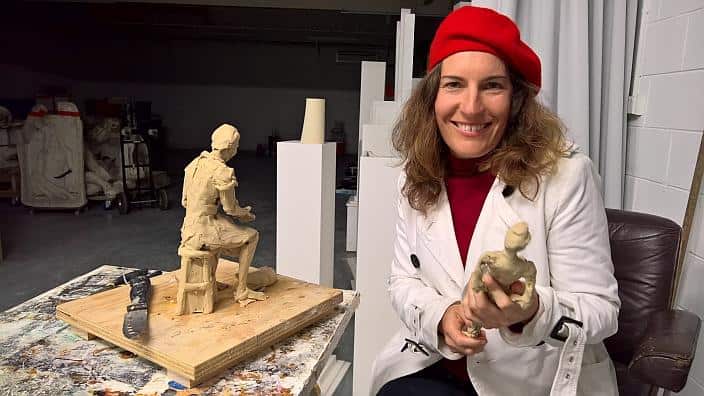
That's not to say studies in her new chosen field proved that easy for Linda either. “We did not have the kind of monumental and technical sculpting that I do here," she explains.
"After my studies here in Australia, I had to go to Czechia and I tried to persuade some great sculptors such as Prof. Kurt Gebauer to take me and teach me.
"Later we found also another sculptor, Ctibor Havelka, who lived in Australia, so I came back."
"It was not as simple, though. I found another sculptor who worked on the Statue of Liberty restoration and I had to move again to follow her: this time to New York.”
“Now, the count of my sculptures is probably higher than for many sculptors for their whole life, because I started really early,” says Klarfeld.
"In Australia, I have 30 monuments, which means large bronze or granite monuments and only here in my studio I have more than 70."
Below, SBS Czech's Filip Koubek caught up with Linda in her studio (in Czech):
A large part of this amount forms Linda’s religious sculptures. “My parents weren’t very religious, but I liked Catholic liturgy."
This is something Linda has in common with her latest subject, Tony Abbott.
"My grandfather took me to the concentration camp Terezin and I discovered Judaism," she says. "Then, in China and so, I found Buddhism thus I learn from all.”
Is it easy to describe the process of sculpting simply? No!
"Firstly, there must be an order or an idea," explains Klarfeld. "To show it, instead of drawing I make a small 3D model."
"According to that I make an iron skeleton with wooden clay holders.
"Then [I] sculpt details on a clay figure and then a rubber form needs to be made.
"Around the rubber there must be plaster shell to hold it together.
"When these are taken I parts the inner skeleton with clay is destroyed and recycled. Then, I pour wax in that.
"On the wax I make another form, this time out of ceramics with a cavity.
"In a furnace the wax melts and leaks out. Into the free space I pour liquid bronze and with a large hammer I smash the ceramic form and weld the bronze parts together."
"As I say, It’s not easy!”, says Linda, laughing.
"I believe there is 20 per cent of the body surface and 80 per cent of the soul in a sculpture.”
There is an interesting part of sculpting that takes place when Linda makes the first small model: “When I’m making the small model I learn the persons personality."
"I can switch off my own ego and it’s all about the person.
"As people say, walking in someone’s shoes.”
How long does it take to make a sculpture like Klarfelds'? It depends on your availability.
"For example, I made Prime Minister Tony Abbott’s bust," says Klarfeld. "He was cooperative, but due to his high position and busy schedule he could not come always when I needed him."
"Therefore it can take – and in this case it took – even a year and half."
"Once I made a sculpture of Australian cardiac surgeon Victor Chang. It was the most difficult sculpting, because he was dead already and I had to make it from photos and I have never met him. This one took two years.”
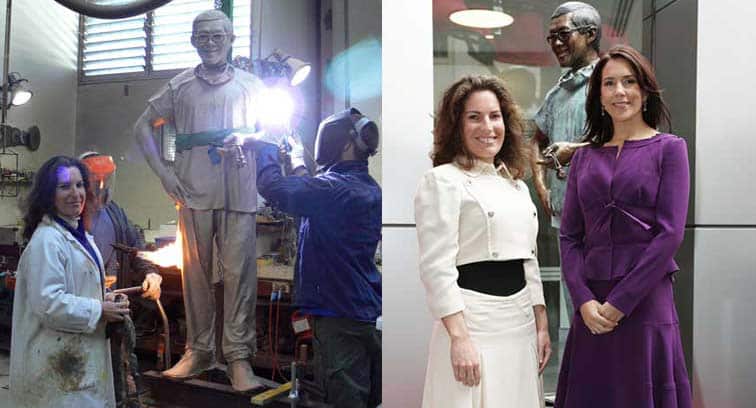
Klarfeld also explains why sculpting in not just about making a perfect copy of the body's surface. “I’ve already tried that, but such a person looks like a death mask or a mannequin."
"I believe there is 20 per cent of the body surface and 80 per cent of the soul in a sculpture.”
“One of my colleagues in Horice, the Czech Republic, told me I was a neo-romantic, because I make my sculptures idealized, a little bit nicer, sometimes smiling."
"The reason is that I always see people better.”
Maybe this could be seen as the Australian influence on her sculpting.