
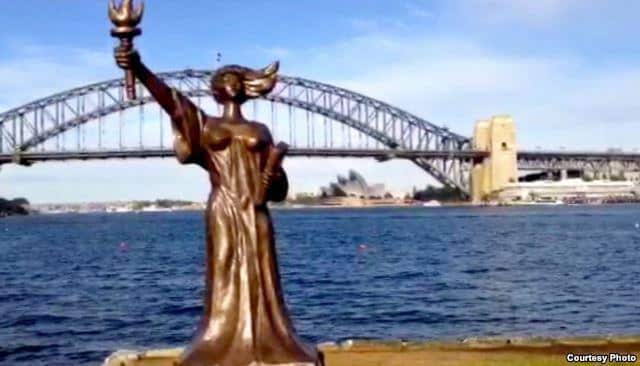
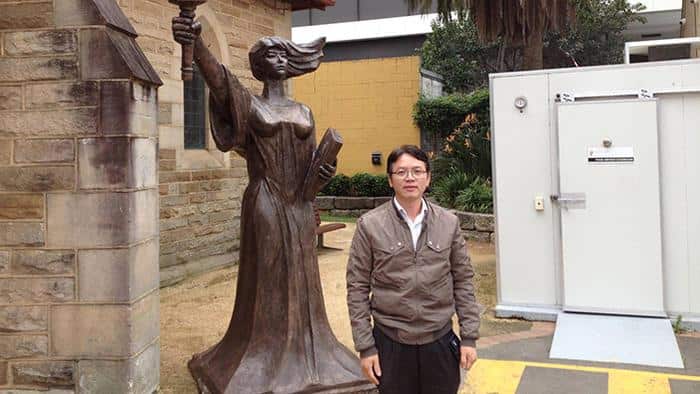
The 3.2m high bronzed fibreglass statue standing on the premises of Ashfield Uniting Church in Sydney's Inner West, was created and given to Australia by a Chinese artist and sculptor Mr Chen Weiming, who was born in Hangzhou, China and stayed in Australia briefly before emigrating to New Zealand in 1988.
The statue forms a replica of the 'Goddess of Democracy' (also known as the 'Goddess of Democracy and Freedom') that was first created by pro-democracy student demonstrators and stood tall in Tiananmen Square in 1989.
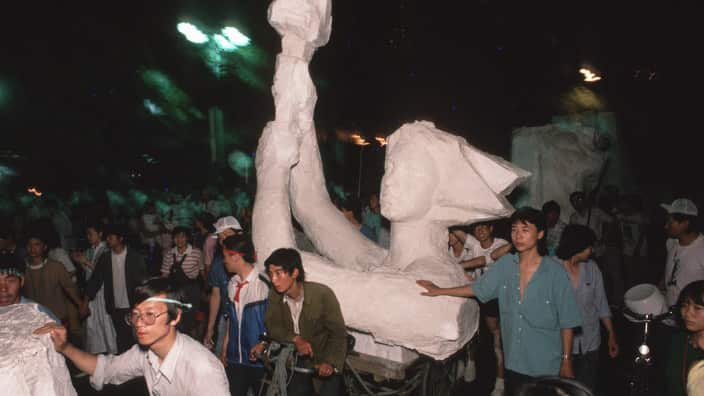
During the world-watching democratic movement, after more than a month of demonstrations, students of the Central Academy of Fine Arts made the 10-meter-tall (33 ft) polystyrene and plaster statue in homage to the United States of the Statue of Liberty, to symbolize their desire for a more democratic rule in Communist China.
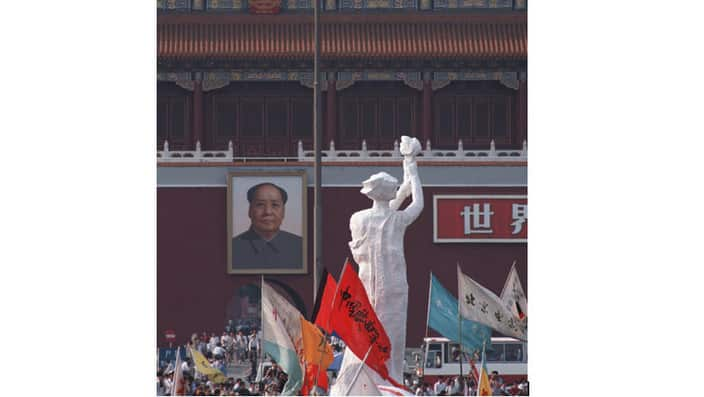
The 'Goddess of Democracy' had been inspiring protesters as a symbol of hope before being demolished a few days later when government troops brutally suppressed the democratic movement.
"The statue is an effective expression as it does not require language to understand your [message]"
As the original statue has become an icon of liberty and a symbol of the free speech and democracy movements, many replicas of the statue have been erected worldwide to commemorate the events of 1989, including the one in Ashfield that was built by artist Chen Weiming and then shipped to Australia in May 2015 - one month before the 26th anniversary of Tiananmen Square Massacre.
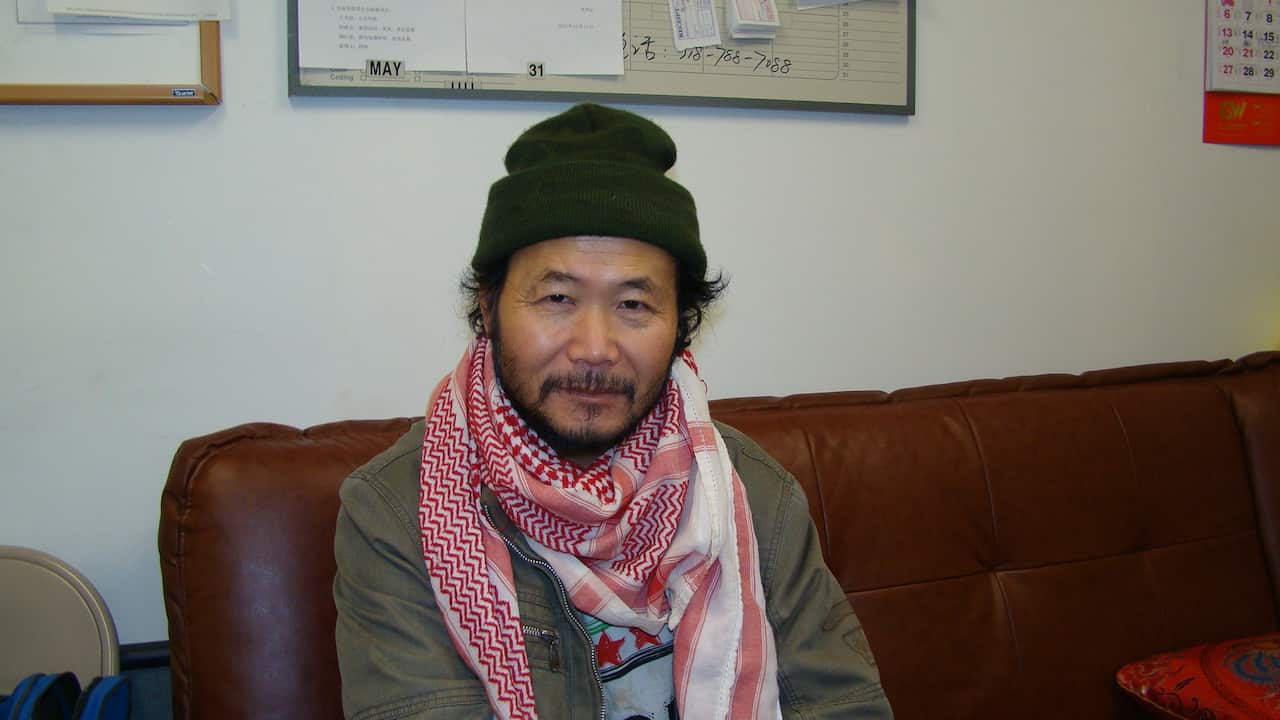
Speaking to SBS Mandarin at the unveiling event, artist Chen Weiming said that it was always his wish to re-erect the statue in Tiananmen Square, "and we have been pushing [for] it constantly."
Weiming has also created other replicas of the 'Goddess of Democracy' statues displayed in Hong Kong during protests in 2008 and 2010. The artist holds a New Zealand passport as well as permanent residence in the United States, and lives in both countries.
"As an artist, I express my concerns of democracy and freedom in an artistic way," says Weiming. "The statue is an effective expression as it does not require language to understand your [message] from a sculpture."

Chen also talked about the materials he deliberately chose for the Goddess statue to make it "last as long as one hundred years."
Explaining the intention behind this Weiming says, "Its meaning and influence may not seem huge at them moment."
"But in 50, 100 years, it will have a significant meaning that is the gift that Chinese Australians gave to a free and democratic country."
Chen expressed his gratitude to the Australian government and then-Prime Minister Bob Hawke for accepting over 40,000 Chinese students and their families following the 1989 June 4th Tiananmen massacre.
"I don't think people should forget this. His conscience, humanity and concepts of freedom allowed us to be able to stay. We shall repay and remark this common memory and present a gift to thank Australian government and to commemorate people who lost lives in the tragedy."
In China, the government still forbids any public discussions about the original statue or about the Tiananmen Square massacre and cracks down on activists who are involved in commemoration activities.
Meanwhile in Ashfield, since the statue has been erected there permanently, the Goddess of Democracy has been seen as a place to pay tribute to people whose lives have been significantly affected following the 1989 Tiananmen democratic movement, and to inspire those who come to Australia to continually pursue freedom and democracy.




