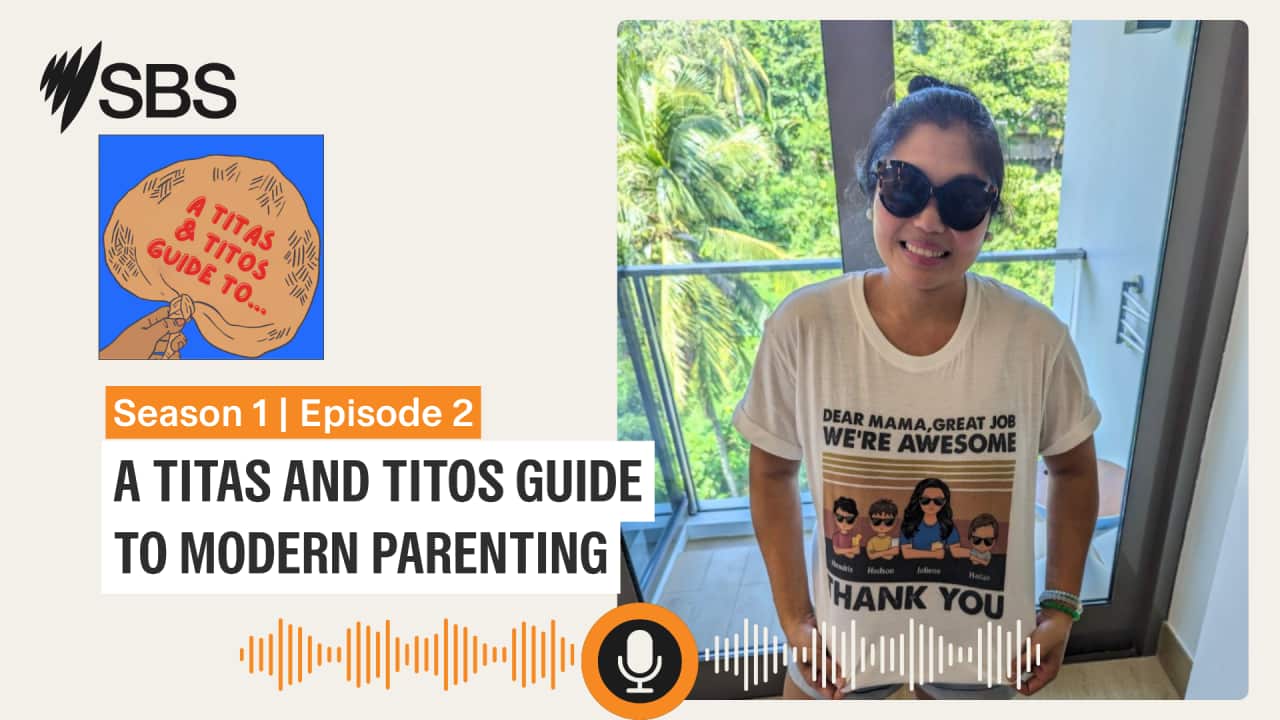


In the Pilot episode of “A Titas and Titos Guide To…”, Maridel and John Marc speak with Filipino-Australian psychologist Arthur de Jesus. He explains the role of Titos and Titas as culture bearers in Philippine society and diasporic communities and unpacks concepts such as kapwa, hiya, chismis culture, and marrying the individualistic and collectivist views of our layered identities as Filipino-Australians.
Key Points
- Arthur De Jesus is a clinical psychologist in private practice, and the founder of Akbay Psychology. Born and raised in Quezon City until age 10, he and his family first migrated to Los Angeles, USA before finally settling into Melbourne, Australia in 2006.
- He’s an advocate for normalising help-seeking and breaking the stigma around mental illness. Through Tagalog in therapy, he hopes to make it easier for the Filipino-Australian community to access mental health services.
- In this episode, we explore what it means to be a Tito or Tita.
Credits:
| Hosted by: Maridel Martinez & John Marc Desengano |
| Executive Producer: Justine Javier Long |
| Edited by: Bridget McNamara of co-content |
| Music by: Kieran Ruffles |
Disclaimer:
The information contained in this segment is general in nature and does not constitute specific medical or health advice. If you require accurate information relevant to your personal circumstances, please consult a qualified health professional.
For further information on topics discussed in this episode, please refer to the following sources:
- Cervantes, C. L. (2025). Sikodiwa: Revisiting Filipino indigenous wisdom for personal and shared well-being. North Atlantic Books.
- Cialdini, R. B., & Goldstein, N. J. (2004). Social influence: Compliance and conformity. Annual Review of Psychology, 55, 591–621.
- Enriquez, V. G. (1992). From colonial to liberation psychology: The Philippine experience. University of the Philippines Press.
- Grusec, J. E., & Davidov, M. (2010). Integrating different perspectives on socialization theory. Developmental Psychology, 46(3), 687–702.
- Pe-Pua, R., & Protacio-Marcelino, E. A. (2000). Sikolohiyang Pilipino (Filipino psychology): A legacy of Virgilio G. Enriquez. Asian Journal of Social Psychology, 3(1), 49–71.
- Sangalang, C. C., Gee, G. C., & Avila, J. L. (2020). Filipino help-seeking for mental health problems and associated stigma: A systematic review. Asian Journal of Psychiatry, 54, 102253.
📢 Where to Catch SBS Filipino
🔊 On Air – Tune in to SBS Filipino on radio stations across Australia and website live stream, and TV Channel 302 from 10 AM to 11 AM AEST daily.
📲 Catch up episodes and stories – Visit sbs.com.au/filipino or stream on Spotify, Apple Podcasts, Youtube Podcasts, and SBS Audio app.
📣 Follow Us on Social Media – Stay updated by following us on Facebook and Instagram.