


During Australia's latest lockdowns, cleaners are busier than ever, sterilising coronavirus exposure sites. This week, Small Business Secrets caught up with one cleaning company that is also offering a lifeline to workers who have lost jobs in other sectors.
Highlights
- Vaccination rates need to be accelerated for cleaners
- With more exposure sites in shops and supermarkets, there are calls for retail workers to be fast-tracked too.
- 13.6 per cent of the Australian population has been fully vaccinated
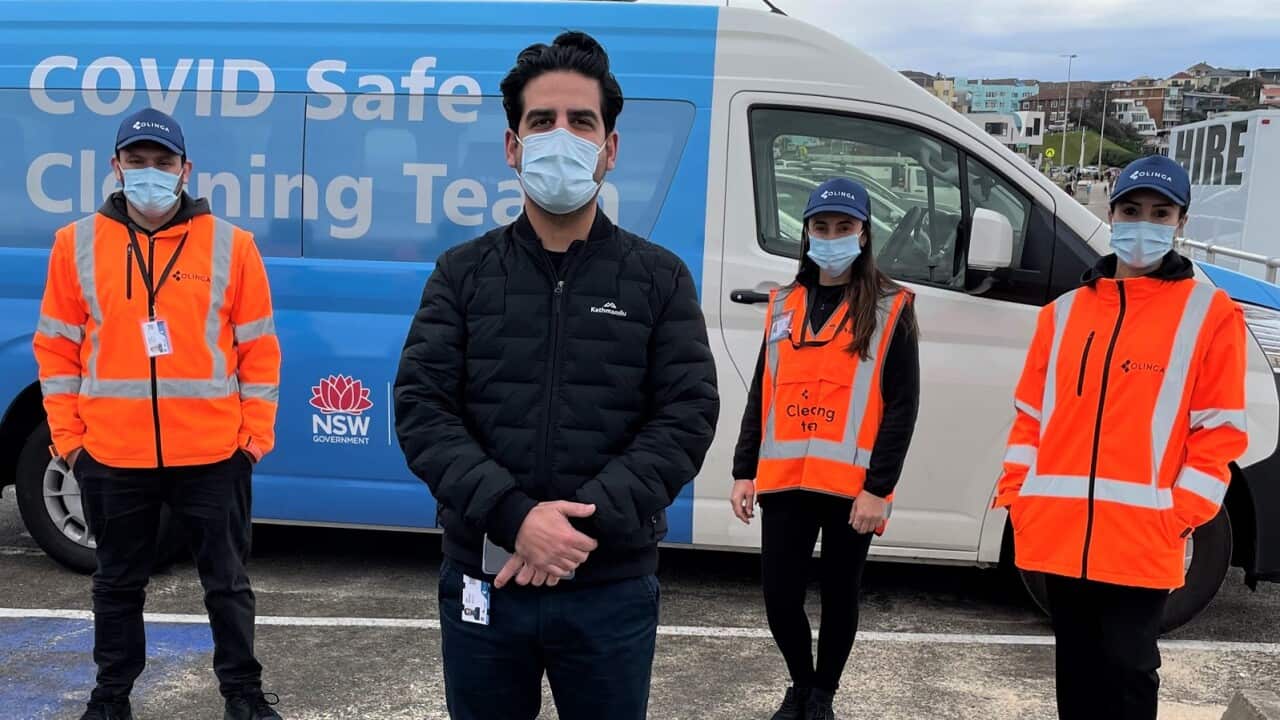
Bruna Bringel is a 27-year-old chef from Brazil who lost her restaurant job when Sydney returned to lockdown.
She is among a diverse team of 600 mostly casual workers employed as cleaners during the pandemic.
Her job includes cleaning high traffic areas like Sydney’s iconic Bondi Beach as part of her daily rounds.
"We clean all the handles. All the bus stops. We clean the trash cans, the rubbish bins, anything people might touch. And give out free masks on the street as well."
Her team works for Badi Mahaba, a refugee from Liberia in west Africa – and a follower of the Bahai faith.
He founded Olinga six years ago, as an extension of his casual labour hire business offering jobs to refugees and migrants.
He says keeping essential workers safe on their daily commute is challenging, with new exposure sites listed each day.
"The trains a major part of the strategy by our Transport for New South Wales and protecting commuters. And in the last 12 months alone, we've cleaned and sanitized more than 2.6 million carriages."
But with so many workers transitioning from other sectors, the union says risks need to be managed.
The United Workers Union says a recent survey it conducted of New South Wales school cleaners found 66 per cent reported they had insufficient time to clean areas required of them.
Sixty per cent of those surveyed said they had to work without adequate PPE.
Lyndal Ryan says every protection needs to be made available to cleaners.
"It's a virtual army that moves around (at) often early hours of the morning or late at night to make sure that the rest of us are safe. And their work is so unseen and unnoticed that people take it for granted. is so Cleaners today are turning up to work, putting their lives at risk so that we can be safe.
Cleaners need to be vaccinated. They should be first in the queue and we're pushing for all essential workers to get the vaccination now."
The NSW government says cleaners -- including contracted cleaning staff – are considered for prioritisation in group phase 1A [[of the vaccine rollout]] as part of support staff for healthcare workers.
In Australia, since February at least 10 million [[10,067,446]] doses of coronavirus vaccines have been administered -- and 13.6 per cent of the population has been fully vaccinated.
Among [[the 38]] OECD nations, the pace of the country's vaccine rollout is the second-slowest -- behind New Zealand.
Badi Mahabat says strategies around personal protection are key to ensuring safety for his employees at Olinga.
"Our staff are aware of the dangers of the role that they're doing. Essentially it comes down to you wearing the proper PPE (personal protective equipment) whether it be gowns, N-95 masks, gloves, eye protection as well."