


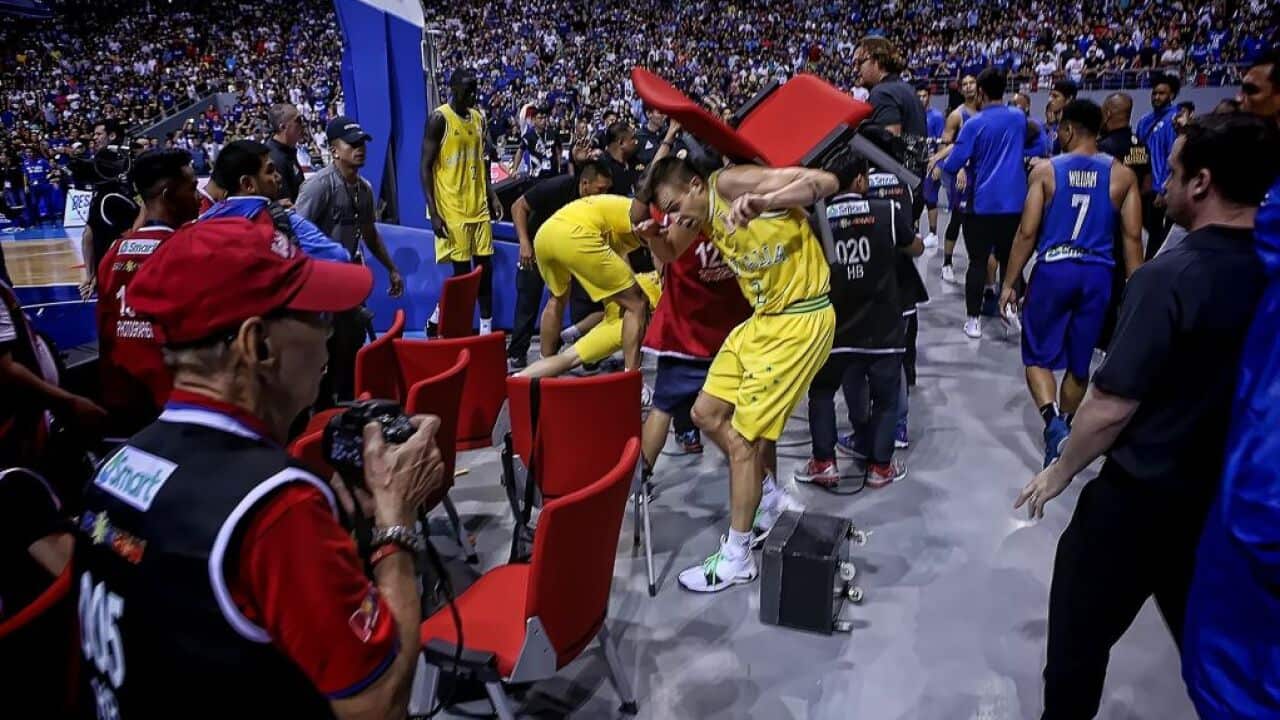

Days after the recent basketball brawl between Philippines and Australia, Boomers have returned safely to Australia.
Days after the recent basketball brawl between Philippines and Australia, the Boomers have returned safely to Australia.
“We deeply regret the incidents that occurred last night and our role in them. Whilst we accept our responsibility for our role in last night’s incidents, what do we do not accept is the action whereby fans and officials get involved in the fray.”
Basketball Australia CEO, Anthony Moore met with the media in Brisbane on Wednesday to comment on Monday’s (2nd July) incident that had happened in the Philippines during a FIBA World Cup qualifier between the host team the Philippines and Australia.
Fans took to social media to voice their support and, likewise, their disappointment over the behaviour displayed by the 13 players who were ejected from the game as a result of the brawl. These players included Boomers’ Chris Goulding, Nathan Sobey, Daniel Kickert and Thon Maker.
The incident happened exactly a year after the Welterweight Championship match between Manny Pacquaio and Jeff Horn at Suncorp Stadium in Brisbane. Many of those who were opposed to the sport of boxing expressed their disgust on social media saying boxing is violence disguised as a sport. Some basketball fans were quick to defend their teams for their show of aggressive behaviour and retaliation on Monday after videos of the brawl went viral.
In his 1963 book ‘Aggression’, Nobel Prize winner Konrad Lorenz suggested that aggression is an inherent part of a person's behaviour. More than 20 years later, author Ismat Abdal-Haqq said that in the context of Lorenz’s biological theory on aggression, sport could be considered to be an acceptable way to release built-up aggression.
At the same time Sociology Professor, Wilbert Marcellus Leonard explained that there are two forms of aggression in sports. There is instrumental aggression - a non-emotional and task-oriented aggression which is the objective in most contact sports such as boxing and various martial arts. The other is reactive aggression which has an emotional component, with a goal to harm. Both Abdall-Haqq and Leonard agreed that reactive aggression results in violence.
In 2014, Harvard's Leonard Glass wrote that whilst a display of aggression is expected in sports, these are and should be controlled within the rules of the game. According to Dr. Glass, people turn to aggressive sports to “escape the struggles and banality of everyday life.” However, he stressed the importance of balancing a person’s inherent appetite for aggressive action with one’s humanity and understanding of the vulnerability of athletes from opposing teams. In the end, the recognition of humanity brings forth respect and will help remind people that these sports, however intense they may get, are just simply games and not real life.