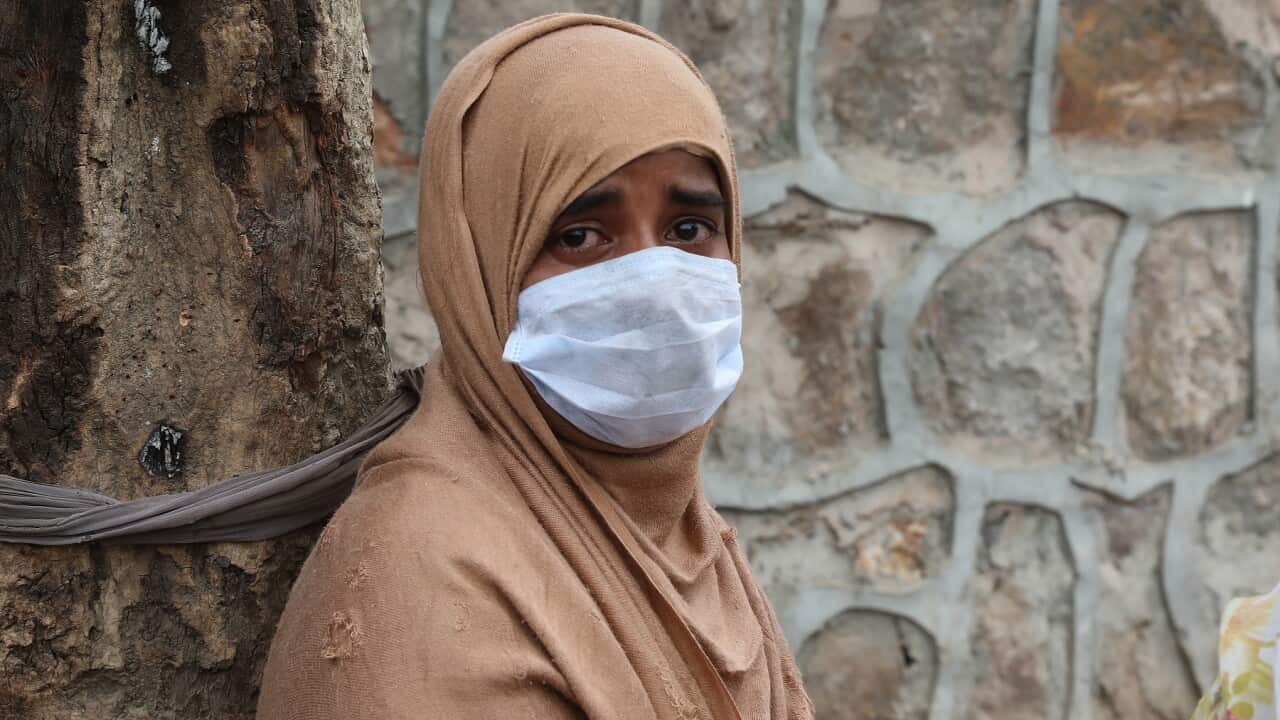

The number of people in the world forcibly displaced has reached its highest level on record, and doubled in the past decade. That’s the finding by the United Nation's peak refugee body, in its annual report.
Highlights
- 48 million are internally displaced within their own country, while the remainder ((34.4m)) are displaced abroad - the majority as refugees.
- According to the UNHCR, closed borders have reduced the number of forcibly displaced people seeking refuge overseas by an estimated 1.5 million.
- For those already in refugee camps, the pandemic took a toll on people’s finances and mental health - while gender and sexual-based violence increased.
The UNHCR found that, as of the end of last year, 82.4 million people were forcibly displaced worldwide - a near-three million increase from 2019.
Naomi Steer, CEO of Australia for UNHCR, describes the growing numbers as worrying.
"Sadly we're seeing record numbers of global displacement. We've seen over the last decade the number of forcibly displaced people double. And if this trajectory continues, it's going to be a question of not 'if' but 'when' we reach the 100 million mark"
Over the past decade, civil war has raged on in Syria, resulting in 13.5 million displacements, making it the worst affected country in the world.
Venezuela’s long-running refugee crisis accounts for four million of those displaced today.
Among other crises highlighted by the UNHCR’s Global Trends Report; the persecution of Myanmar's Rohingya Muslim minority, where one million people remain in overcrowded camps in neighbouring Bangladesh.
While in Africa, ethnic conflict is still widespread.
Violence in Ethiopia displaced one million people in 2020 alone, while half a million fled abduction and massacre in Mozambique.
Ms Steer says those displacements are merely a small sample - of a growing global problem.
“Conflict is the greatest factor forcing people from their homes. But now we're seeing much more complex situations where climate change, urbanisation, poverty, food security, are all coming together to really be I guess you might say a megastorm where we're seeing these very large numbers of people leaving"
And, according to World Vision Australia CEO Daniel Wordsworth, the COVID pandemic has exacerbated and complicated the situation.
"You already had communities that were under pressure, you then have COVID, you then put on top of that the isolation and the restriction of economic activity, you have food insecurity and food shortages, and you're going to see an increased number of people moving which will add and compound and increase conflict."
Monday Vikie is a World Vision child protection worker at the Bidibidi camp in Uganda.
She says school closures are just one example of how already precarious existences have become even harder
And it's children who remain of major concern when it comes to dealing with the world's displaced.
Not only are they more vulnerable, but they also make up a disproportionate amount of those forced to flee.
They constitute 30 per cent of the world's population - but 42 per cent of those who are displaced.
Since 2018, the UNHCR found that one million babies were born into refugee life.
The children, and those entrusted to protect them, are holding on to glimmers of hope.
Like the fact that three and a half million displaced people were safely able to return home last year.
Although far fewer - less than 35 thousand - were resettled in new countries, the lowest number in two decades