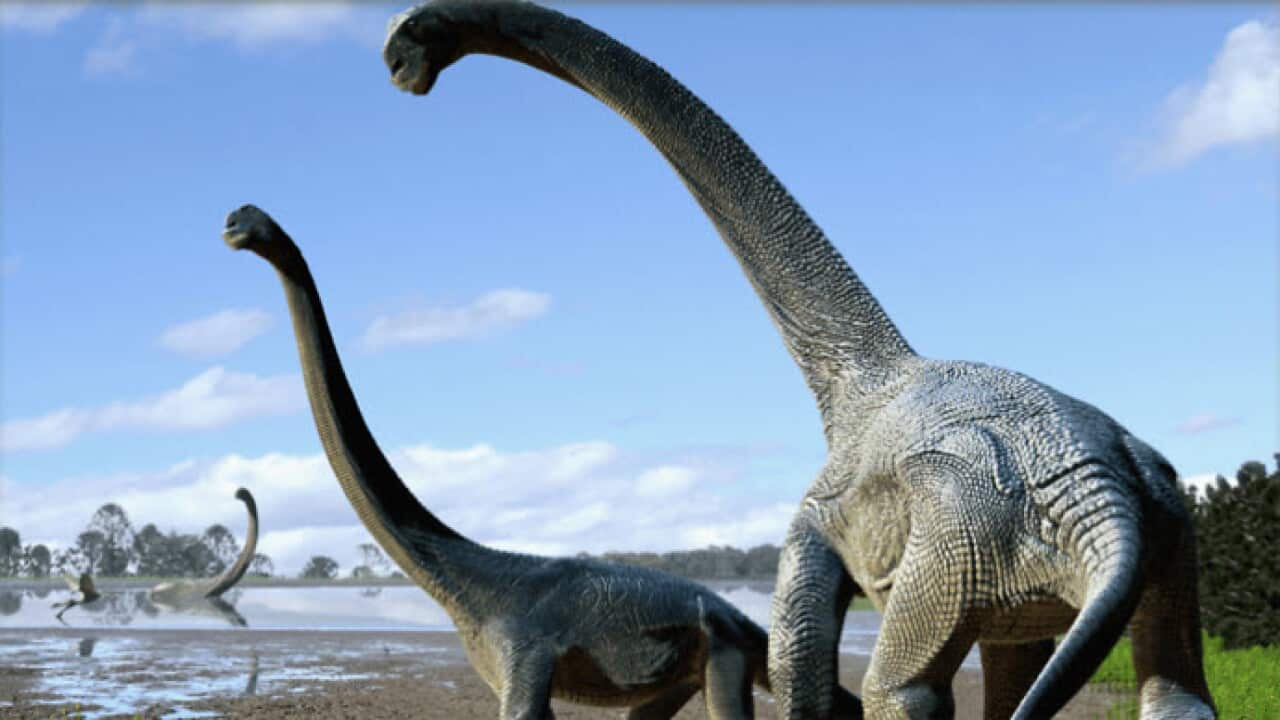
An international team of researchers, including Australian palaeontologists from Queensland, have identified a new species of Australian dinosaur.
Savannasaurus elliottorum is a sauropod – these were large, herbivorous dinosaurs with long necks and tails.
“It’s a huge deal because [it] is only the twentieth Mesozoic dinosaur ever to be named in the whole of Australia,” first author Dr Stephen Poropat from the Australian Age of Dinosaurs Museum of Natural History tells SBS Science.
“Savannasaurus is represented by one of the most complete sauropod skeletons ever found in Australia, in fact there are probably only two specimens that exceed it in completeness in terms of sauropods.”
Although only around 20 to 25 per cent of the total skeleton was recovered, they were able to compare it to other sauropods and successfully identify enough structural differences in the pelvic, ankle and vertebrae bones to be able to classify it as a new species.
The new species falls into a group of dinosaurs called titanosaurs, which include some of the largest creatures to have ever lived. They were the dominant sauropods at the end of the Cretaceous period before their mass extinction. Savannasaurus is quite small for its kindred, measuring about 7 metres in length.
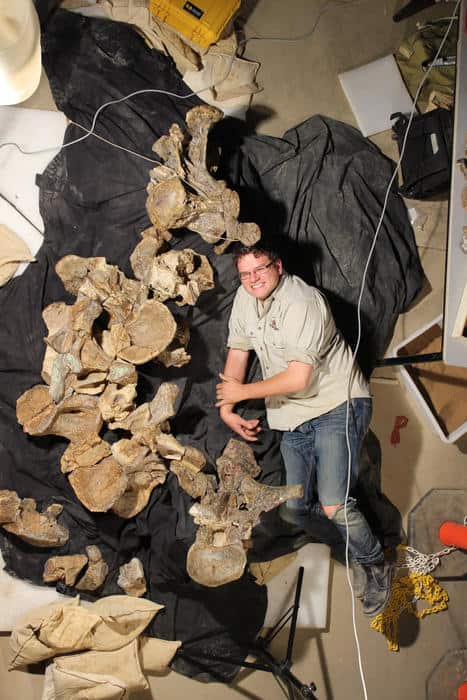
The researchers also unearthed the first fossilised dinosaur head bones to ever be found in Australia, belonging to another sauropod species known as Diamantinasaurus matildae. The findings were published today in Scientific Reports.
Both specimens were discovered in the Winton Formation in central western Queensland, and the Savannasaurus was named after the Elliott family who first found fossils in 1999 while mustering sheep on their property - a chance discovery that lead to the establishment of a whole museum and research facility.
Poropat explains that before the rocks of the Winton Formation were laid down, much of that area of Queensland was covered by an interior seaway. About 100 million years ago it receded to the north, giving way to a flood plain that allowed many species of dinosaurs to thrive.
Hence, it remains one of the richest areas for dinosaur fossils in Australia and Savannasaurus is the fourth new dinosaur species to have been discovered there.
The researchers suggest that the Savannasaurus may have originated from South America, where sauropods were particularly dominant between 120 and 110 million years ago. They think it crossed over to Australia via Antarctica during a warming period that removed climactic barriers between the continents.
“Cold temperatures may well have prevented sauropods from existing in Antarctica between 120 and 105 million years ago,” says Poropat.
“However, about 105mya the Earth warmed significantly… and that meant that Antarctica became much warmer than it had been for the previous 15 million years and this might have enticed sauropods to come through Antarctica.”
Dr Thomas Rich, a palaeontologist and senior curator from Museum Victoria, says that both specimens shed light on the ecological diversity of that prehistoric era.
“It’s the first skull of a sauropod dinosaur from this continent and it’s one of the few dinosaur skulls known from Australia of any kind of dinosaur, so it’s a very important discovery,” Rich tells SBS Science.
“This is just adding to the diversity of the dinosaur assemblage that we know from central Queensland – collecting the bones and describing the bones is only part of it, we’re trying to reconstruct the environment in which they lived.”
However, he suggested that the dinosaurs could just as easily have travelled in the reverse order – from Australia to South America – and that travelling through Antarctica may have involved island-hopping.
“The thing you have to remember about Antarctica is that east Antarctica is a solid land mass [...] west Antarctica was an archipelago,” says Rich.
“It wasn’t a wide-open route – yes, the continents were close together, but it wasn’t a continuous landmass from South America to Australia.”



