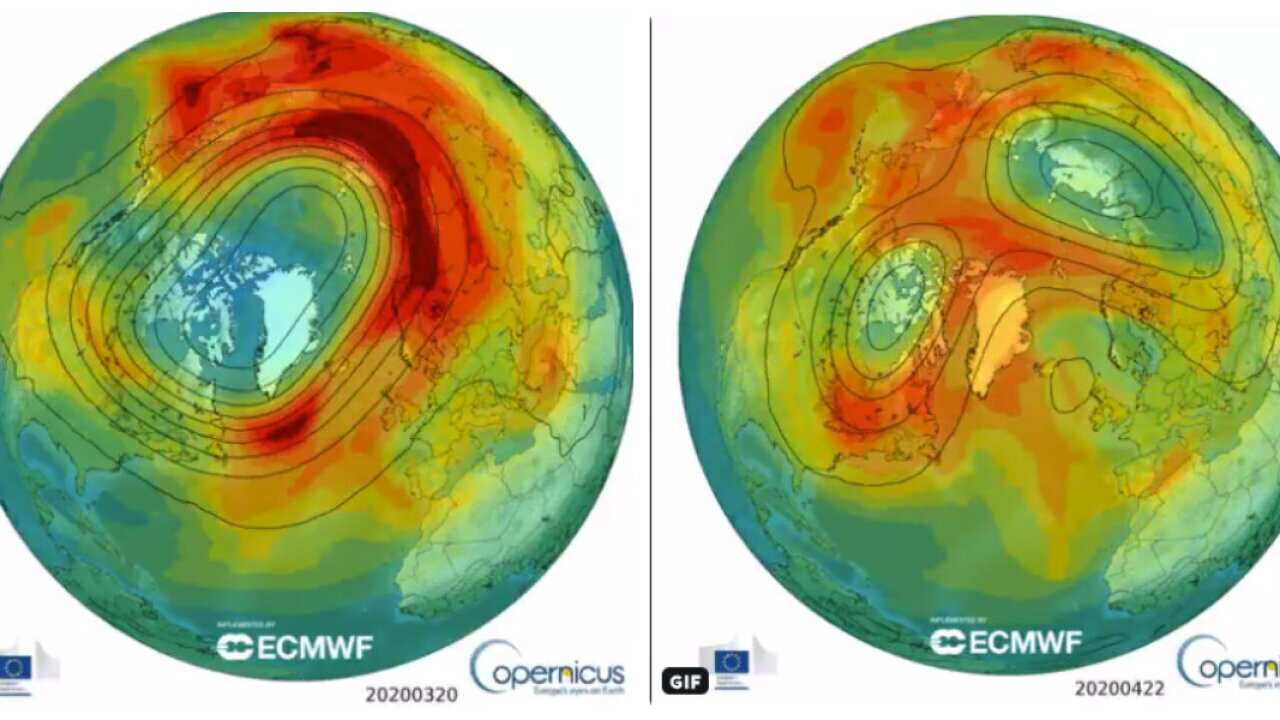
The European Union’s Copernicus' Atmospheric Monitoring Service (CAMS) announced last week that the largest hole ever recorded in the ozone layer over the Arctic has now closed.
“The last time similarly strong chemical ozone depletion was observed over the Arctic was during spring 2011, and ozone depletion in 2020 seems on course to be even stronger,” the CAMS team stated in the beginning of April, citing such a severe depletion that affected most of the ozone found in the layer of an around 18 km altitude.
Signs of the rather unusual ozone hole were observed at the end of March.
"While we are used to ozone holes developing over the Antarctic every year during the Austral spring, the conditions needed for such strong ozone depletion are not normally found in the Northern Hemisphere," the team explains.
"The Antarctic ozone hole is mainly caused by human-made chemicals including chlorine and bromine that migrate into the stratosphere."
The cause was not attributed to human activity but rather an exceptionally strong and persistent polar vortex this year bringing extreme cold temperatures that led to the depletion.
In the same vein, according to the scientists the closing of the hole had nothing to with improved air quality from the global COVID-19 lockdown measures.
The polar vortex is set to return, but scientists believe it won’t affect the ozone layer that much.



