
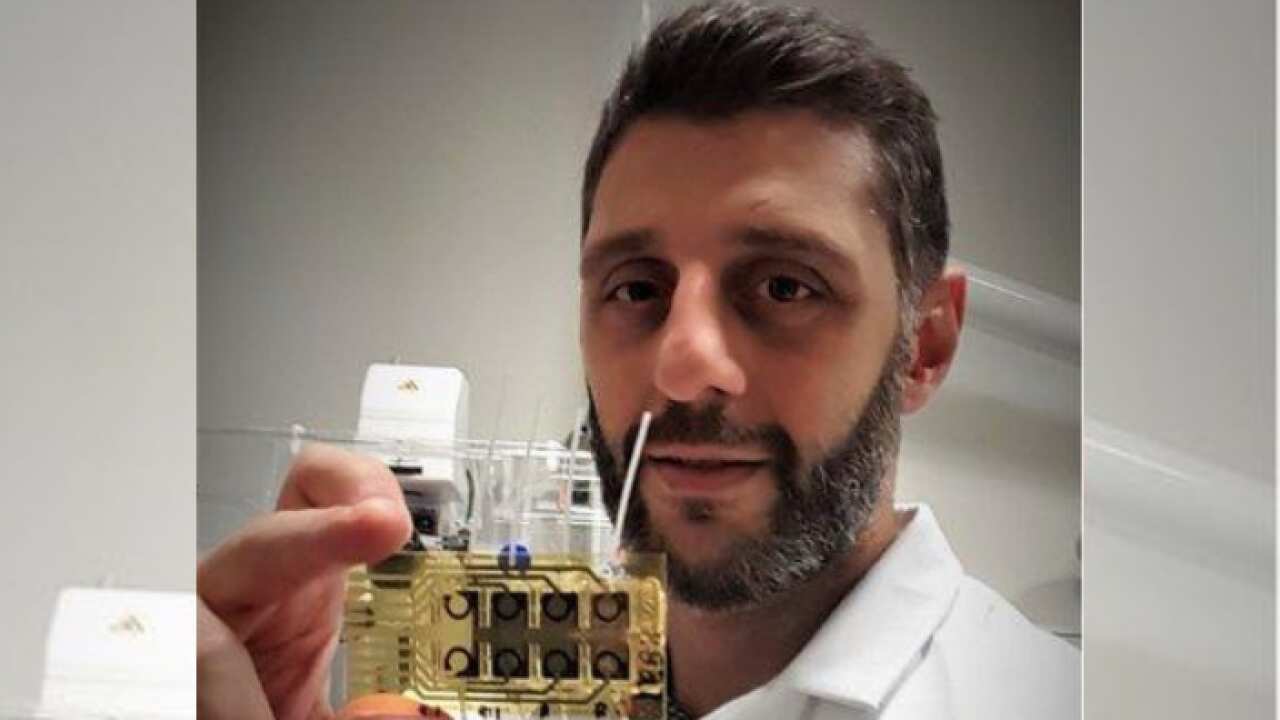

A group of scientists led by the University of Cambridge have developed an «organ on a chip». We hear more from the study’s first author, Dr Charalampos Pitsalidis who talked to Vasili Ragousis
Dr Pitsalidis’s research aims to revolutionise the drug screening process. What motivates him is the use of animals as test subjects. According to Dr Pitsalidis «Animal studies remain the major means of drug screening in the later stages of drug development however they are increasingly questioned due to ethics, cost and relevance concerns». Tubistor – the result of his research- might be able to change the field of Animal studies.
Tubistor: What is it?
Dr Pitsalidis’s own method focuses on developing technology that mimics the physiological environment in order to accurately assess potential therapies. Tubistor is a step in this direction. It is a «three –dimensional organ on a chip» that allows scientists to better observe how cells grow on the human body. It acts as a simulator, showing the effect treatments can have on the human organs. Depending on the cells, it can mimic a different organ each time.
Next steps
Tubistor has the potential to mimic human organs but more research is needed. Dr. Pitsalides hopes that his research will help in replacing or reducing the animal research in science. He believes that in our age, we have the power to make better tools for assessing therapies.
The researchers plan to use their device to develop a ‘gut on a chip’ and attach it to a ‘brain on a chip’ in order to study the relationship between the gut microbiome and brain function as part of the IMBIBE project, funded by the European Research Council.
The researchers have filed a patent for the device in France.