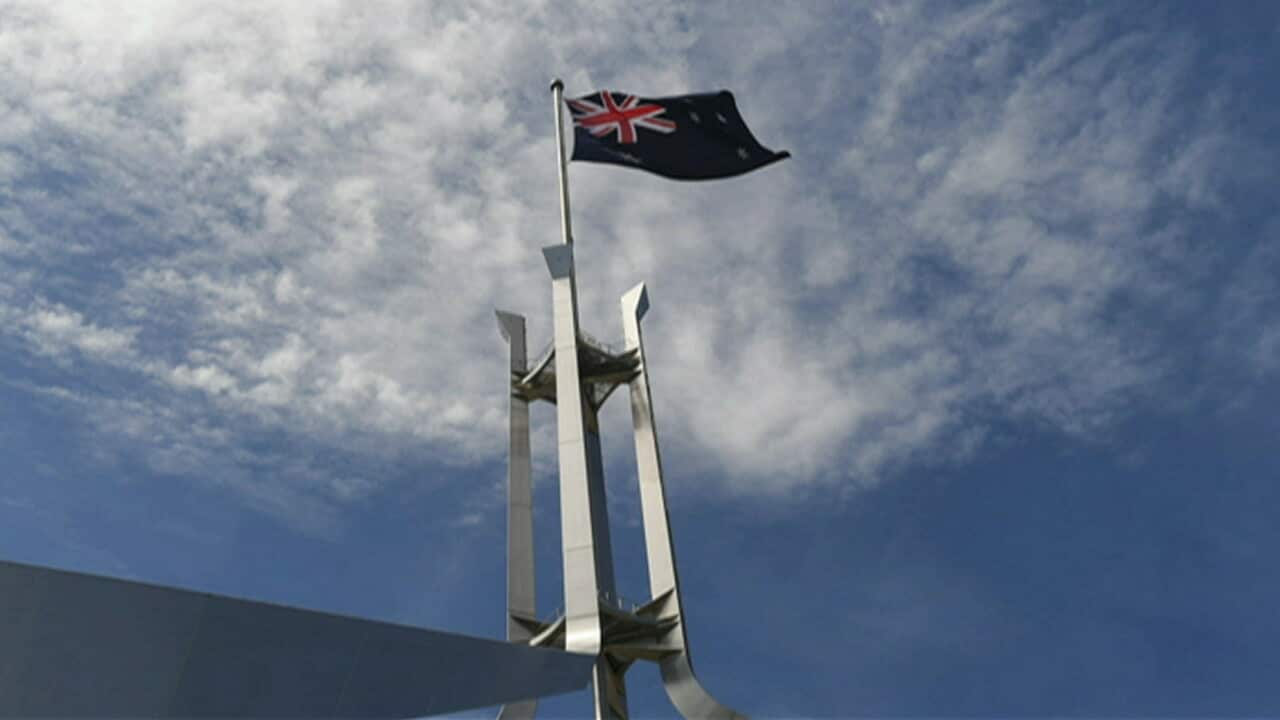
When a government finds itself without the ability to pass its legislation successfully through both houses of parliament, Australia's Constitution allows for a special mechanism that can disrupt the electoral cycle -- a double-dissolution election.
To understand how and why this works, it's necessary to look at the history of Australia's parliamentary democracy. Based on the British Westminster system, the federal, or executive,
Based on the British Westminster system, the federal, or executive, government is responsible to the parliament, or the legislative arm of government.
In Australia, the parliament comprises two chambers. Federal elections are held every three years.
The government is formed by the party with a majority in the lower house - the House of Representatives. The upper house, the Senate, is a house of review.
Professor of politics at the University of Adelaide in South Australia, Clem MacIntyre, says dissolving both houses for re-election - a double-dissolution election - is a serious endeavour.
For a double-dissolution election to occur, the government needs what's known as a "trigger bill".
Professor Macintyre explains it refers to a specific piece of legislation which the two houses of federal parliament cannot agree to pass.
The Governor General represents Australia's head of state, the Queen, and is expected to act on the advice of the prime minister and dissolve both houses of parliament.
And only six times since the federation of Australia's colonies in 1901 has this happened.
The first double-dissolution election was called in 1914 over union employment in the public service.
The most recent was in 1987 - again by a Labor government, but this time using legislation proposing the introduction of a national identity card.
In 1950, the conservative Liberal-National government led by Prime Minister Robert Menzies had hoped a bill banning the Communist Party of Australia would act as a trigger for a double-dissolution vote, but it was ultimately passed by a Labor-dominated Senate.
Dr. Barry York is a historian at the Museum of Australian Democracy at Old Parliament House in Canberra. He says, in 1951 Mr. Menzies tried again -- using the failure of another bill to ultimately secure a majority in the upper house.
Dr. York warns that the move doesn't guarantee government control over both houses of parliament.
And if, even after a double-dissolution election, the Senate refuses to pass the trigger legislation, both houses of parliament can be called for a joint sitting.