Parties sworn this month have proposed to change the constitution and returning the Broad Guidelines for State Policy - one of the long-term national development goals that could bring President Jokowi's executive branch under his control.
Indonesia prior to 1998, the People's Consultative Assembly or MPR, which was piled up with military officials and supporters of the late dictator Suharto who ruled for 32 years, had the power to elect a president based on General Guidelines.
Since then the Constitution has been amended four times to separate the legislative and executive powers, decentralize the government, directly elect the president and limit the leaders to two periods of government.
One of the main supporters of the latest amendment is Widodo's own party, the Indonesian Democratic Party of Struggle (PDI-P), while a number of other parties including the Gerindra and NasDem (National Democracy) parties have also supported the plan.
But legal experts and activists are worried.
"Recovery (General Guidelines) can roll back everything related to reform and return the political landscape back to the past," said Asfinawati, head of the Legal Aid Institute.
Arya Fernandes, a researcher at the Center for Strategic and International Studies, said there was no need to restore the Code.
"That will have an impact on our constitutional system: the president becomes weaker, the parliament becomes stronger."
On the other hand, Eva Kusuma Sundari, a former MP from the PDI-P who has been in talks with lawmakers on this issue since 2009, said the amendment was intended to encourage the country to deal with issues of radicalism and economic inequality.
"We want guidelines that are long-term, have a broad perspective, and are formulated by all: legislative, executive, NGO."
According to Sundari, the amendment will not include articles related to election or impeachment.
But in a directive it states that direct presidential elections could be a barrier.
MPR Speaker Bambang Soesatyo told the media in August that such a vote was "complicated and too expensive."
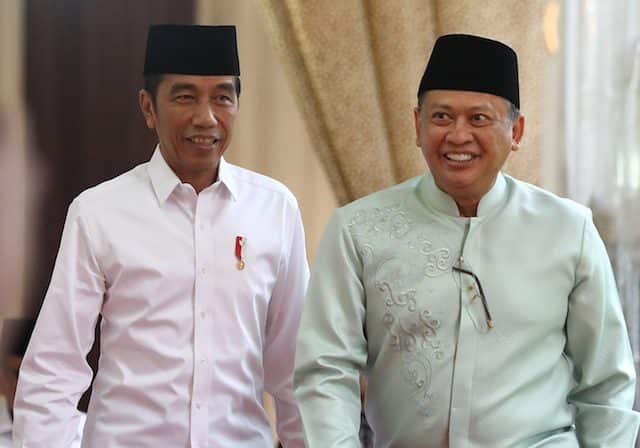
Jokowi with Bambang Soesatyo (Bamsoet) Head of MPR periode 2019-2024. (Hendra Eka/JawaPos)
President Joko Widodo himself seems to want to avoid taking sides on this issue. He urged parliament to seek the views of all parties before continuing constitutional reform.
"Let's give the MPR an opportunity to work, do research, and include all possible input," he said in a statement.
"The most important thing is that it requires in-depth study. It is necessary to accommodate proposals from all figures, academics, the community, "he said Widodo after the meeting with Soesatyo.




