Key Points
- Japan moved away from Lunar New Year in 1873, when the Meiji government legally adopted the Gregorian calendar.
- Despite the legal change, many farming and fishing communities continued using the lunar calendar, resulting in years of dual calendar use.
- In parts of Japan’s south-western islands, including Okinawa and Amami Ōshima, Lunar New Year traditions still endure.
Lunar New Year is one of Asia’s most significant annual celebrations, bringing families together for reunions, ceremonial meals and prayers for ancestors.
While it remains central in countries such as China, South Korea, Vietnam, Malaysia and Singapore, its place in Japan’s calendar has largely disappeared.
Lunar calendar abolished by law
In 1873, the Meiji government officially adopted the Gregorian calendar and abolished the lunar calendar by law.
Hirochika Nakamaki, Professor Emeritus at the National Museum of Ethnology, Japan and an expert on calendar culture, says moving to the new calendar in the early Meiji period followed the broader flow of so-called "civilisation and enlightenment".
"It was a major decision to break away from the calendar used in the Chinese civilisation sphere and switch to a Western calendar."
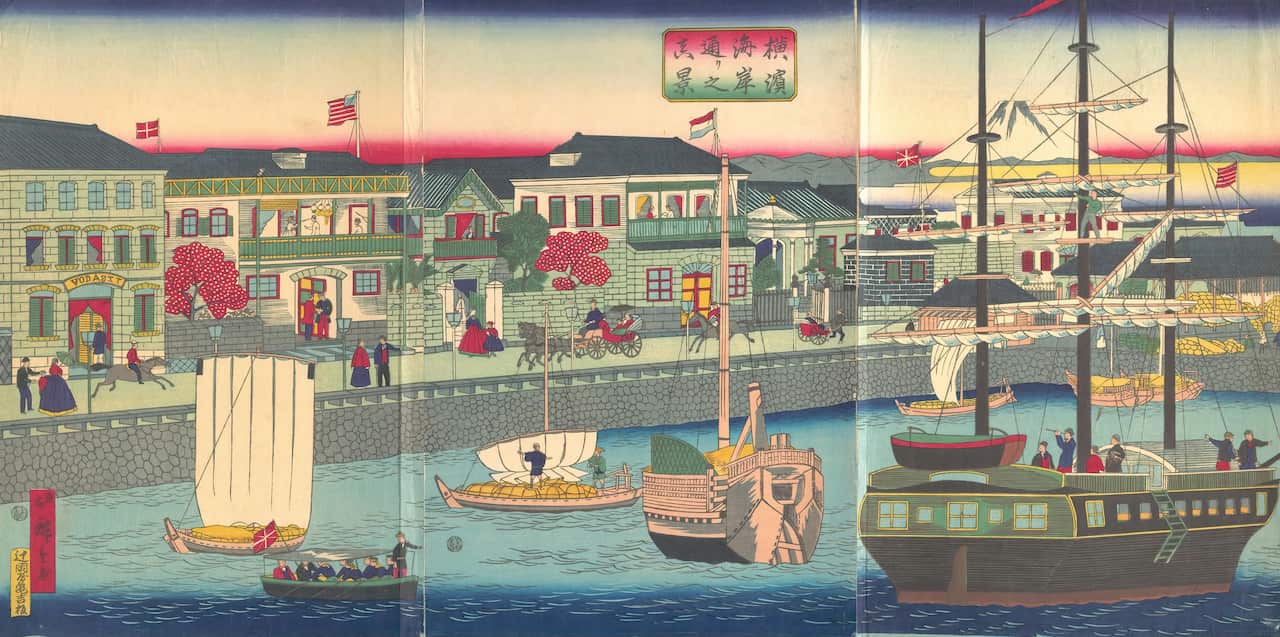
He adds that the change symbolised Japan’s determination to reposition itself internationally.
"The Meiji government pursued policies aimed at catching up with, and surpassing, the West.
"Diplomatically and domestically, adopting Western civilisation reflected the ideology known as datsu-A nyū-Ō—leaving Asia and entering Europe. The calendar reform can be seen as a symbolic expression of this shift," he says.
Japan’s "lost month"
The transition was abrupt.
On 3 December 1872, under the old calendar, the government declared that the date would jump ahead to 1 January 1873.
Nearly 27 days vanished overnight, creating what is often called Japan’s "lost month".
Prof Nakamaki says the impact was felt most strongly by people whose livelihoods depended on natural cycles.
"For agriculture, the seasonal cycle was disrupted. Fishing communities were closely connected to tides and the phases of the moon. Because people were accustomed to living by lunar rhythms, it was difficult to shift immediately to the new calendar."

As a result, adoption varied widely.
That uneven transition is reflected in a nationwide survey conducted in 1889 by Hisashi Terao of the Tokyo Astronomical Observatory.
It found that urban centres and state institutions — including civil servants, the military, schools and banks — adjusted more quickly, while rural and coastal communities continued to rely on the older system.
In many regions, the old and new calendars were used side by side. Where both systems coexisted, they took on different roles.
The Gregorian New Year became the public marker, shaped by official observances and community events, while the Lunar New Year was often preserved as a quieter, family-centred celebration.
The old calendar was abolished by law, but in practice it continued to be usedProfessor Emeritus at the National Museum of Ethnology, Japan, Hirochika Nakamaki.
Caught between the lunar and Gregorian calendars, communities adopted a practical compromise, holding festivals about one month later to align with the seasons.
Many of those adjustments remain today, including major festivals such as Kyoto’s Gion Matsuri and Osaka’s Tenjin Matsuri.
Prof Nakamaki also points to Obon, a Buddhist period when ancestral spirits are believed to return home.
In Tokyo, it is observed in mid-July, while in many other parts of Japan, it continues to be marked one month later.
Where the lunar rhythm endured
While Lunar New Year faded nationally, elements of it persisted in pockets such as Okinawa and Amami Ōshima — part of the Amami Islands in Kagoshima Prefecture — regions that were historically part of the Ryukyu Kingdom.
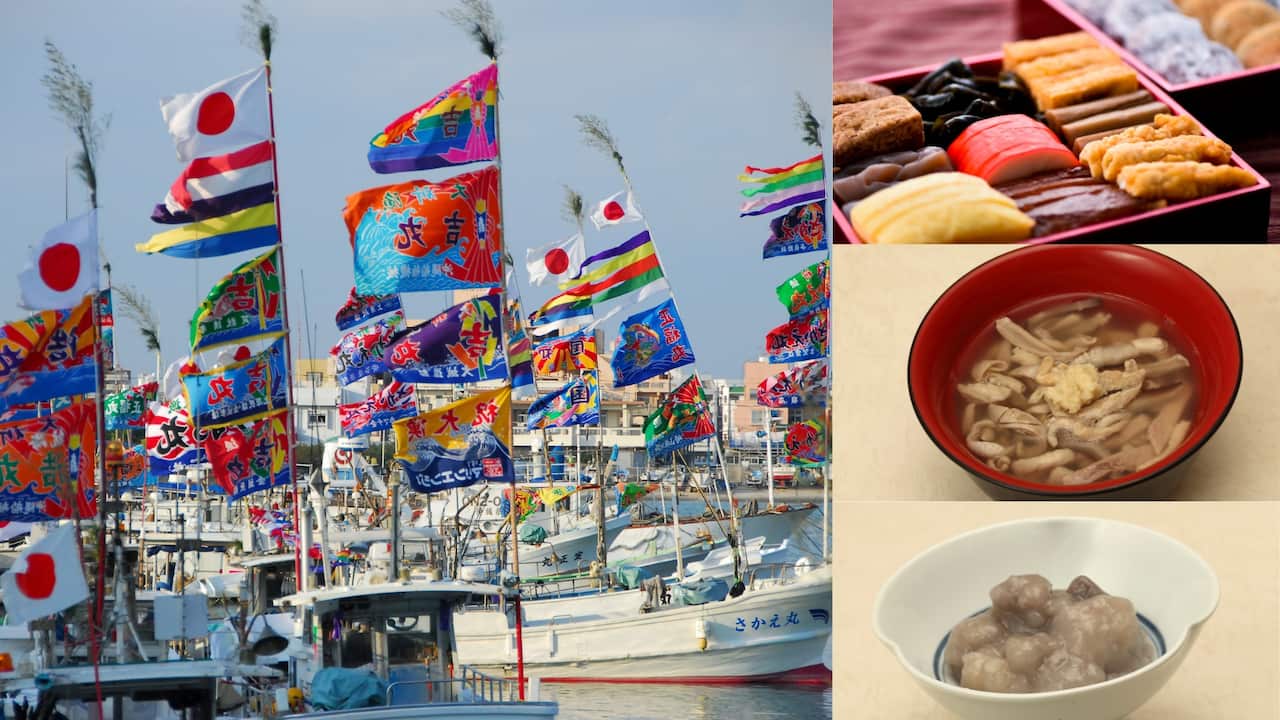
Sydney resident Kumiko Ho, born and raised in Itoman city, Okinawa, says her family did not celebrate the Gregorian New Year at all.
"There's no real celebration for 1 January. We might watch the New Year's TV shows and say 'Happy New Year,' but the real feeling that 'New Year has come' is with Lunar New Year."
In Itoman’s fishing port, boats raise flags on the lunar date for a bountiful catch, drawing visitors, she says.
Unlike Lunar New Year celebrations elsewhere in Asia, Okinawa’s festivities are understated.
I only learned after moving here that many Asian communities decorate many things in red. In Okinawa, we don’t really have that.Kumiko Ho
"For Lunar New Year, everyone comes together to prepare special food for the day. Families make celebratory dishes packed into ojū boxes, along with foods like nakami-jiru, (a clear soup made with pork offal), and taamu dengaku (sweet taro). We then visit relatives, even distant ones, so it feels like a once-a-year reunion," explains Ms Ho.
In Okinawa, almost all traditional events, including Bon and tomb-visiting festivals such as Shīmī, continue to follow the lunar calendar, creating a rhythm of life distinct from the rest of Japan.

A similar rhythm can be found in parts of Amami.
Yukino Matsumoto, who was born and raised on Amami Ōshima and now lives in Sydney, remembers celebrating both calendars as a child.
"Until I was in about third or fourth grade, we celebrated both. But after my grandmother passed away, we only celebrate 1 January.
"On Amami Ōshima, New Year isn't celebrated with mainland-style osechi, but with a traditional ceremonial meal called sangon. Originally prepared for Lunar New Year, the meal gradually shifted to 1 January as the Gregorian calendar became established. Back then, in our household, sangon was prepared for both new years."

The dish symbolises wishes for good health, prosperity, and stronger family bonds, and is shared during New Year family visits, Ms Matsumoto says.
Other annual events such as Bon, the Star Festival and Girls’ Day continued to follow the lunar calendar, she adds.
"For Girls’ Day, we started displaying hina dolls on 3 March according to the new calendar.
“But we left them up until the lunar date, celebrated then, and only after that did we put them away."
A dual structure of time
Japan may no longer mark Lunar New Year as a national holiday, but the older rhythm has not disappeared.
Prof Nakamaki says Okinawa once existed "in between" two worlds, shaped by China while also sitting alongside the political and cultural order of the Edo shogunate, developing a distinct civilisation of its own.
"On the surface, Japan appears to live by the Western calendar. But underneath, the lunar calendar has continued too. Rather than forcing a clean break, Japan adjusted as it urbanised and westernised. That dual structure may be one of the defining features of Japanese civilisation.”
Listen to SBS Japanese Audio on Tue, Thu and Fri from 1pm on SBS 3. Replays from 10pm on Tue, Thu and Sat on SBS1. Listen to past stories from our podcast. Download the free SBS Audio App and don't forget to visit SBS Japanese Facebook and Instagram page!