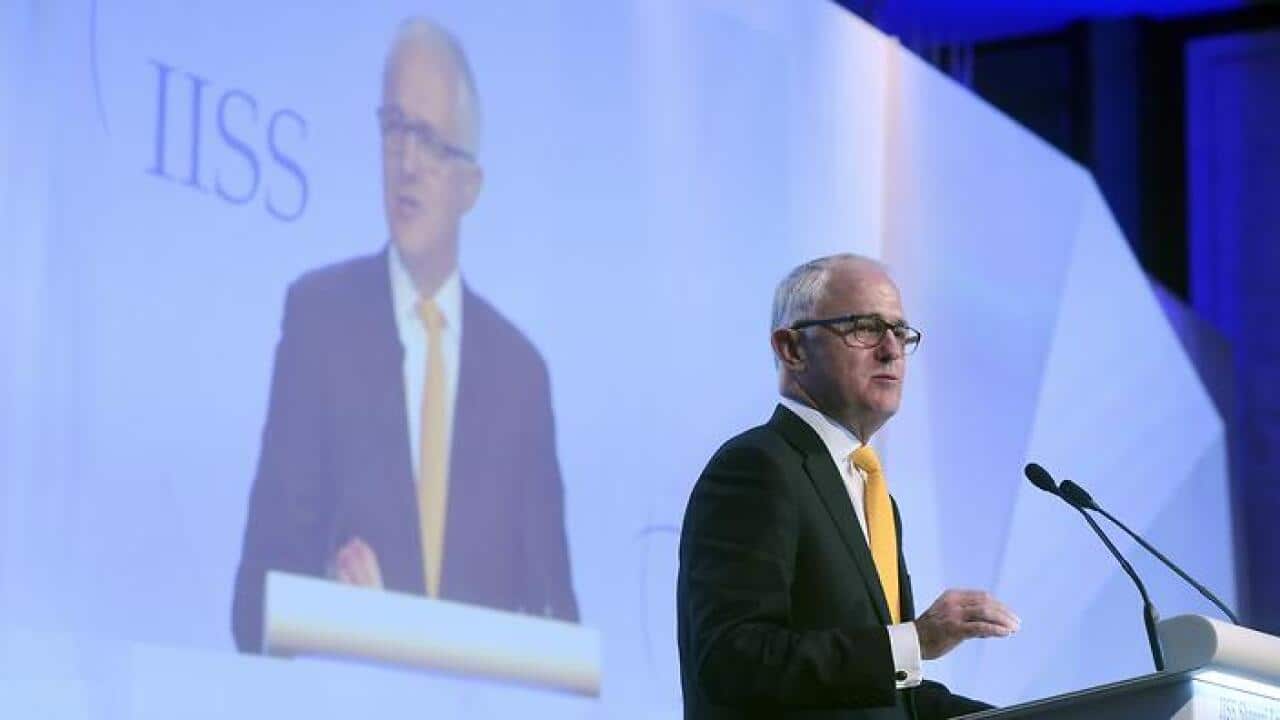
In a keynote address on Friday night at the security summit in Singapore, Prime Minister Malcolm Turnbull went straight to rising anxiety in the region over China's increasing power and the militarisation of islands within the vital trading route of the South China Sea.
The speech was a preview of comments made by US Defense Secretary Jim Mattis on Saturday morning at the summit, who went harder.
"(China's) artificial island construction and indisputable militarisation of facilities on features in international waters undermine regional stability," he said.
Mr Mattis noted that the "scope and effect" of China's actions in the South China Sea differed from others, pointing to its "disregard for international law, its contempt for other nation's interests and its efforts to dismiss non-adversarial resolution of issues".
"We cannot and will not accept unilateral coercive changes to the status quo," he added.
This message was tempered by a welcoming of what he described as China's "renewed commitment to work with the international community toward denuclearisation" of North Korea.
Describing North Korea as a "clear and present danger", he said the "pace and scope" of its nuclearisation efforts signal a "clear intent" to acquire nuclear armed ballistic missiles.
Disappointed, not surprised: PM
"Ultimately, we believe China will come to recognise North Korea as a strategic liability, not an asset," Mr Mattis added.
Mr Turnbull later rejected there was any danger of Australia being seen by China as America's deputy sheriff in the region or "cat's paw", adding "Australia's foreign policy is conducted in Australia's national interest and Australia's national interest alone".
In response to questions as to how America and Australia would assert a rules- based order in the disputed waters of the South China Sea in the face of China's continued militarisation of the region, Mr Turnbull said: "We exercise our right to freedom of navigation and overflight all the time, so that is a given.
It's up to China to bring 'dangerous' North Korea 'to its senses': Turnbull
"As to what particular operations would be undertaken at a particular time that is obviously not something we are going to speculate or foreshadow."
He said he also would not be drawn on what discussions he had with Mr Mattis on"military matters" but told reporters "I assure you we stay in the closest of contact with our ally on all of these issues".