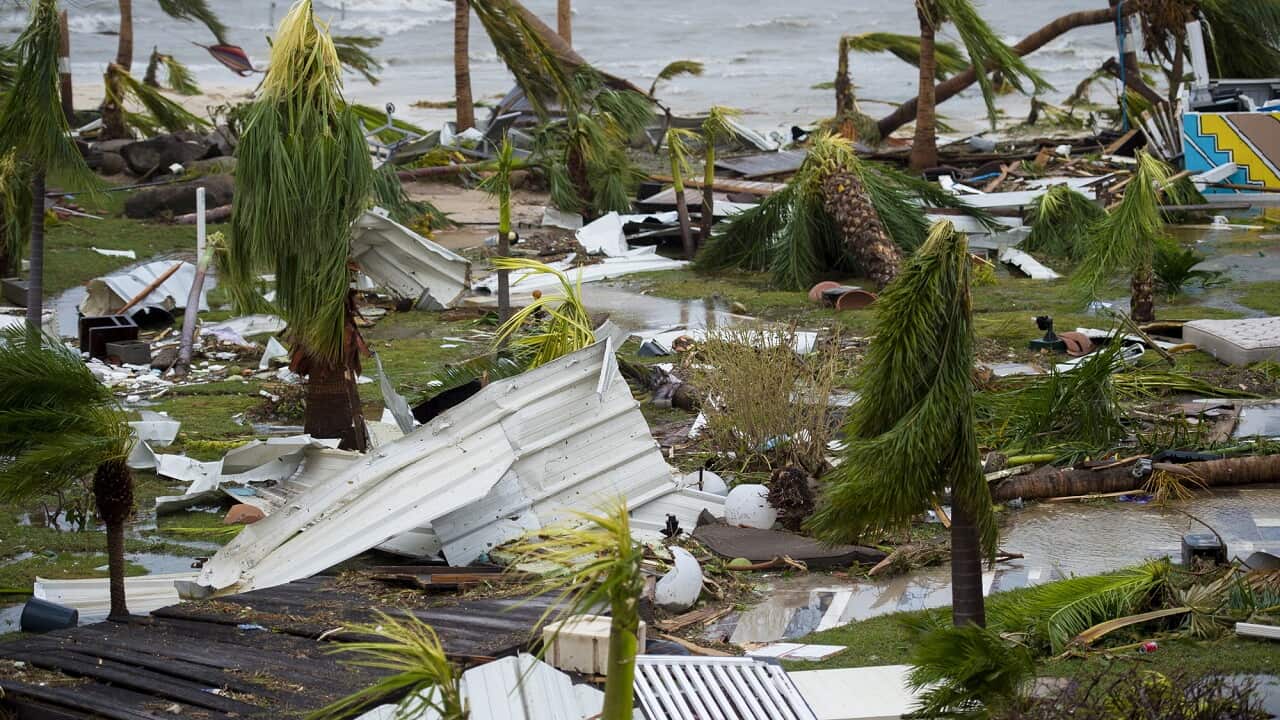
- Barbuda island reduced to 'rubble' - Prime Minister
- About 70 per cent of Puerto Rico without power
- Storm likely to hit Florida Sunday
- Two other hurricanes formed
With winds of around 185 miles per hour (290 km per hour), the storm has smashed through several small islands in the northeast Caribbean in recent days, including Barbuda, Saint Martin and the British and US Virgin Islands, ripping down trees and flattening homes and hospitals.
Winds dipped slightly on Thursday to 175 mph as the storm lashed the northern coast of the Dominican Republic but it remained an extremely dangerous Category 5 storm, according to the National Hurricane Center (NHC). Irma is expected to hit Florida as a very powerful Category 4 on Sunday, with storm surges and flooding beginning within the next 48 hours.
"The amount of wind that's coming in, we don't think we've seen anything quite like this," US President Donald Trump told reporters at the White House on Thursday after declaring a major disaster in the US Virgin Islands.
"To the people of Florida, we just want you to protect yourselves, be very very vigilant and careful," said thepresident, who owns the waterfront Mar-a-Lago estate in Palm Beach, Florida.
CNN's George Howell on Hurricane Irma
Evacuations in Florida
Florida emergency management officials began evacuations, ordering tourists to leave the Keys. Gas shortages in the Miami-Fort Lauderdale area worsened on Thursday, with sales up to five times the norm.
A mandatory evacuation on Georgia's Atlantic coast was due to begin on Saturday, Governor Nathan Deal said.
Residents evacuate Florida as Irma looms
Across the Caribbean authorities rushed to evacuate tens of thousands of residents and tourists in the path of the storm, while on islands in its wake, shocked locals tried to comprehend the extent of the devastation.
In the US Virgin islands, a major hospital was obliterated by the wind and Barbuda, where one person died, was reduced "to rubble", according to Prime Minister Gaston Browne. In the British overseas territory of Anguilla another person was killed, while the hospital and airport, power and phone service were damaged, emergency service officials said.
French Prime Minister Edouard Philippe said four bodies were recovered on the tiny French-Dutch island of Saint Martin, which was hit hard. Earlier, in the confusion surrounding Irma, France's interior minister had said eight people were killed and nearly two dozen injured.
"It is an enormous disaster. Ninety-five percent of the island is destroyed. I am in shock," Daniel Gibbs, chairman of a local council on Saint Martin, told Radio Caribbean International.
Television footage from the island showed a damaged marina with boats tossed into piles, submerged streets and flooded homes. French President Emmanuel Macron spoke with British Prime
Minister Theresa May on Thursday to coordinate an emergency humanitarian response.
Three people were killed in Puerto Rico and around two-thirds of the population lost their electricity, Governor
Ricardo Rossello said after the storm passed by the US territory's northern coast. A surfer was also reported killed in Barbados.
The storm passed just to the north of the Hispaniola island shared by Dominican Republic and Haiti, causing some damage to roofs and flooding as it approached the impoverished Haitian side of the island, which is particularly vulnerable to hurricanes and rain.
The first bands of rain and wind began to lash Haiti's normally bustling northern port city of Cap-Haitien on Thursday.
“We're asking all those living in areas at risk to leave their homes. If you don’t, you’ll be evacuated by force,"
President Jovenel Moise said. "When you go to shelters you’ll find food, you’ll have something to sleep on."
Records shattered
Hurricane Irma, rampaging across the Caribbean towards the Bahamas and south Florida, is smashing not only homes and hotels but weather records as well.
The Category Five super-storm has generated winds averaging 295 kilometres per hour (183 miles per hour) for more than 33 hours, longer than any cyclone of comparable power ever recorded, France's weather service said on Thursday.
"Such an intensity, for such a long period, has never been observed in the satellite era," which began in the early 1970s, said Etienne Kapikian, a forecaster at Meteo France.
The runner up is Typhoon Haiyan, which left more than 7,000 people dead or missing in the Philippines and packed winds of nearly 300 km/h for 24 hours in 2013.
Category Five tropical storms, the highest level on the Saffir-Simpson scale, produce sustained winds of more than 252 km/h.
Irma may remain at Category Five for another day or two, by which time it will be at Florida's doorstep, Kapikian told AFP.
"Most scenarios track the hurricane through the Miami region," he added. "When it hits, it will likely be at least a Category Four storm."
Irma set another record by reaching such intensity without having entered the balmy waters of the Caribbean Sea or the Gulf of Mexico, historically the incubators of mega hurricanes.
Tropical storms gather strength from ocean waters above 26 degree Celsius (79 degrees Fahrenheit).
"What is remarkable about Irma - and this is a first - is that it reached Category Five before it arrived at the Caribbean," said Patrick Galois another forecaster at Meteo France.
Children at risk
The United Nations Children's Fund warned millions of children could be at risk in those two countries. Irma's eye was forecast to pass over the Turks and Caicos Islands, a British territory, and the Bahamas before moving towards Cuba's sandy keys.
Cuba started evacuating some of the 51,000 tourists visiting the island, particularly 36,000 people at resorts on the picturesque northern coast, most of them Canadians.
“Canada decided ... to evacuate all the Canadian tourists in the country,” said Cuban Tourism Minister Manuel Marrero, estimating they made up 60 percent of tourists in the country’s keys.
Authorities in the Dominican Republic also ordered evacuations in towns along the northern Atlantic coast such as
Cabarete, a thriving tourist spot where trees were brought down by high winds but no severe damage was reported.
Webcam in St Maarten captures full force of Irma
Amid criticism from many residents that the British government could have done more to help its territories, Foreign Office Minister Alan Duncan said a Royal Navy ship would reach the affected islands on Thursday with tents, vehicles and other relief equipment. Britain released 32 million pounds ($42 million) for aid.
"Anguilla received the hurricane's full blast. The initial assessment is that the damage has been severe and in places critical," Duncan told parliament.
Britain's Queen Elizabeth said she was "shocked and saddened" by the reports of Caribbean devastation.
In Puerto Rico, Rossello said it was too early to estimate the cost of the damage. The streets of the capital San Juan were littered with downed tree limbs and signs.
Juan Pablo Aleman, a restaurant owner, said he had ridden out the storm in his 11th-floor apartment.
"The building moved, shook a few times. A lot of shingles came off and some windows broke," he told Reuters. "If it had gone a little more to the south, it would have been catastrophic."
Irma was the strongest hurricane ever recorded in the Atlantic Ocean and one of the five most forceful storms to hit the Atlantic basin in 82 years, according to the NHC.
Two other hurricanes on the horizon
Two other hurricanes formed on Wednesday.
Katia in the Gulf of Mexico posed no threat to the United States, according to U.S. forecasters. Hurricane Jose was about 815 miles (1,310 km) east of the Caribbean's Lesser Antilles islands, and could eventually threaten the US mainland.
The storm activity comes after Harvey claimed about 60 lives and caused property damage estimated to be as much as $180 billion in Texas and Louisiana.