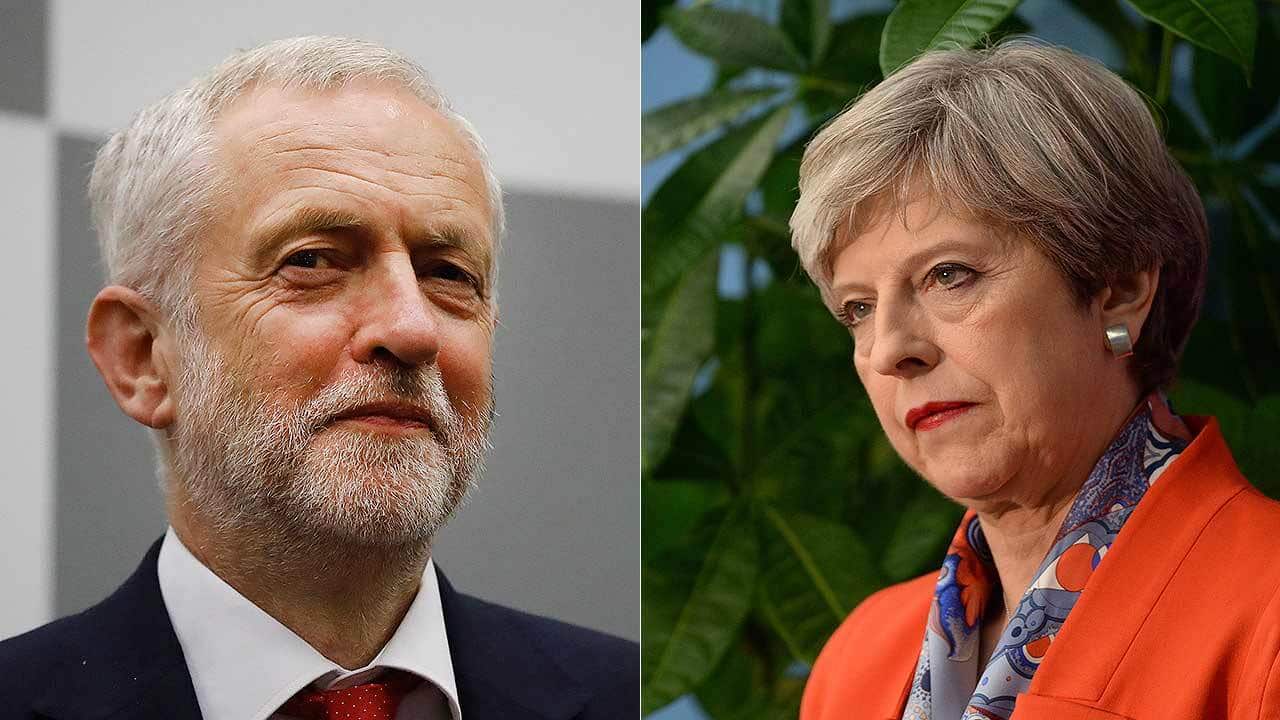
British Prime Minister Theresa May's Conservatives are in talks with Northern Ireland's Democratic Unionist Party after failing to win a majority in Thursday's national election, Sky News reported on Friday, citing sources.
With 646 out of 650 seats declared, the Conservatives had won 315 seats and are therefore no longer able to reach the 326-mark they would need to command a parliamentary majority.
The DUP won 10 seats.
The pound fell sharply amid fears the Conservative leader will be unable to form a government and could even be forced out of office after a troubled campaign overshadowed by two terror attacks.
After being re-elected with an increased majority in the London commuter seat of Maidenhead, May said Britain "needs a period of stability" as it prepares for the complicated process of withdrawing from the European Union.
She said that while the full results had yet to emerge, her party seemed to have won the most seats and "it would be incumbent on us to ensure we have that period of stability".
But Leftist opposition leader Jeremy Corbyn, whose Labour party surged from 20 points behind, urged May to quit, saying she had "lost votes, lost support and lost confidence".
Former Conservative minister Anna Soubry, who just held onto her seat, said May was "in a very difficult place" following a "dreadful campaign".
Labour are expected to increase their share from 229 to 260 seats, resulting in a hung parliament.
Labour's finance spokesman John McDonnell ruled out doing coalition deals with other parties, saying its preferred option is leading a minority government.
"We'll put ourselves forward to serve the country and form a minority government and the reason for that is I don't think the Conservative Party is stable, I don't think the prime minister is stable. I don't want to be derogatory but I
think she is a lame duck prime minister," he told BBC Radio.
May, a 60-year-old vicar's daughter, is now facing questions over her judgement in calling the election three years early and risking her party's slim but stable majority of 17.
"It is exactly the opposite of why she held the election and she then has to go and negotiate Brexit in that weakened position," said Professor Tony Travers of the London School of Economics.
Sterling fell nearly two percent against the dollar on the back of the exit poll, as investors questioned who was now going to control the Brexit process.
Early newspaper editions reflected the drama, with headlines such as "Britain on a knife edge", "Mayhem" and "Hanging by a thread".
In a night that threatened to redraw the political landscape once again, the UK Independence Party (UKIP), which won 12.5 percent of the vote two years ago and was a driving force behind the Brexit vote, was all but wiped out, hovering around two percent.
The pro-European Liberal Democrats, who have campaigned for a second EU referendum, increased their number of seats from nine, but their former leader Nick Clegg lost his seat.
Meanwhile the Scottish National Party of First Minister Nicola Sturgeon, which has dominated politics north of the border for a decade and called for a new independence vote after Brexit, was tipped to lose around 21 of its 54 seats.
Deputy leader Angus Robertson, one of the strongest SNP performers in the House of Commons, was an early casualty.
'Pressure to resign'
May, who took over after last year's Brexit referendum, began the formal two-year process of leaving the EU on March 29, promising to take Britain out of the single market and cut immigration.
Seeking to capitalise on sky-high popularity ratings, she called the election a few weeks later, urging voters to give her a stronger mandate to go into Brexit talks that are expected to begin as early as June 19.
Officials in Brussels were hopeful the election would allow her to make compromises, but this has been thrown into question by the prospect of a hung parliament.
"It creates another layer of uncertainty ahead of the Brexit negotiations," said Craig Erlam, senior market analyst at OANDA currency traders.
Despite campaigning against Brexit, Labour has accepted the result but promised to avoid a "hard Brexit", focusing on maintaining economic ties with the bloc.
Barely a month ago, the centre-left party seemed doomed to lose the election, plagued by internal divisions over its direction under veteran socialist Corbyn.
But May's botched announcement of a reform in funding for elderly care, a strong grassroots campaign by Corbyn and the terror attacks, which increased scrutiny of her time as interior minister, changed the game.
"Even if she manages to get just enough seats it will be seen as a failure and she may indeed be under pressure to resign as leader quite quickly," said Paula Surridge, senior lecturer at the University of Bristol.
Terror in the campaign
Britain has been hit with three terror attacks since March, and campaigning was twice suspended.
A suicide bomber blew himself up outside a pop concert in Manchester on May 22, killing 22 people.
Last Saturday, three assailants wearing fake suicide vests mowed down pedestrians and launched a stabbing rampage around London Bridge, killing eight people before being shot dead by police.
The attacks led to scrutiny over May's time as interior minister from 2010 to 2016, particularly since it emerged that some of the attackers had been known to police and security services.
Labour seized on steep cuts in police numbers implemented as part of a Conservative austerity programme, although May insisted she had protected funding for counter-terrorism.