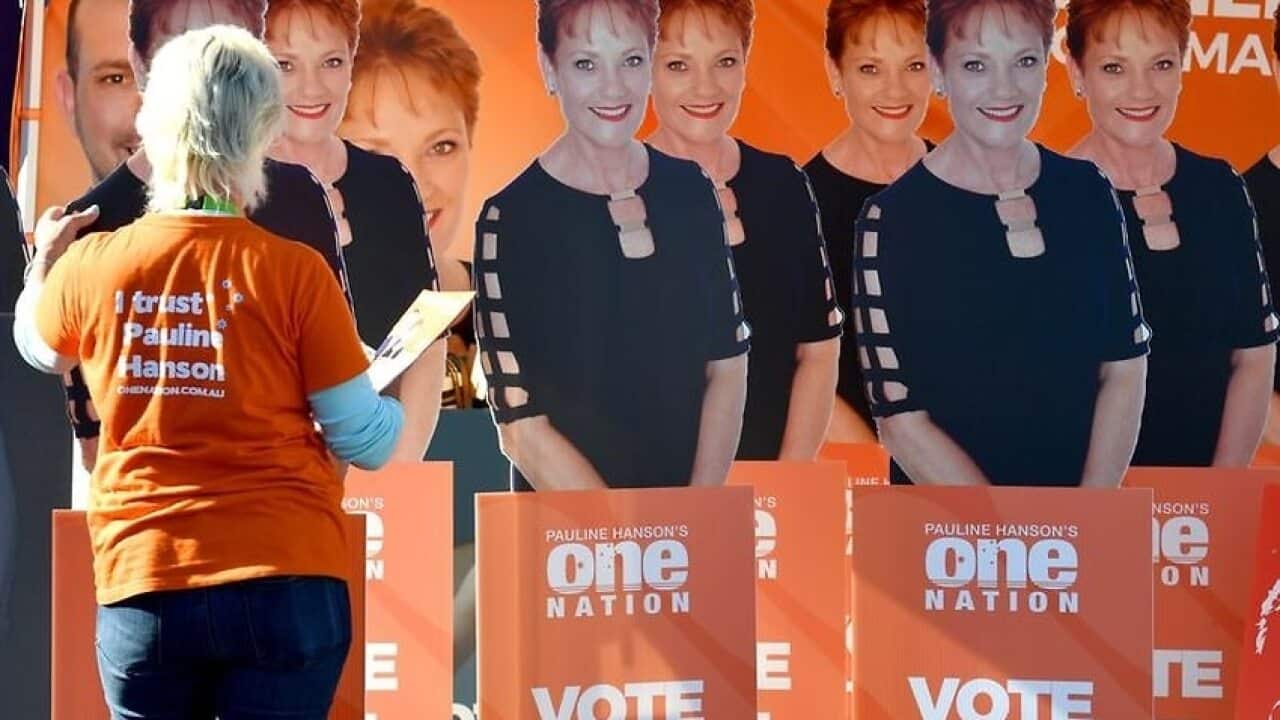
One Nation’s share of the primary vote has increased across the country - but nowhere more so than in Queensland, where voters punished Labor and rewarded Pauline Hanson’s party.
The Labor party recorded a 3.47 per cent swing against it in the Sunshine state, based on first preferences, while a three per cent swing to One Nation helped it capture 8.7 per cent of the state primary vote.
That compares to the 2016 election when the party’s share of the vote was 5.52 per cent in the state.
Griffith University’s Paul Williams said it appeared that growth had come disproportionately off the Labor party.
“Those One Nation and Palmer voters have moved away from Labor, voted one Clive Palmer or One Nation and then they’ve voted Liberal National Party,” he told SBS News.
“And that’s disastrous (for Labor). That’s the exact reversal of what we saw in the 2017 state (Queensland election) when LNP voters moved to One Nation and preferenced Labor."
University of Queensland political expert Chris Salisbury had a similar view, saying it’s likely most of those Labor voters turned to One Nation in Queensland.
“Labor has bled a lot of votes and it seems it has landed to a lot of the minor parties,” he told SBS News.
Support for the Adani mine and regional unemployment were major issues in parts of the state, he said, and One Nation campaigned strongly for the controversial mine.
History repeating itself?
Nationally, One Nation’s primary vote has almost doubled.
It improved its vote from 1.29 per cent in 2016 to almost three per cent in 2019.
However, the surge did not translate to lower house seats. And it appears One Nation senator Peter Georgiou is likely to lose his West Australian seat.
While the party failed to capture any House of Representatives seat, it is on track to secure at least one Senate spot.Queenslander Malcolm Roberts, who was dismissed from the Senate because he held dual citizenship in 2017, is likely to return to federal parliament.
Dr Salisbury said One Nation's support has always been scattered.
"They attract supporters in considerable numbers but never enough to make that breakthrough (in the House of Representatives)."
In NSW, a surprise result in the seat of Hunter had One Nation candidate Stuart Bonds, a mining mechanic and coal industry supporter, capturing a strong share of the primary vote.
While Mr Bonds is not going win the seat, he managed to gain almost 22 per cent of the primary vote in the electorate.
Senior Labor figure Joel Fitzgibbon is on track to retain the seat but recorded a substantial swing against him of 14 per cent.
Dr Salisbury said it might be a case of history repeating itself.
“It was certainly the case 20 years ago when One Nation first appeared take votes away from the Coalition and Labor - and the support Labor lost was from the blue collar, working class that Labor had long represented.
“I thought that the electorate dynamics changed a bit in 20 years … But maybe in selected seats like Hunter and mining seats in Queensland, it would possibly be the case again.”
Surprising result
One Nation’s election campaign was marred by allegations aired in an Al Jazeera documentary that it was willing to accept donations from the American gun lobby in exchange for watering down Australia’s gun laws.
It was also hit by a mid-campaign resignation from Senate candidate Steve Dickson, who appeared in the documentary, after footage of him making disparaging and racially charged remarks at a US strip club emerged.
Dr Salisbury said One Nation also defied pre-election polling which suggested its support amongst voters had slightly flatlined.
“As so often happens when it comes to the crunch, Pauline Hanson’s supporters came out of the woodwork and cemented the vote around her party,” he said.