

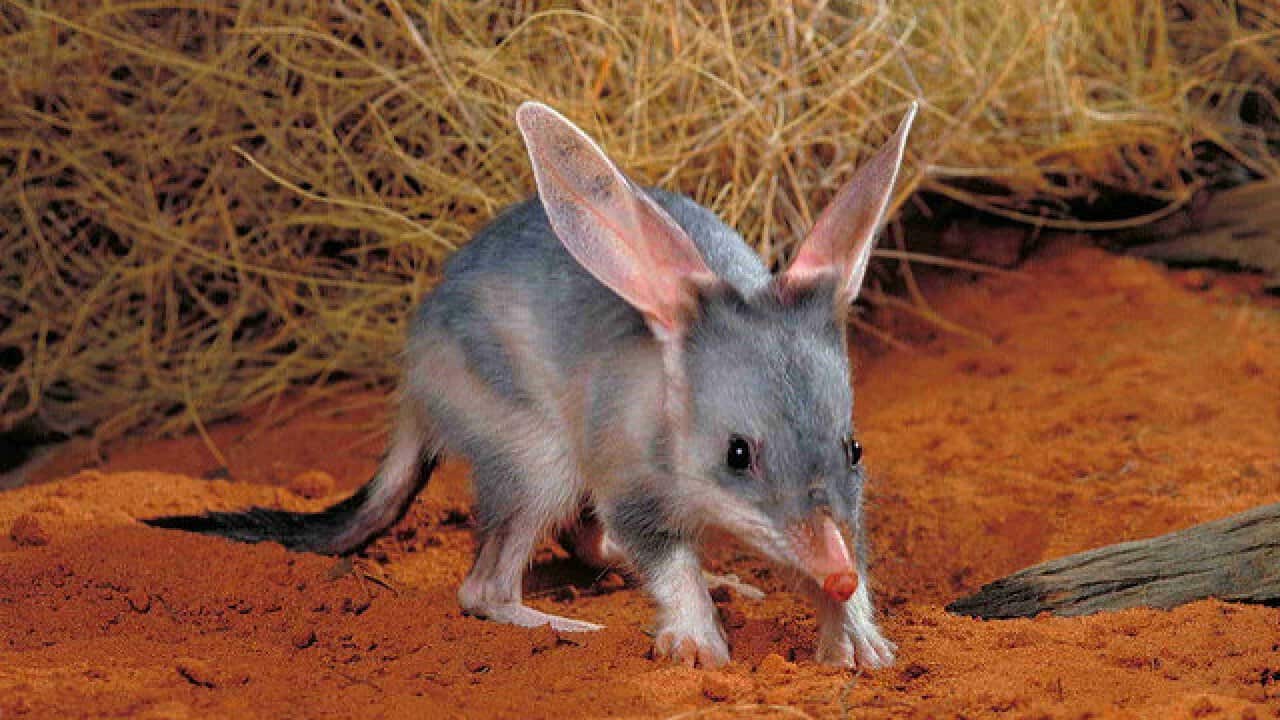
Aboriginal trackers and a new bilingual app are being used in a major new conservation project aimed at protecting the native Bilby. The desert-dwelling animal once roamed a huge section of inland Australia, but their habitat has declined by more than 80 per cent in just 200 years.
With its long ears and hopping gait, the Greater Bilby is sometimes referred to as Australia's own version of the Easter bunny.
The small burrowing marsupial once roamed widely across the country's arid centre, but Australia's Threatened Species Commissioner, Sally Box, says that's no longer the case.
"So, we know that bilbies were once widespread across the dry areas of Australia, and we know that their range has contracted by about 80 per cent, and that range has contracted northwards."
She says introduced species are among the many threats that have devastated numbers. "Feral cats, feral foxes, wrong way fire, and also damage by animals like donkeys, camels and rabbits, so the bilby is under threat."
Tracking a bilby takes patience and good observation skills, as Dione Kelly from the North Tanami Rangers explains.
"You get on the field and check the landscape, see the tracks and start tracking them. If you see little diggings, that means they're looking for food."
He's one of hundreds of Indigenous rangers from about 20 groups who will be tracking bilbies, from the Western Desert of the Northern Territory through to the Kimberley region of Western Australia over the next five weeks. The data will be collected and collated in a new bilingual app, developed by the Central Land Council with funding from the federal government.
Thalie Partridge, a Land Resource Information Officer at the Central Land Council, helped develop the app, which can also be used in conservation efforts for other species.
"The app allows us to collect data on animals, on their tracks and other signs that animals leave behind in the environment, so their tracks, their burrows, their scats - their poos - and diggings they might leave behind."
At the moment, the Tracker app is available in English and Warlpiri, an Indigenous language of the Northern Territory.
Anmatyerr ranger Josephine Grant hopes it will soon be available in other languages, in part to help rangers who speak English as a second language communicate their findings, but also to help pass on knowledge to the next generation.
"It'll be useful for rangers to use it in their own language. Not only that, but it's keeping your language alive as well I think. Having your language alive, and teaching children at the same time."
She says the bilby holds special meaning for some Indigenous groups, "Some of them are used for ceremony, some of them are used for dreaming totem, so bilby's got a special place for Aboriginal people."
The 'bilby blitz' will run until the end of April. Then, says Threatened Species Commissioner Sally Box, the data collected will be used to help shape future conservation efforts.
"And programs like this, where we get a better understanding of local trends, a better understanding of the threats to bilbies and a better understanding of what's happening nationally will really help us work out what action is needed, and where."
The writer travelled to the Bilby Blitz launch, near Alice Springs, with the assistance of the Central Land Council.