

Libby Dunstan Queensland Executive Officer of the Stroke Foundation says to dail triple O as soon as you see or feel any symptoms of a stroke. This year we want Australian's to understand the impact time has on a stroke. A speedy reaction not only influences the treatment path for a person having a stroke but also their recovery. Most treatments for stroke are time sensitive so it is important we Think F.A.S.T. and Act FAST! Did you know during a stroke 1.9 million brain cells are lost per minute? This is why it is important to identify the signs and symptoms of stroke F.A.S.T and call ‘000’ immediately. Taking part in the awareness week is a great chance to engage in a fun way with your workplace, friends, sporting or community. - See more at: https://strokefoundation.com.au/how-you-can-help/stroke-week#sthash.R0VjRsQJ.dpuf
Did you know during a stroke 1.9 million brain cells are lost per minute? This is why it is important to identify the signs and symptoms of stroke F.A.S.T and call ‘000’ immediately.
Taking part in the awareness week is a great chance to engage in a fun way with your workplace, friends, sporting or community.
Follow all of the Stroke Week 2016 action below:
Blogs
Check out the official Stroke Week blogs here. Topics covered include stroke survivors F.A.S.T stories, facts about what to do when you recognise the signs of stroke and the importance of calling '000' immediately, because a stroke is always a medical emergency!
Get social
Check out all the National Stroke Week social media activity below as it unfolds. Share your Stroke Week activity by using the hashtags #fightstroke and #strokeweek and don't forget to follow us @strokefdn on Twitter, Facebook and Instagram. To find an event near you click her
- See more at: https://strokefoundation.com.au/How-you-can-help/Stroke-week#sthash.L7LtoKfU.dpuf
It's National Stroke Week from the 12th to the 18th of September - the Stroke Foundation's annual awareness campaign.
This year they want people to understand the impact time has on strokes. They say a speedy reaction not only influences the treatment path for a person having a stroke, but also their recovery.
https://soundcloud.com/strokefdn/stroke-rap - Listen to Naomi and Rukmani’s stroke rap that runs through vital stroke awareness messages, such as lifestyle advice, learning the signs of stroke, and crucially the need to seek medical advice when stroke strikes.
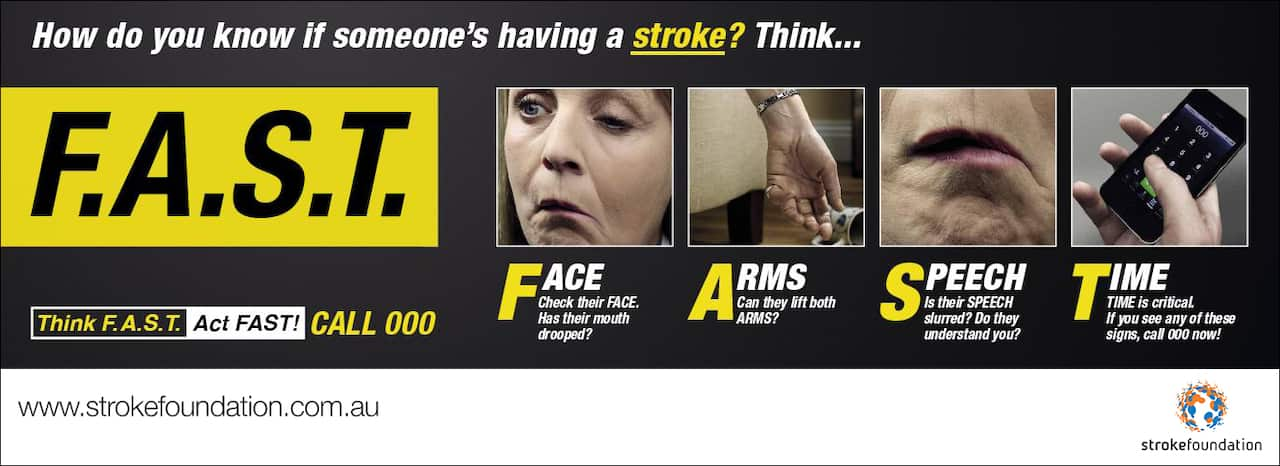
ath for a person having a stroke but also their recovery. Most treatments for stroke are time sensitive so it is important we Think F.A.S.T. and Act FAST! - See more at: https://strokefoundation.com.au/how-you-can-help/stroke-week#sthash.R0VjRsQJ.dpuf
This year we want Australian's to understand the impact time has on a stroke. A speedy reaction not only influences the treatment path for a person having a stroke but also their recovery. Most treatments for stroke are time sensitive so it is important we Think F.A.S.T. and Act FAST!
Did you know during a stroke 1.9 million brain cells are lost per minute? This is why it is important to identify the signs and symptoms of stroke F.A.S.T and call ‘000’ immediately.
Taking part in the awareness week is a great chance to engage in a fun way with your workplace, friends, sporting or community.
- See more at: https://strokefoundation.com.au/how-you-can-help/stroke-week#sthash.R0VjRsQJ.dpuf
This year we want Australian's to understand the impact time has on a stroke. A speedy reaction not only influences the treatment path for a person having a stroke but also their recovery. Most treatments for stroke are time sensitive so it is important we Think F.A.S.T. and Act FAST!
Did you know during a stroke 1.9 million brain cells are lost per minute? This is why it is important to identify the signs and symptoms of stroke F.A.S.T and call ‘000’ immediately.
Taking part in the awareness week is a great chance to engage in a fun way with your workplace, friends, sporting or community.
- See more at: https://strokefoundation.com.au/how-you-can-help/stroke-week#sthash.R0VjRsQJ.dpuf
A stroke is always a medical emergency, however too often we hear people make an appointment to see their GP, some have a massage, or many phone a family member, rather than call 000 immediately. - See more at: https://strokefoundation.com.au/Blog/2016/09/13/When-stroke-strikes-call-an-ambulance#sthash.5Y1vzP3y.dpuf
A stroke is always a medical emergency, however too often we hear people make an appointment to see their GP, some have a massage, or many phone a family member, rather than call 000 immediately. - See more at: https://strokefoundation.com.au/Blog/2016/09/13/When-stroke-strikes-call-an-ambulance#sthash.5Y1vzP3y.dpuf
A stroke is always a medical emergency, however too often we hear people make an appointment to see their GP, some have a massage, or many phone a family member, rather than call 000 immediately. - See more at: https://strokefoundation.com.au/Blog/2016/09/13/When-stroke-strikes-call-an-ambulance#sthash.5Y1vzP3y.dpuf
Aboriginal and Torres Strait Islander people are:
- Between two to three times more likely to have a stroke
- Twice as likely to be hospitalised from stroke
This year we want Australian's to understand the impact time has on a stroke. A speedy reaction not only influences the treatment path for a person having a stroke but also their recovery. Most treatments for stroke are time sensitive so it is important we Think F.A.S.T. and Act FAST!
Did you know during a stroke 1.9 million brain cells are lost per minute? This is why it is important to identify the signs and symptoms of stroke F.A.S.T and call ‘000’ immediately.
Taking part in the awareness week is a great chance to engage in a fun way with your workplace, friends, sporting or community.
- See more at: https://strokefoundation.com.au/how-you-can-help/stroke-week#sthash.R0VjRsQJ.dpuf
Nationally
More than 50,000 strokes each year – that’s one every ten minutes in Australia.
More than 450,000 stroke survivors living in the community
Libby Dunstan the Queensland Executive Officer of the Stroke Foundation says people need to dail triple O as soon as you see or feel any symptoms of a stroke.
Did you know during a stroke 1.9 million brain cells are lost per minute? This is why it is important to identify the signs and symptoms of stroke F.A.S.T and call ‘000’ immediately.
Taking part in the awareness week is a great chance to engage in a fun way with your workplace, friends, sporting or community.
Follow all of the Stroke Week 2016 action below:
Blogs
Check out the official Stroke Week blogs here. Topics covered include stroke survivors F.A.S.T stories, facts about what to do when you recognise the signs of stroke and the importance of calling '000' immediately, because a stroke is always a medical emergency!
Get social
Check out all the National Stroke Week social media activity below as it unfolds. Share your Stroke Week activity by using the hashtags #fightstroke and #strokeweek and don't forget to follow at us @strokefdn on Twitter, Facebook and Instagram. To find an event near you click her
- See more at: https://strokefoundation.com.au/How-you-can-help/Stroke-week#sthash.L7LtoKfU.dpuf
Did you know during a stroke 1.9 million brain cells are lost per minute? This is why it is important to identify the signs and symptoms of stroke F.A.S.T and call ‘000’ immediately.
Taking part in the awareness week is a great chance to engage in a fun way with your workplace, friends, sporting or community.
Follow all of the Stroke Week 2016 action below:
Blogs
Check out the official Stroke Week blogs here. Topics covered include stroke survivors F.A.S.T stories, facts about what to do when you recognise the signs of stroke and the importance of calling '000' immediately, because a stroke is always a medical emergency!
Get social
Check out all the National Stroke Week social media activity below as it unfolds. Share your Stroke Week activity by using the hashtags #fightstroke and #strokeweek and don't forget to follow at us @strokefdn on Twitter, Facebook and Instagram. To find an event near you click her
- See more at: https://strokefoundation.com.au/How-you-can-help/Stroke-week#sthash.L7LtoKfU.dpuf
Did you know during a stroke 1.9 million brain cells are lost per minute? This is why it is important to identify the signs and symptoms of stroke F.A.S.T and call ‘000’ immediately.
Taking part in the awareness week is a great chance to engage in a fun way with your workplace, friends, sporting or community.
Follow all of the Stroke Week 2016 action below:
Blogs
Check out the official Stroke Week blogs here. Topics covered include stroke survivors F.A.S.T stories, facts about what to do when you recognise the signs of stroke and the importance of calling '000' immediately, because a stroke is always a medical emergency!
Get social
Check out all the National Stroke Week social media activity below as it unfolds. Share your Stroke Week activity by using the hashtags #fightstroke and #strokeweek and don't forget to follow at us @strokefdn on Twitter, Facebook and Instagram. To find an event near you click her
- See more at: https://strokefoundation.com.au/How-you-can-help/Stroke-week#sthash.L7LtoKfU.dpufoke.
https://strokefoundation.com.au/media-centre/blog
The official Stroke Week blog covers topics including stroke survivors F.A.S.T stories, facts about what to do when you recognise the signs of stroke and the importance of calling '000' immediately, because a stroke is always a medical emergency! Image
Follow all of the Stroke Week 2016 action below:
Blogs
Check out the official Stroke Week blogs here. Topics covered include stroke survivors F.A.S.T stories, facts about what to do when you recognise the signs of stroke and the importance of calling '000' immediately, because a stroke is always a medical emergency!
Get social
Check out all the National Stroke Week social media activity below as it unfolds. Share your Stroke Week activity by using the hashtags #fightstroke and #strokeweek and don't forget to follow at us @strokefdn on Twitter, Facebook and Instagram. To find an event near you click here.
- See more at: https://strokefoundation.com.au/How-you-can-help/Stroke-week#sthash.Vv8ml3hL.dpuf
Did you know during a stroke 1.9 million brain cells are lost per minute? This is why it is important to identify the signs and symptoms of stroke F.A.S.T and call ‘000’ immediately.
Taking part in the awareness week is a great chance to engage in a fun way with your workplace, friends, sporting or community.
Follow all of the Stroke Week 2016 action below:
Blogs
Check out the official Stroke Week blogs here. Topics covered include stroke survivors F.A.S.T stories, facts about what to do when you recognise the signs of stroke and the importance of calling '000' immediately, because a stroke is always a medical emergency!
Get social
Check out all the National Stroke Week social media activity below as it unfolds. Share your Stroke Week activity by using the hashtags #fightstroke and #strokeweek and don't forget to follow at us @strokefdn on Twitter, Facebook and Instagram. To find an event near you click her
- See more at: https://strokefoundation.com.au/How-you-can-help/Stroke-week#sthash.L7LtoKfU.dpu