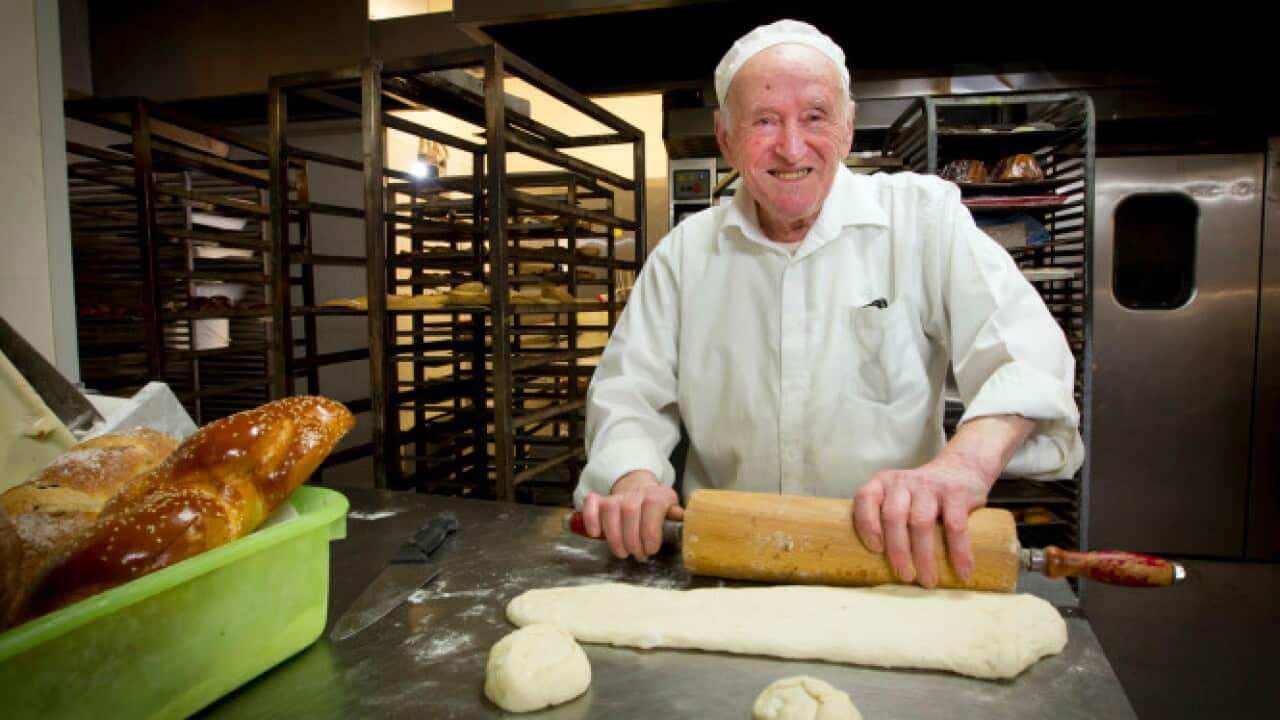
It's probably impossible to find a bagel-lover in Australia who is not familiar with a bagel from Glick's. Australians love the family-owned bakery founded by the Melburnian Mendel Glick almost 50 years ago, which has been serving up traditional European baking traditions and recipes ever since.
This weekend Melbourne said goodbye to the iconic 92-year-old baker. His story is an example of human resilience and zest for life.
He shared some of his incredible life story with Russian-Australian blogger and writer Sarah Rivkah-Bendetsky in 2014. With her permission we have republished it again here.
Each time I walk into the Glick’s shop on Carlisle St, I wonder if I am lucky enough for Mr Mendel Glick to be around. Today, he is.
Dressed in a white shirt and a white yarmulke, he is always busy – shaping another challah loaf or removing bones from herring – like a jeweller faceting a diamond.
The iconic Melbourne baker and the founder of the Glick’s Cakes & Bagels chain recently celebrated his 91st birthday.
Before coming to Australia, he left behind six concentration camps including the notorious Auschwitz and Buchenwald. He lost both parents and nine siblings.
He barely survived. Yet, despite these unbearable personal tragedies, Mr Glick managed to start a new life in Australia and recreate his own dynasty with his wife Chaya.
A proud father of nine and grandfather to over 120 grandchildren, [editor's note: in 2017, he is survived by over 170 grandchildren, great-grandchildren and great-great grandchildren he continues to bake the best bagels in town, while inspiring everyone around him.
We sit inside the Balaclava-based Glick’s cafe on Carlisle street on a warm autumn afternoon. Mr Glick looks out the window for a minute. He looks at passers-by and trams, Yeshivah students and young mothers with prams… He concentrates. And then he starts his story.
"The very fact that we are able to talk in this café today is a pure miracle"
"The very fact that we are able to talk in this café today is a pure miracle," says Mr Glick. "I wasn’t meant to survive in Buchenwald."
Buchenwald was one of the largest Nazi-run concentration camps within Germany during World War II, located on Etter Mountain, near Weimar.
"There we slept in barracks on the floor, 300 people or more, without any pillows or blankets," says Mr Glick.
He shares the tale of the time he had a very close encounter with death.
"Once, I woke up from terrible pain caused by a strange insect bite," he says.
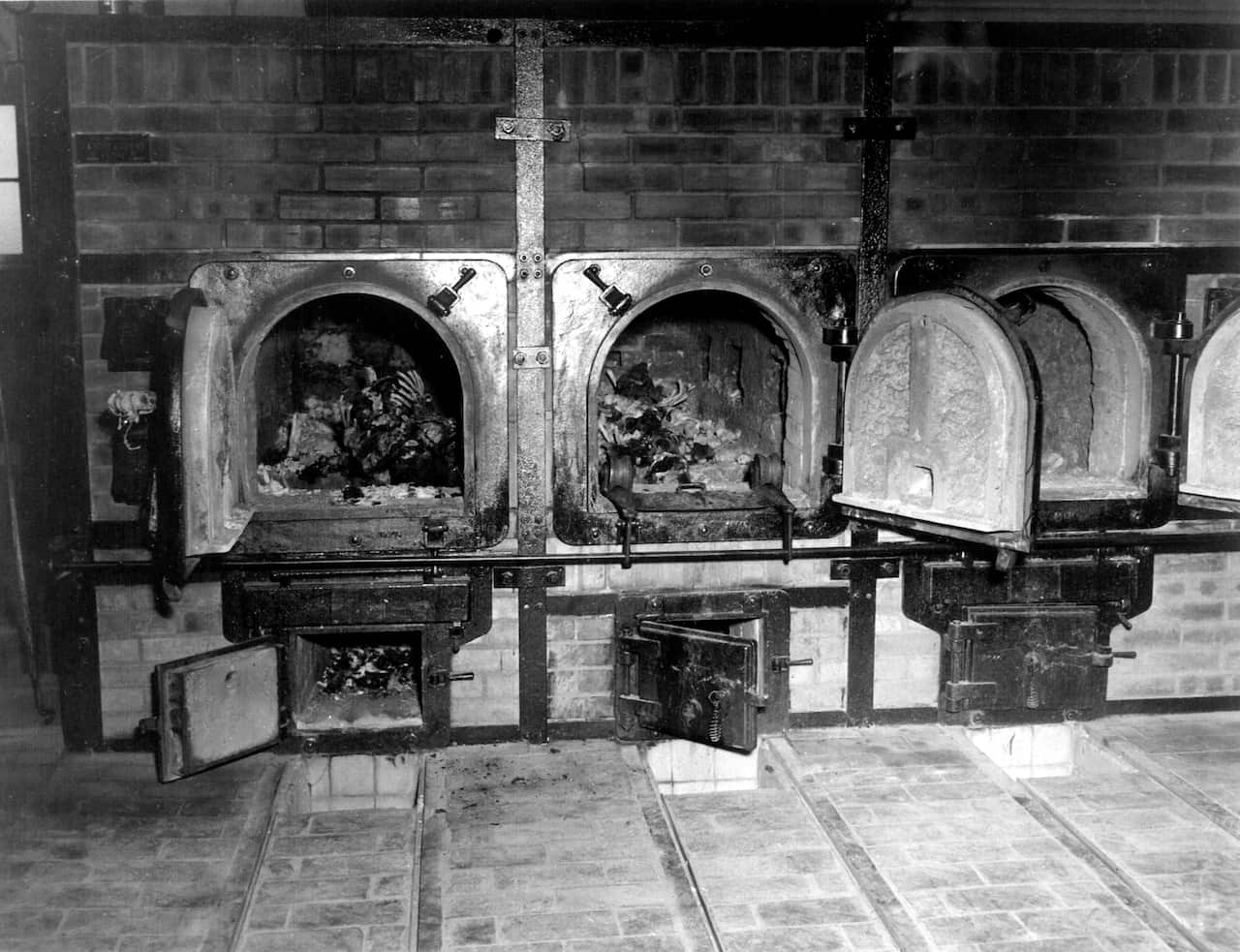
"My leg got very swollen, so I decided to see a doctor, whose office was located just a few doors away from the double crematorium, which never stopped working."
"It didn’t scare me. In fact, it didn’t scare anyone at that stage.
"There were quite a few people before me in line to be checked. I begged God to make time go quicker.
"A trolley full of corpses stood next to the backdoor, metres away from the crematorium."
"The pain was getting worse. Suddenly, when just one patient was in front of me, two German security soldiers entered the building to pick up the doctor – it was time for lunch.
"Before leaving his office, the doctor said that he was going to come back in half an hour, and therefore, we should wait.
"I decided to stay. The other patient asked me what my issue was. I showed him my swollen leg.
"Then he said that there was no point in wasting my time and I should rather go back and walk more since walking helps reduce swelling.
"I nodded without the intention to go back. Instead, I decided to walk around the building while waiting for the doctor to return.
"I realised how much God loves me."
"I walked and walked, when suddenly I saw a twenty-centimetre gap in the fence revealing the doctor’s office backyard.
"A trolley full of corpses stood next to the backdoor, metres away from the crematorium.
"I quickly understood what was going on and hobbled back into the barracks. Later on, I found out that very doctor used one treatment against all illnesses – a deadly needle killing a person within seconds."
Mr Glick said it was then that, "I realised how much God loves me."
While he may have survived that close call, when the war came to an end, Glick was almost close to death again.
"When the Americans liberated Buchenwald in 1945, I was a living skeleton, just like everyone else," says Mr Glick.
"I still remember an American soldier picking me up and taking me outside. I couldn’t walk on my own."
Mr Glick recalls his slow path to recovery. "While in the hospital, I wasn’t allowed food to avoid sudden death from overeating," he says.
"Just a tablespoon of warm water every half hour and a lump of sugar was all I could eat."
"I still remember its taste in my mouth.
"Slowly, as I began to recover, my doctor said that in order to speed up the process I had to start walking, since the human body requires motion in order to survive. I listened to him and adapted this attitude to this day."
"I was 'promoted' to work in the kitchen, which I liked most."
After the war, Glick began to rebuild his life again.
"I started to work at the American military base not far away from Buchenwald. I cleaned their bedrooms, polished their shoes, and then I was 'promoted' to work in the kitchen, which I liked most."
Mr Glick sighs as he remembers, "In a way, it reminded me of our home in Poland, where my parents had their own dairy business and made cheese."
It was an experience that would prove invaluable for his future life in Australia.
"Working at the military kitchen helped me to learn the basics of the catering business I applied in future," says Mr Glick. "It was a useful experience."
So what was it that prompted his move to Australia after the war?
"After the end of the war, every survivor was obliged to publish his contact details in local newspapers, and I did so, too," Glick explains. "Later on, these details were published worldwide."
"I had an aunt in Australia, who moved here before the war and she managed to find me and sent me the entrance papers. Then I bought the ticket and set out on the journey."
Once in Melbourne, Glick didn't open his bakery straight away. "Not at all," says Glick. "It was a dream I cherished but I had no money to make it happen."
"So, I became a cleaner - setting money aside to start my business."
"And a few years later I finally opened my first Glick’s shop on Carlisle Street, where we are sitting right now."
"Other shops followed… My kids are managing those today. I prefer this shop."
"Why would I [ever take a holiday]? I have the job I love. "
Glick's bakery is now a chain, with three other stores in Melbourne and three in Sydney.
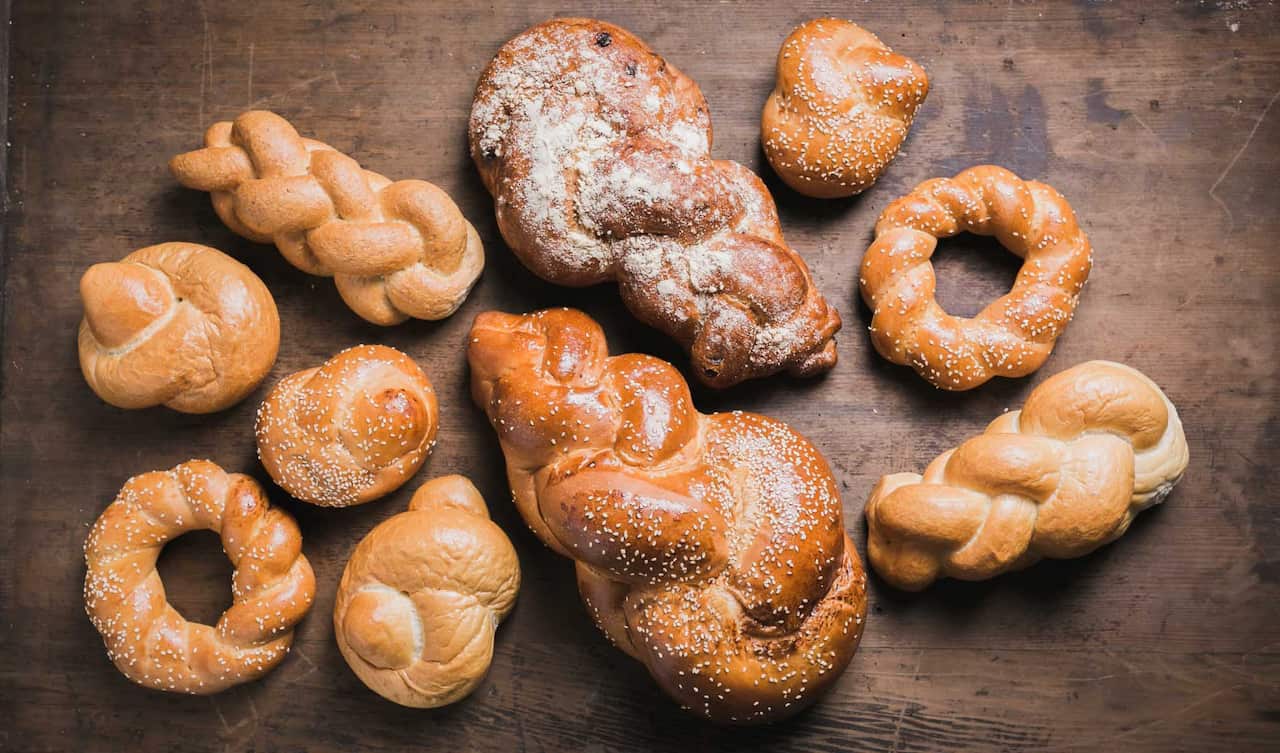
This year you’ve Glick's bakery also gave its support to Jewish Care’s Annual Appeal by overprinting their iconic brown paper challah bags with the Appeal message and a quote from you Glick himself reading “Nobody can do everything, but everybody can do something.”
As to why he finds it’s important to assist those less fortunate, Glick says, "I guess it’s in the blood."
"Back in Poland, my mother always gave her dairy products to the poor free of charge.
"I was a baby but I clearly remember that it was the right thing to do. It stayed with me for the rest of my life.
"What can I say, I am a happy man!"
"And today, no matter how advanced the world is, there are still many people who need assistance, be it money, a piece of bread, or a kind word.
"Even if it’s impossible to answer every person’s need, we can all still do something to improve someone’s life.
"And this is the message I wanted to pass on, hence, it’s written on Glick’s bags."
"While Mr Glick is now in his 90s, he's still showing no signs of slowing down. There is a rumour that he never takes a holiday. I ask him if this is true.
"Yes, it is," answers Mr Glick with a smile.
"Why would I? I have the job I love. And I have regular time to rest on Shabbos and Yom Tov."
"What can I say, I am a happy man!"
See the original article here.



