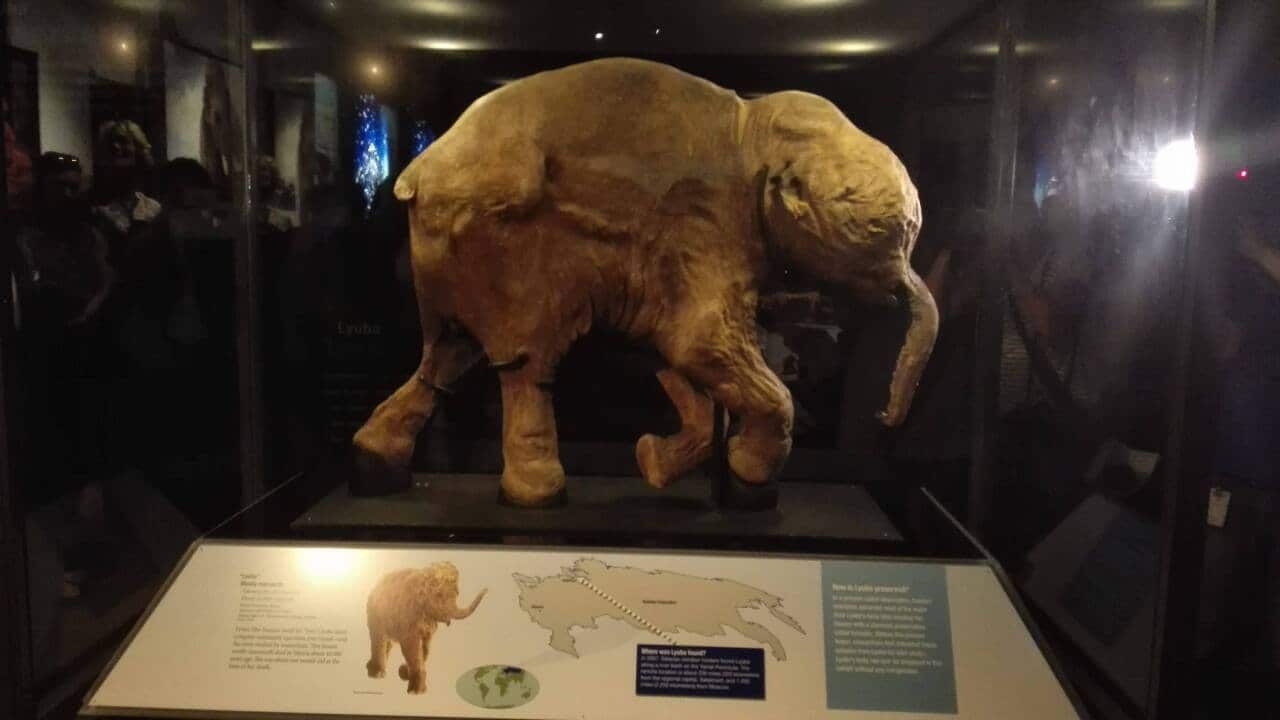
A story of a herder Yuri and mammoth Lyuba
Lyuba travelled to Australia accompanied by a group of Russian museum workers. As they told SBS Russian, Lyuba’s perfect intact condition is attributed to the man who discovered her.
Afraid of destroying a single part of the animal, the Siberian herder Yuri Hoody travelled 150 km to the nearest town to report the discovery. If Lyuba had not been found by humans, wild animals would have found her leaving only the remnants of the baby mammoth. Today, there is no other mammoth in the world like Lyuba so well persevered.
Australian Museum's paleontologist Dr Matthew McCurry was a bit emotional when he saw the baby mammoth.
‘Seeing Lyuba for the first time this week gave me goosebumps. Everyone was breathless as we saw how they moved her to the gallery’.
Lyuba comes from love
Lyuba is the short version of the Russian name Lyubov’, which literally means ‘love’. She was named after the herder’s wife. As the Russian delegation told SBS Radio, it's tradition to name mammoths after the person who discovers them.
Can she be cloned?
Tatiana Koptseva, director of the Shemanovsky Museum where Lyuba usually lives, explained that a full DNA chain must be restored in order to clone something and this is not possible with Lyuba. Scientists conducted DNA research after she was discovered and confirmed that her cells were completely destroyed.

The exhibition ‘Mammoths – Giants of the Ice Age’ was developed by the Chicago’s Field Museum and includes different types of fossils, casts and cave drawings but Lyuba is the main attraction of this exhibition.



