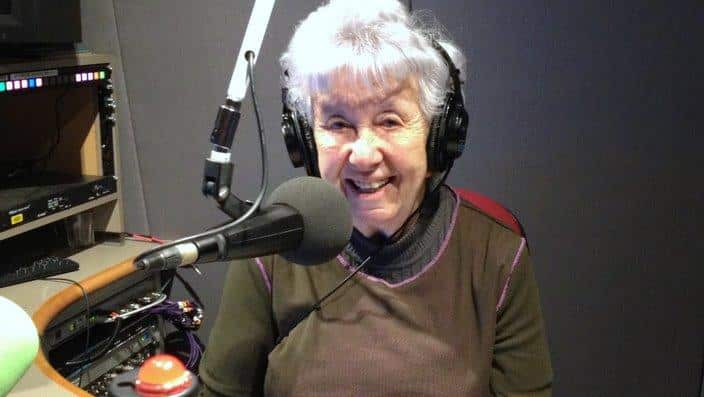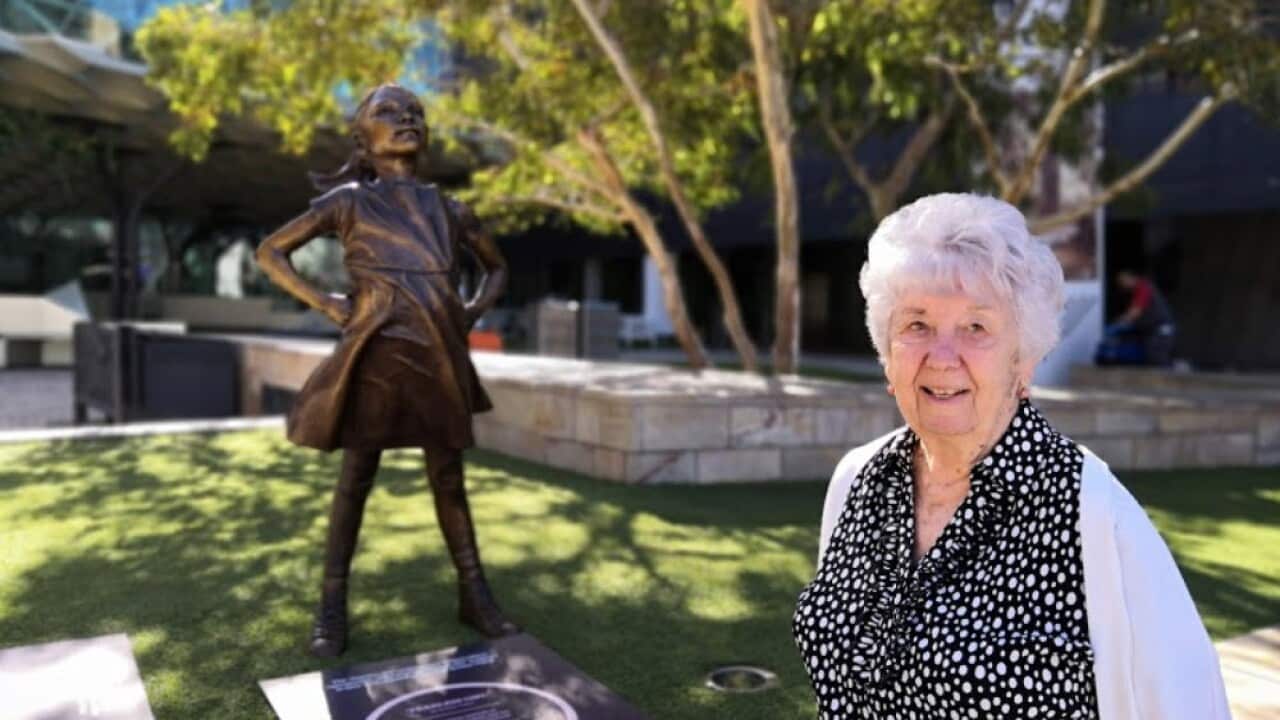
Katya Danova is well known in the Australian-Russian Jewish community, having published 11 books about little-known, yet significant episodes from the history of Australia, a country that became her home in 1996.
And every Wednesday Katya brings a new story about her beloved Melbourne to SBS Russian, where she has been working for over 20 years. In recognition of her service to the broadcast and print media, she has been honoured with the Medal of the Order of Australia in this year's Queen's Birthday list.
But it is her own remarkable story of Holocaust survival, World War II subterfuge, resilience and hope that we tell today.
It begins in a trench
Thousands of Jews were killed in the Crimean city of Simferopol, Katya’s home city, during World War II.
In early December 1941, when Katya was 11-years-old, Simferopol was occupied by Nazi forces, and all Jews in the city were ordered to gather in near an anti-tank trench.
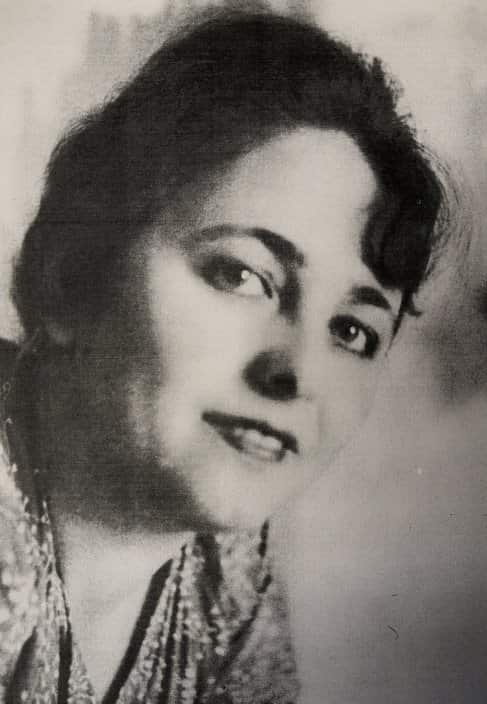
The little girl held the hand of her mother, Mariya Feldman, and walked what would have been her last walk.
“There were many local women standing along the road who had to dig and widen the trenches as there was no more room for bodies,” Katya remembers vividly.
She saw her father Solomon Feldman walking in front, helping his sister with her own seven children. One of them was born a few days before their march, and in her short life was never given a name.
Groups were executed line by line and thrown into the trench. Katya couldn’t see the end of the road, but says she heard the machine-gun just before the ditch.
“All of a sudden mum released my hand and threw me away, out of our column into the hands of another woman,” she says of the decisive moment.
“All I remember is we started to run like mad. I heard Nazis shouting, I could hear my mum yelling but we kept running until we found ourselves in someone’s backyard and then someone closed a cupboard door behind me... There in the dark, I regained consciousness. But I had no idea that this would be my home for the next two-and-a-half years.”
Life in a closet
The woman who rescued Katya was Ekaterina Kolesnikova. She had a family of her own, a husband named Sergey and a five-year-old son called Vladimir.
Katya believes that Ekaterina only later realised how dangerous her brave rescue was, and what peril her family could face for it.
“Nazis were sweeping through the city, looking for the Jews who managed to escape and those who helped them, killing everyone. So, I became the biggest secret of that family that, if found out, would cost them their lives.”
The place they lived was a narrow city outskirt where everyone knew about their neighbour’s lives. With a shared yard, outdoor toilet and kitchen, their home was part of a communal space where it was almost impossible to hide a kitten, let alone a child.
The family of three and the Jewish girl in the cupboard all lived in one room for two-and-a-half years.
Little Vladimir was told that the girl in the cupboard was his elder sister from Sevastopol, a city destroyed under Nazi barrage and occupation. He had to stay locked in the house as his parents feared that outside he could let the secret slip.
“I must have cried a lot because I remember they [the family] would often put music on,” says Katya. “It was the same song again and again.”
Even today when Katya hears that song the trauma returns to her.
“It’s a beautiful song called ‘I opened the window’ but every time I hear it, I can’t talk, my ears are ringing and everything goes dark,” she says.
'Walk or die'
Katya’s saviours, Ekaterina and Sergey, were involved in the city’s underground resistance campaign, but in February 1944, their network was discovered and the family had to flee in one night.
When they brought Katya out of the cupboard they found an adolescent girl who had outgrown her coat and shoes, and could barely walk.
“Spending two-and-a-half years hunkered down, I forgot how to walk and I had no winter clothes nor shoes on me,” says Katya. “We wrapped rags and tatters around my feet and escaped into the night of the forest.”
Katya says that if it wasn’t for Ekaterina she would have died in that escape. She was so weak and close to barefoot in the winter forest that she often fell to the ground, unable to continue.
The man guiding the fleeing partisans through the forest threatened Katya: Keep walking or die.
“The guerilla guide was pointing his rifle to my chest saying he didn’t want to, but he couldn’t leave anyone behind and would have to kill me.”
The fear was that the Nazis were coming after them and if one person was captured, the rest of the partisans would be found.
“And then Ekaterina took me on her back and carried me along,” says Katya of the woman who saved her once more. “Me, a 13-year-old girl in the snowy forest. She didn’t do this for her own son, but she carried me,” says Katya, barely holding her tears.
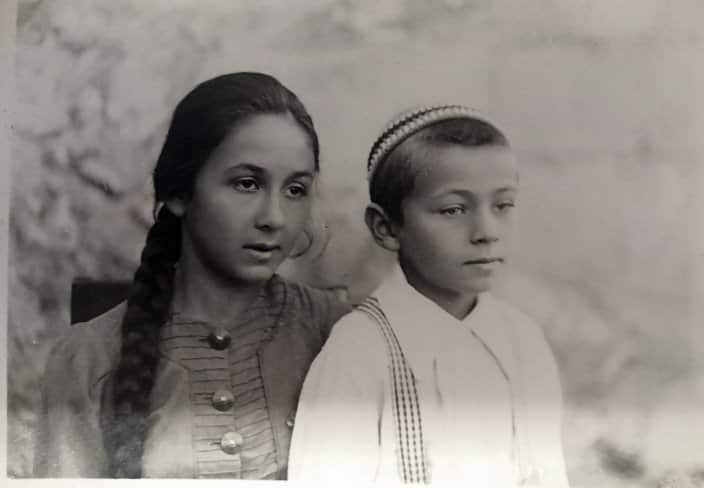
It took them three months to leave their forest refuge, which had little food and no proper shelter. It was in April 1944 that the USSR’s Red Army liberated Crimea from the Nazis. Katya was 13.
“I was covered in dirt, blood, barefoot and skinny but I had the rifle and the partisan ribbon,” says Katya. “That was the only time I held a gun. I call this time my only war.”
With her new family they returned to a completely devastated home of one room. The place had been looted by neighbours.
“We had to rebuild our homes and our lives. That was our only option.”
But just in two month’s time the family was struck by another devastating event.
A decree, signed by the Soviet ruler Joseph Stalin, condemned 37,000 Greeks, Armenians and Bulgars in collaboration with the Germans and saw them deported in one dark night. Ekaterina’s husband was Armenian, and with that, Sergey Danov disappeared forever.
‘We never saw him again. I couldn’t find him. He vanished. What did these people do to him?,” Katya still wonders.
Now it was just three of them who had to start anew.
Katya decided to honour both of her partisan foster parents in her post-war life, taking Ekaterina and Sergey’s first and last names respectively, becoming Ekaterina Danova. Now she prefers her nickname Katya, shortened from Ekaterina.
Some of her school friends, who had managed to escape Crimea before the Nazi occupation, returned to Simferopol with their families.
Katya went back to school and despite having missed three years, she wanted to be in the same class with her pre-war classmates who had continued studying in exile.
People knew that Katya was orphaned and the challenges she had gone through at her young age, so she was allowed to join the class.
To the surprise of her teachers, not only did Katya not lag behind, she graduated with high distinction.
A message from a stranger
After school as an aspirational young woman, Katya moved to Leningrad (now St Petersburg) where she wanted to pursue a career as a journalist.
In a climate of Soviet antisemitism, the young Jewish woman who had lived through Nazi occupation was not welcomed into a prestigious journalism degree, despite her excellent academic record.
Katya took the only course offered to her: a degree in ancient Roman and Greek history.
“It was a completely useless degree,” she says. “Nobody needed specialists in Roman and Greek history at that time, but I wasn’t given a choice.”
One day, just before she moved to Leningrad to begin her studies, Katya was approached by a stranger who had been following her for some time.
“I was smitten,” she remembers. “He said, ‘You don’t look like your mother,’ and he gave me some creased papers and walked away.”
Katya couldn’t believe her eyes. The papers were a letter from her mother Mariya, which Katya suspects she wrote secretly in Gestapo detention, having been taken prisoner after helping her flee.
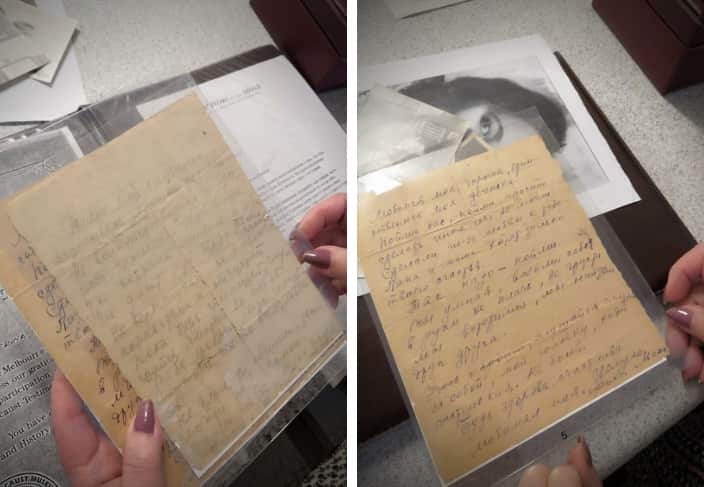
“Probably the Nazis took her and God knows what they did to her to find out where I was,” says Katya, expressing a dreadful thought that has haunted her ever since.
In the letter Mariya asks Katya to forgive her and her husband Solomon, as they did what was best for her and because they loved her:
"My life, my dear and only daughter, don't worry. Please understand we couldn't do it another way. Your dad and mum only want you to be happy. We had to do this. You are a clever girl, pull up your socks and don't cry. We will find each other and meet again. Do well at school and behave yourself. Wash your hair and stay clean. Be happy. Your loving mama."
Katya has carefully preserved those two brittle sheets of paper, but they are not only thing of her mother’s that the stranger gave her.
A pair of her mother’s earrings were also in the envelope, and those two simple salmon-coloured stones have decorated Katya’s ears ever since.
“This is all I have from her and I have never taken them off, my mother’s earrings,” she says.
Katya believes that the stranger must have worked with the Gestapo, as he told her it was his way to pray for forgiveness, which she gave him.
Ekaterina’s life of sacrifice
“As much as I remember Ekaterina Trofimovna,” says Katya of her foster mother, naming her by her patronymic name (a sign of respect in Russian culture), “She always worked. A very poor woman after the war ended, she was left with two children and no husband.”
Ekaterina lived in poverty her entire life.
Katya’s own children always thought Ekaterina was their grandmother.
“What difference would that make it I told them the truth?,” Katya asks. “They wouldn’t have loved her more or less.”
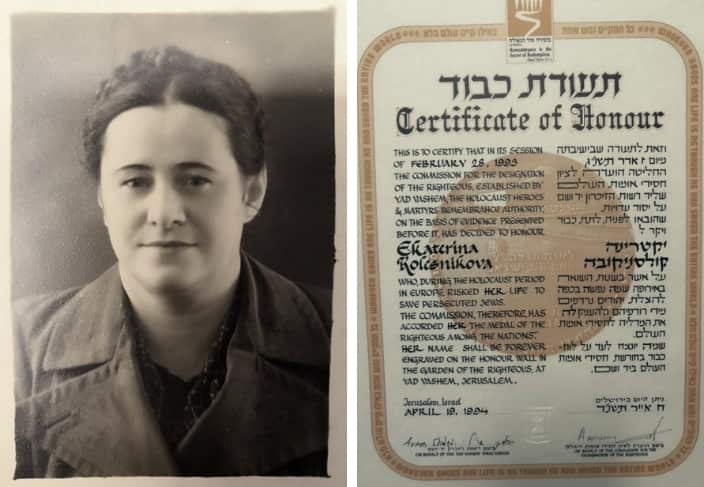
“They say one good action is followed by another,” says Katya of Ekaterina. “I found out that this woman also saved a couple of Soviet pilots who were still in Crimea [during Nazi occupation].”
In 1993, 10 days before she died, Ekaterina was awarded the honorary title, ‘Righteous among the Nations’ by the State of Israel. The award is bestowed upon non-Jews who have risked their life to save at least one Jewish person during the Holocaust.
Katya is satisfied by that recognition of Ekaterina’s life and sacrifices.
“I believe that as long as Israel remains, her life will be respected,” Katya says.
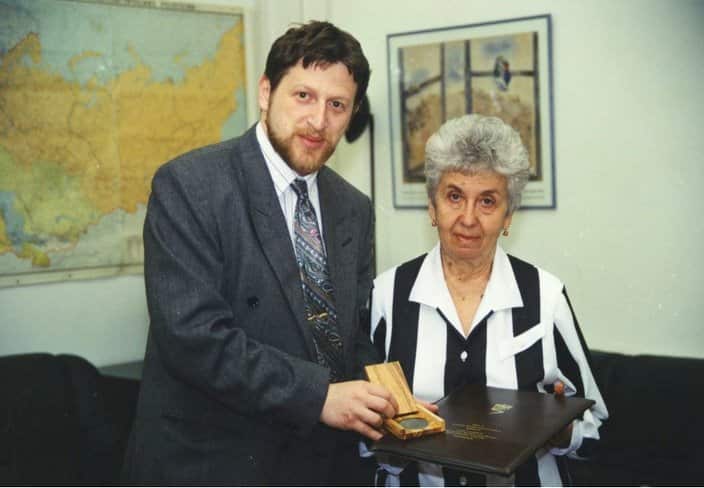
More than 2,600 people from Ukraine have been awarded this title, the fourth largest total among other nations.
This year Katya turned 90. She has always been strong, as her mama asked her to be, and against all odds, she became a journalist and now celebrates a 65 year-long career.
Her voice may not be as steady as it used to be, but her enthusiasm and curiosity has never waned, and we hope to listen to Katya’s fascinating stories for many more years to come.