


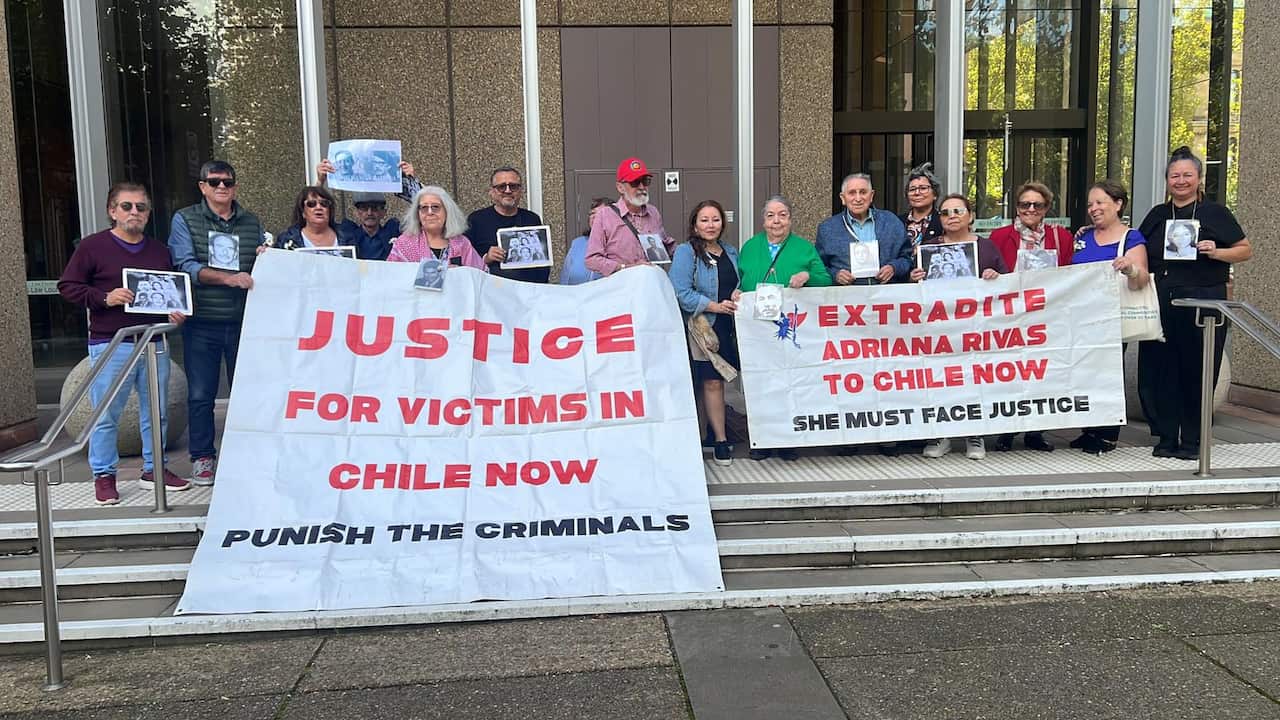
The New South Wales Federal Court held a two-day hearing this week in the case of Adriana Rivas, a Bondi nanny accused of taking part in the kidnapping and torture of seven people during Augusto Pinochet’s dictatorship in Chile.
Highlights:
- Rivas’s defence argued that, if extradited, she could be tried for a crime that did not exist in Chilean law when the events occurred, which could prevent her extradition.
- The lawyer for the Chilean government held in court on Tuesday that the requirement of double criminality is met.
- All of Rivas' previous legal challenges have been rejected.
The Federal Court of New South Wales, presided over by Judge Michael Lee, reconsidered the extradition case of former Pinochet agent Adriana Rivas during a two-day hearing in Sydney on Monday and Tuesday.
Rivas, a dual Chilean-Australia citizen, again sought to stop her extradition, while denying the allegations.
Rivas, who worked for the intelligence agency Dirección de Inteligencia Nacional (DINA) from 1973 to 1977, during Pinochet's dictatorship, is accused of taking part in the aggravated kidnappings of seven people in Chile.
She has lived in Australia since 1978. While visiting relatives in Chile in 2006, she was detained and later released on bail.
In 2010, she left Chile illegally and returned to Australia, where she lived in Bondi and worked as a babysitter and cleaner until her arrest in 2019.
This week, the court focused on whether the charges against her should be classified as aggravated kidnapping or as crimes against humanity, a distinction with significant legal consequences for the case.
Chile’s government lawyer Trent Glover told the court on Tuesday that the double criminality requirement for the extradition had been met and that “the crime of aggravated kidnapping existed in the Republic of Chile when Rivas's alleged acts and omissions took place."
"If Ms Rivas is returned, surrendered to Chile, there cannot be any charge of a crime against humanity," Glover said.
"Chile has very clearly set out, in considerable detail, that Ms Rivas will be prosecuted for those seven counts of aggravated kidnapping," he added.
Rivas’s lawyer Sean Baron Levi argued that the statute of limitations had expired.
“If it were simply an aggravated kidnapping, there could be no criminal liability because the statute of limitations has expired. The only reason there is any criminal liability is because the action is classified as a crime against humanity,” Levi told the court.
Levi cited Chilean documents showing that the country’s courts have also classified the acts as crimes against humanity.
The defence also argued that crimes against humanity did not exist in Chilean criminal law in 1976 and 1977. It said a person cannot be extradited for a crime that did not exist when the events occurred.
That decision, Levi said, “cannot be left in the hands of Chile.”
Glover insisted that “this does not change the nature of the crime of extradition” and added that these issues are matters for the Chilean courts.
Elsewhere in the proceedings, Rivas' lawyer indicated that the classification of the case could theoretically expose Rivas to the death penalty. "There is a recognition that at least theoretically there is a penalty of death that is open," he said.
"At least this raises a potential concern as to the consequences of a mischaracterisation of the offence," he added, though he also clarified that this outcome was not being sought.
Glover pointed out that Chile has abolished capital punishment in 2001.
Previous extradition cases that could shape the ruling
Both sides referred to the case of Charles Zentai, a former Hungarian who lived in Perth.
Hungary requested his extradition for a crime committed in 1944.
Australia reportedly refused because the offence of “war crime” did not exist in Hungarian law at the time.
Rivas's defence argued that her situation is the same.
Glover, however, pointed out a difference.
"Hungary requested extradition for a crime that never existed in its own right, while Chile is asking for extradition for aggravated kidnapping, a crime that existed in 1976," Glover said.
The 2013 High Court case Commonwealth Minister for Justice v Adamas was also raised during the hearing.
In that case, Australia extradited one of its own citizens to Indonesia, where he had been convicted in absentia for corruption.
The High Court reversed an earlier Federal Court decision that had blocked the extradition, ruling that the Minister for Justice had correctly exercised his power to approve the surrender.
Judge Lee raised the extent to which the Australian government must analyse another country's law before authorising an extradition.
“Foreign legal systems deserve respect in the application of their own law,” Judge Lee said, adding that “the role of Australian decision-makers, including the minister, is not to anticipate or question that process.”
Sydney-based lawyer Adriana Navarro, who represents families of Chilean victims in Australia, told SBS Spanish that “the intention of the Rivas team is to try to convince the judge to look beyond what is required by the extradition law”.
She added that “the minister’s team, which ordered the extradition, also has alternatives if Judge Lee’s decision goes against them.”
A long road of appeals
The case of Adriana Rivas has dragged on for years, since Chile requested her extradition in 2014.
This was her latest bid to block the extradition after Australia's government ruled in 2024 that she should be sent to Chile.
Rivas, 72, previously tried through her lawyers to stop the extradition by lodging judicial appeals, citing health problems, questioning the guarantees of the Chilean judicial system, and claiming the process was politically motivated.
All these attempts have been rejected by different judges.
The last failed appeal attempt was in July 2025, when Judge Erin Longbottom rejected Rivas' claims that there were inconsistencies and unfairness in the government's refusal to provide them with certain documents on which the decision to extradite her was based.
The government invoked legal professional privilege to avoid disclosing them.
Judge Longbottom upheld that position and found there were no irregularities.
Closing the hearing on Tuesday, Judge Lee announced that he will issue his ruling shortly.