Back then - and there is no intention here to draw an ominous comparison - defeats against host nation Germany, Argentina and Tunisia led to newly-installed FFA chairman Frank Lowry ending Frank Farina's six-year tenure as coach.
Even without the services of absent talisman Mark Viduka and Harry Kewell more was expected of the national team, which just a year later were the darlings of the nation during a heady dash to the last 16 under Guus Hiddink at the 2006 World Cup.
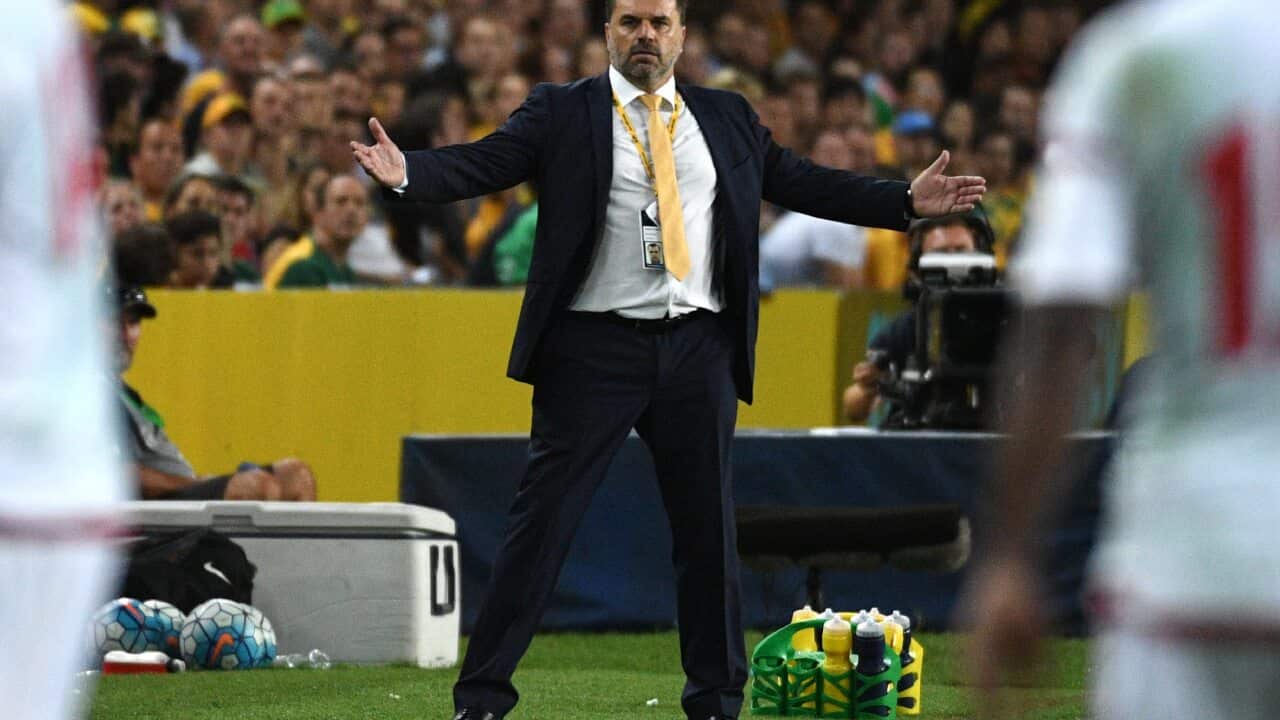
Flash forward to the here and now, and with 2015 AFC Asian Cup success in the vault, current coaching incumbent Ange Postecoglou can afford to lose all three group games against Germany, Cameroon and back-to-back South American champions Chile and dust himself off for Australia's last two Russia 2018 qualifiers against Japan and Thailand.
The hammer and sickle is not poised over him, but questions and queries surrounding his boom-or-bust ideology have become the backing track heading into the tournament.
By Postecoglou's own admission his "we want to win it" statement in the aftermath of Monday's 4-0 schooling by Brazil in Melbourne, might sound "ridiculous".
And, frankly, it does a little.
But Postecoglou's faith in a philosophy of adventure at all costs is likely to persist when Australia take the field against an experimental Germany on Tuesday morning (AEST).
It was Germany who beat a swashbuckling Australia 4-3 in the 2005 tournament opener in Frankfurt - and in the light of recent Socceroos performances a repeat of that result would be deemed by some to be a minor success.
Probably not, though, by Postecoglou, who with the apparent abandon of a mad scientist, sums up his approach thus: "When you're ambitious you have spectacular failures and spectacular successes.
"I am not going to coach in between, just notch up a stint for my country as a coach flat-lining. Let's go there and see what we can do."
Postecoglou's bravado has offered ammunition to a peanut gallery already showering him with brickbats over a newly-unveiled 3-2-4-1 system which seems to invite misadventure more than repel it.
So what does Australia really want from a tournament which is little more than a low-key curtain-raiser to next year's main event?
Whilst winning it is mere whimsy, Postecoglou will be lauded if he can produce performances - if not results - which vindicate his beliefs in setting the bar higher whilst refusing to bow to the pragmatism that punctuated the uninspiring eras of his predecessors Pim Verbeek and Holger Osieck.
Postecoglou has no interest in "glorious failures" but they would be preferable to defeats in which reckless, and ineffective, tactical experiments cause his players to stumble and stutter on a global stage.
In the coaching high-wire act success can come in many forms, like Otto Rehhagel's Greece side who erected a defensive fortress to win Euro 2004, or Jose Mourinho's Inter Milan, the stifle and strangle specialists who became UEFA Champions League victors in 2010.
It's safe to say Postecoglou won't be channeling either Otto or Jose as Australia buckles up for a roller-coaster ride in Russia.
Whatever the outcome, Postecoglou won't suffer the same fate as Farina.
He has earned the right ... and will ultimately be judged after the real business of the World Cup qualifiers in August and September.
Until then, all the rest is shadow boxing.

Watch the FIFA World Cup 2026™, Tour de France, Tour de France Femmes, Giro d’Italia, Vuelta a España, Dakar Rally, World Athletics / ISU Championships (and more) via SBS On Demand – your free live streaming and catch-up service. Read more about Sport

Have a story or comment? Contact Us