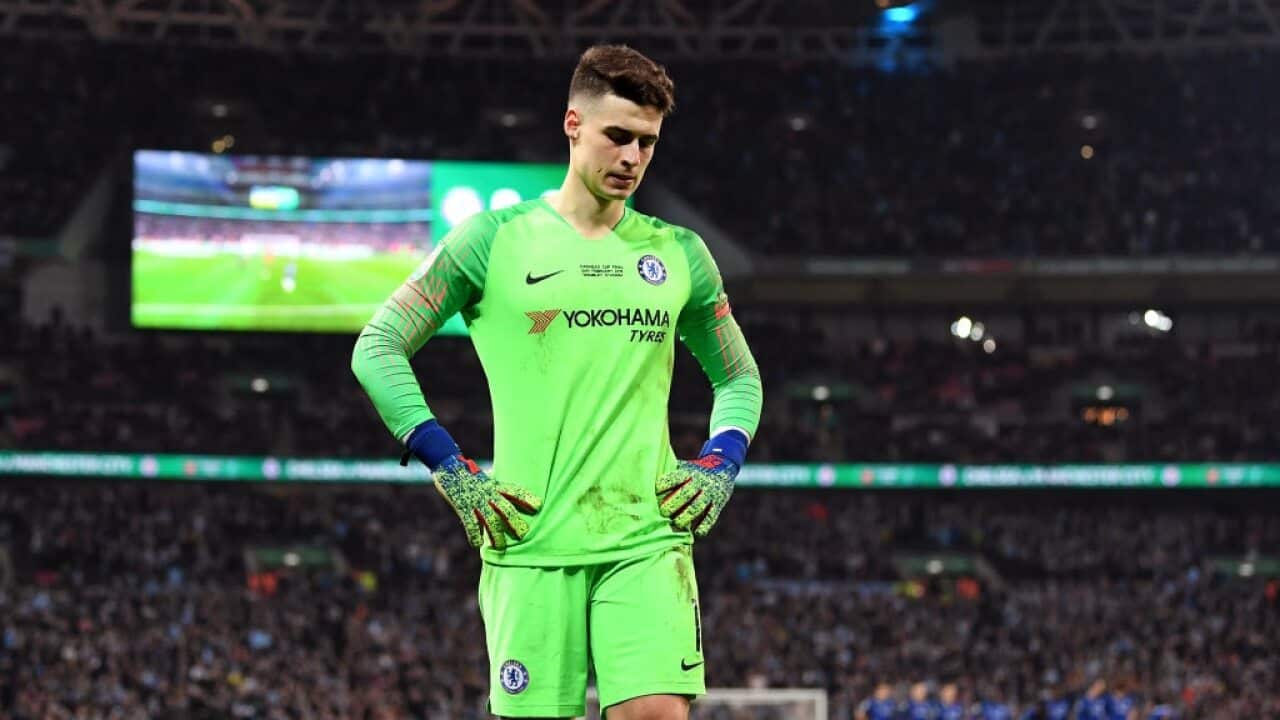
To defy his manager, Maurizio Sarri, during the final moments of a major final, is beyond extraordinary. It’s one thing to ignore tactical instruction but this is an altogether different beast.
Both manager and player have been desperately trying to defuse the situation in the aftermath. No surprise there. Sarri, who is on the brink of being sacked, is doing whatever he can to appease a dressing room that is teetering on mutiny.
The under-fire boss passed it off as a “misunderstanding”, which would be fine if he didn’t erupt so spectacularly, walk down the tunnel and then storm about in a fit of volcanic rage. We all saw what we really thinks; mostly because we thought the same.
Even if Kepa’s explanation about cramp is indeed correct, the fact the goalkeeper refused to be substituted when his number came up is the only fact we can triangulate with certainty.
I think anyone who has played the game at a reasonable level sympathises with Kepa. We’ve all been there: we could have played on, but the coach pulls us off. And we’re mad.
But no matter how angry we get, we exit the field.
I’ve seen players storm off – memorably, one player exited the far side of the pitch and left the arena – but never stay on after being subbed off.
Kepa may have been completely ready to keep playing. But it’s not his call to remain if the substitution was lodged. Literally, his number was up.
What is rather concerning is that a precedent has now been set. If you don’t want to go off, don’t. Wave the boss away. And now we’ve seen a referee repeal the request for a substitution, if you mount a convincing enough argument.
I don’t think we’ll see it happen often, but I wouldn’t be shocked to see it happen again. Why? Because we are in a whole new era of player-manager relations.
This incident was just a moment, but it speaks to a much larger reality. Once, players were simply subject to the manager’s order. These days, they answer back.
And the bigger the player, the more influence he has. Sometimes players don’t exercise power so publicly; they aren’t scared to make private visits to the board or call their agent.
Nor are they afraid to post on social media, often in cryptic tones, about how they are feeling.
Players are just as protective of their own brands as they are about the clubs they play for. In truth, their loyalty is to former before the latter.
This has emboldened big name players in way that we have never known before. They are prepared to back themselves, to take on anyone and everyone. How times have changed.
Can you imagine Kepa ever playing for Chelsea again if indeed Sir Alex Ferguson was still in charge? He’d be on the transfer list before the final whistle was blown, €80 million player or not.
Look, it’s 2019. We all know that the world has changed, and generational issues need to be factored in. And it’s good that player welfare, for example, is one of the most important things in football. Bullying managers, for example, are thankfully becoming a thing of the past.
But the tilt of power towards the dressing room (especially at the peak of the sport) at the expense of the manager has been rising for a while. It feels like this moment has been coming.
Ultimately, you can disagree with the gaffer, just as any employee can disagree with the boss in any office or workplace. But even if you don’t like their choice, you need to accept it or move on.
It’s not much fun to talk about respecting hierarchy, especially in this era of disruption and change. But surely the manager deserves better than this.

Watch the FIFA World Cup 2026™, Tour de France, Tour de France Femmes, Giro d’Italia, Vuelta a España, Dakar Rally, World Athletics / ISU Championships (and more) via SBS On Demand – your free live streaming and catch-up service. Read more about Sport

Have a story or comment? Contact Us