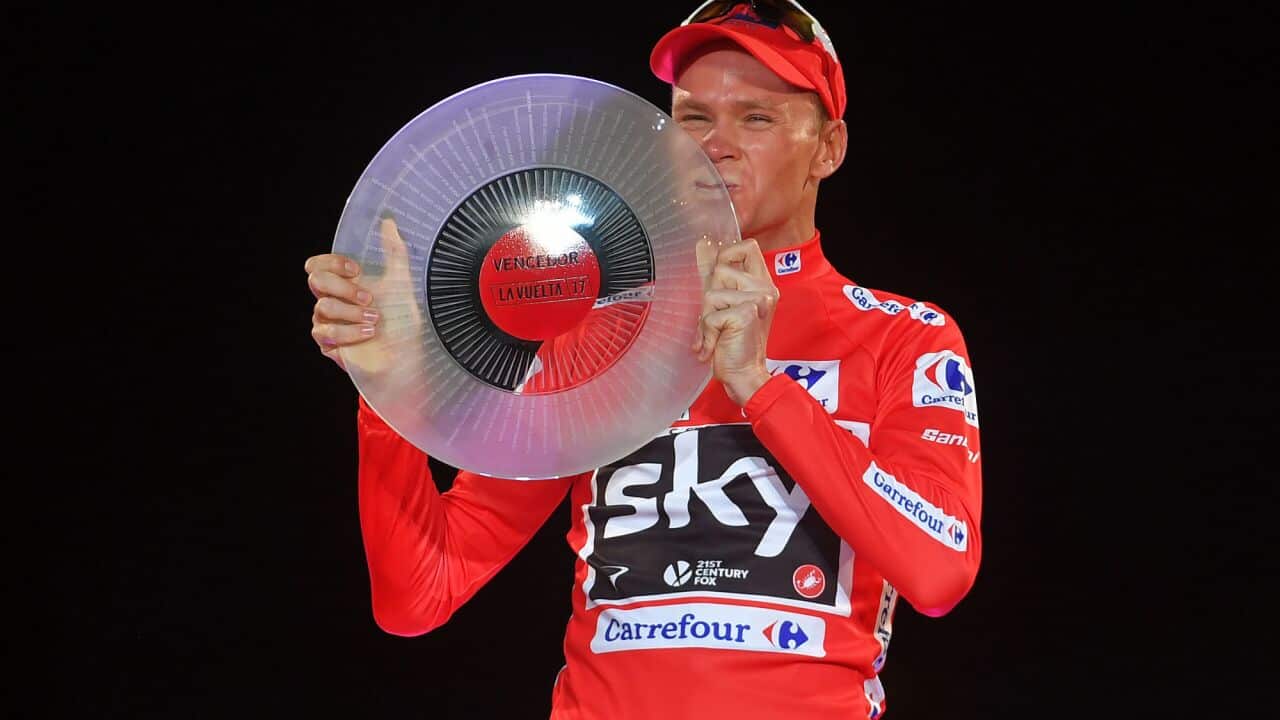
Two stars, at opposing ends of their careers. The final stage said it all.
Chris Froome, not content with 'only' being the winner of the 72nd Vuelta a España, and the first person in history to win the Tour de France followed by the Spanish Grand Tour, sprinted to 11th place in Madrid as if he and runner-up Vincenzo Nibali of Bahrain-Merida were on equal time, and their placings would determine the final outcome.
Meanwhile, Froome continues to count his calories, no doubt thinking what to do next year, and how to raise the bar.
Of course, that was not the case at all. At the start of the day Nibali was a sizeable 2'15 behind the Kenyan-born Brit. No, Froome wanted also to be the winner of the points classification, which, by virtue of his stage result, he indeed won by a two-point margin from Quick-Step Floors' Matteo Trentin, who took his fourth stage Sunday.
Greedy? Not really. Froome's a bike racer. The Vuelta is a bike race. It was there for the taking, and he took it.
"I think it probably is my greatest achievement, being the first person to win the Tour de France and then go on to win the Vuelta," said the 32-year-old after the previous stage to the Alto de l'Angliru, where, for Froome, things effectively went from history in the making to history made. Two riders - Jacques Anquetil and Bernard Hinault - had also accomplished the double, in 1963 and 1978, respectively, but pre-1995, the Vuelta preceded the Tour on the cycling calendar.
"I have to say that is probably the toughest Grand Tour I've ever ridden. There was something different happening every day. I've had good days and then I've been lying on the ground, bleeding, thinking my race might be over. It's been a rollercoaster – absolutely relentless."
Much was made of the penultimate stage, though Froome never looked troubled. Well before then, he knew he had the measure of Nibali, Ilnur Zakarin (Katusha-Alpecin) and Wilco Kelderman (Team Sunweb), eventual second to fourth, as did his team, who were nothing short of superlative. Team Sky ride like they do because it works, it wins bike races. He's a bike racer, remember?
As journalist Daniel Friebe said, Froome is on the best team because at present, he's the best stage racer in the world, and it's the way it's always been. The best team invariably has the biggest budget. With the best rider and the biggest budget, the best team, therefore, recruits the best domestiques. The best rider with the best domestiques makes for a winning combination. It's a self-fulfilling prophecy, and unless cycling capitalism becomes cycling communism, things aren't likely to change anytime soon.
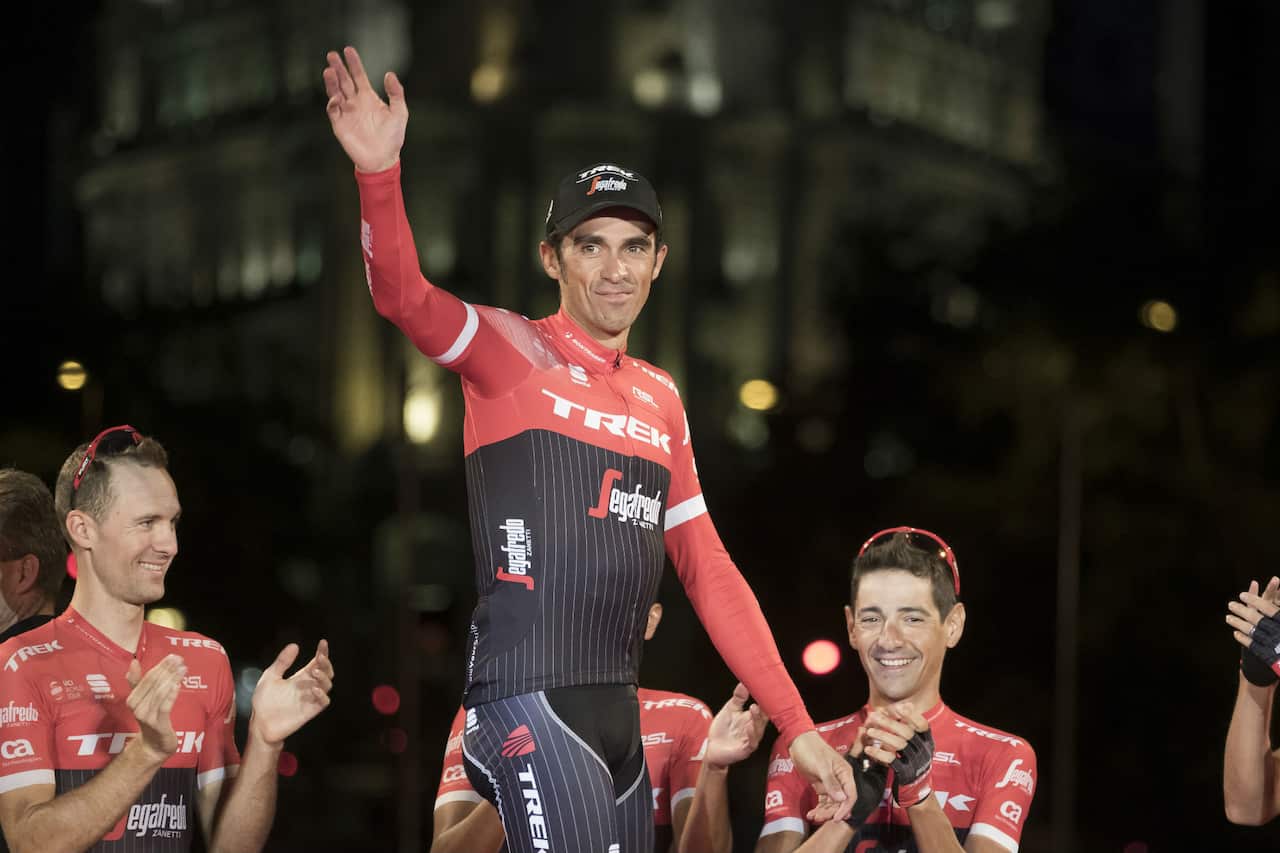
While Froome took no risks on the stage to the Angliru, the same could not be said for Alberto Contador. The descent of the penultimate climb of the Alto del Cordal was as dangerous as the Mont du Chat that befell Richie Porte at the Tour de France - yet the Spaniard, riding his final race before retiring and fifth overall at the start of the day, aided by team-mate Jarlinson Pantano, took off with reckless abandon.
If his sport director had told him that Nibali and David de la Cruz both crashed on the Cordal, the latter forced to abandon, and to exercise caution, it wouldn't have mattered. Climbing the Angliru, Contador had ridden into a virtual podium position, but as he said afterwards, "this is not what's important": "What's important is to take the victory of the stage and finish with this result for the rest of my life." Ever since his comeback from a doping suspension in September 2012, where he returned with a bang to win his second Vuelta, the style of he and Froome have been at polar opposites, even though they have sought the same prize.
"I think it's very difficult to say good-bye in a better way than this, in this place, in this event. In the end, it's a full stop at the end of a career in which I have done everything I wanted. I think it's been a beautiful Vuelta even though I am not on the podium. But perhaps if I had been in contention for the overall podium I would have ridden in a different way, more conservative, and instead I have ridden the race I have ridden - I look at the photos, and almost every day there are pictures of me alone because I have been on the attack.
"I have been able to enjoy the affection of all the people who say thank you to me. It's been a remarkable month, unforgettable," concluded Contador. "I think in the future it'll be remembered that in my last day of competition, I finished it with a win."
That he regarded Saturday, not Sunday, as his final day of racing spoke for itself. While Froome sprinted home as if his life depended on it, El Pistolero, who more than anyone else the past decade provided succour to Grand Tour racing when things were less than lively, insouciantly rolled across the line and lost enough seconds to trade places with Kelderman and slip to fifth overall. It cost him 2,500 Euros' prize money, yet Bertie couldn't give a bugger.
For a person known for his fastidiousness in much the same way as countryman and newly-crowned US Open tennis champion Rafael Nadal, Contador, after 15 years as a professional, seems content to let that go. "The first days after retiring, there won't be much peace. I certainly won't get on the bike. I'll go and have breakfast where I usually go. At the weekend I'll be at the Giro presentation in Israel, but it will be more relaxed. Every morning without looking at the scales, neither at night. I'll be able to eat jamón con tocino (ham with bacon) in the morning. My life will be normal, without crossing the demands and slavery of top level cycling."
He's already planning a wardrobe to accomodate his future fuller figure. "I'll gain weight, you'll make jokes about it when you see me, but I'll try to keep it under control."
Meanwhile, Froome continues to count his calories, no doubt thinking what to do next year, and how to raise the bar. I, for one, cannot see him take on the Giro d'Italia, for we have seen what happens when one attempts the Giro-Tour double. If he's to win a fifth (or perhaps even a sixth) Tour, he'll need to go in all guns blazing, and unlike the Vuelta, he's never regarded winning the Giro as "unfinished business".
The Vuelta discovered him, but the Tour made him.

Watch the FIFA World Cup 2026™, Tour de France, Tour de France Femmes, Giro d’Italia, Vuelta a España, Dakar Rally, World Athletics / ISU Championships (and more) via SBS On Demand – your free live streaming and catch-up service. Read more about Sport

Have a story or comment? Contact Us